Water is surprisingly ordered on the nanoscale
Nanometric-sized water drops are everywhere - in the air as droplets or aerosols, in our bodies as medication, and in the earth, within rocks and oil fields. To understand the behavior of these drops, it is necessary to know how they interact with their hydrophobic environment. This interaction takes places at the curved droplet interface, a sub-nanometric region that surrounds the small pocket of water. Researchers from EPFL, in collaboration with the institute AMOLF in the Netherlands, were able to observe what was going on in this particular region. They discovered that molecules on the surface of the drops were much more ordered than expected. They pave the way to a better understanding of atmospheric, biological and geological processes.
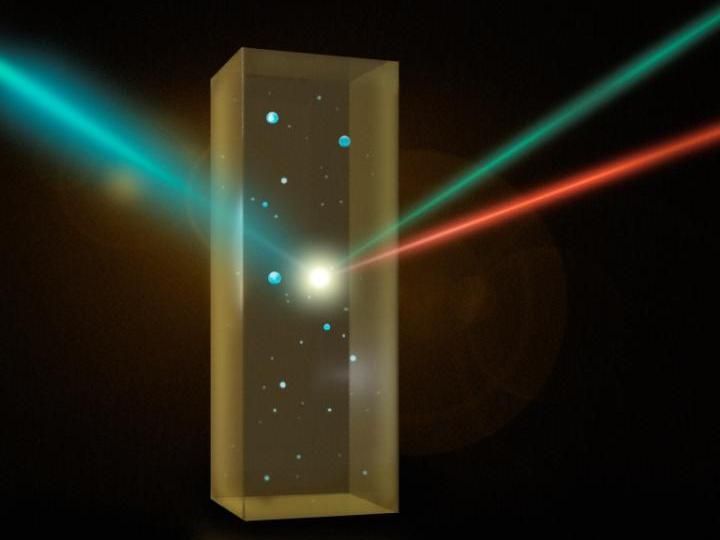
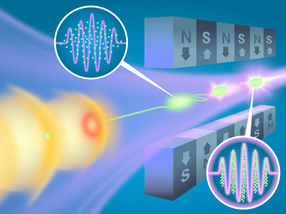
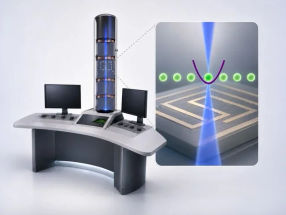
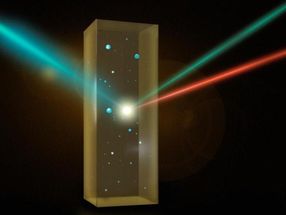
The method involves overlapping ultrashort laser pulses in a mixture of water droplets in liquid oil and detecting photons that are scattered only from the interface.
© EPFL/Julia Jacobi Chair of Photomedicine - Laboratory for Fundamental BioPhotonic
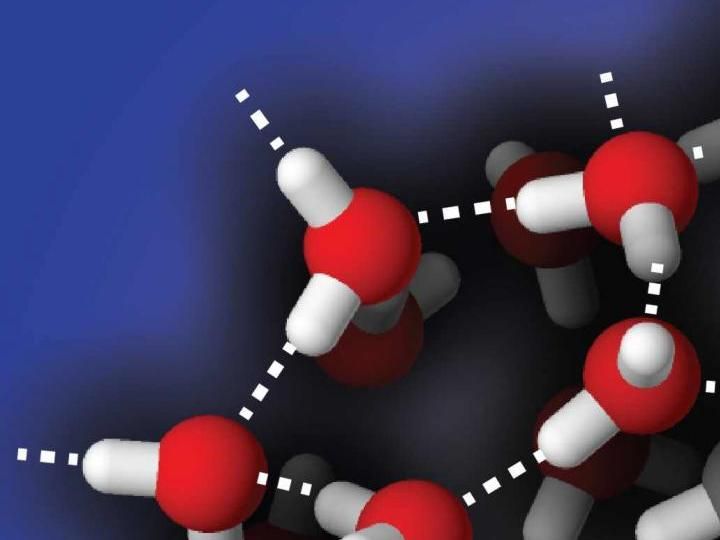
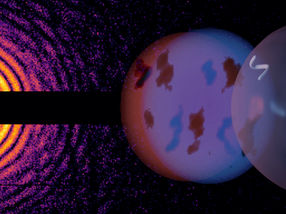
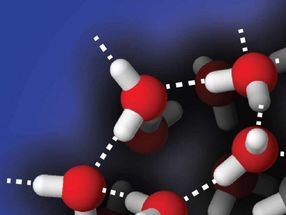
The surface of the water droplets turns out to be much more ordered than that of normal water and is comparable to super cooled (liquid < 0 °C water) water in which the water molecules have very strong hydrogen bond interactions.
© EPFL/Julia Jacobi Chair of Photomedicine - Laboratory for Fundamental BioPhotonic
Unique perspective on miniscule droplets
At EPFL, Sylvie Roke, director of the Julia Jacobi Chair of Photomedicine-Laboratory for Fundamental BioPhotonics, has developed a unique method for examining the surface of these droplets that are as thick as one thousandth of a hair, with a volume of an attoliter. "The method involves overlapping ultrashort laser pulses in a mixture of water droplets in liquid oil and detecting photons that are scattered only from the interface", explains Roke. "These photons have the sum frequency of the incoming photons and are thus of a different color. With this newly generated color we can know the structure of the only the interface."
Hydrogen bonding as strong as in ice
The surface of the water droplets turns out to be much more ordered than that of normal water and is comparable to super cooled (liquid < 0 °C water) water in which the water molecules have very strong hydrogen bond interactions. In ice, these interactions lead to a stable tetrahedral surrounding of each water molecule. Surprisingly, this type of structure was found on the surface of the droplets even at the room temperature - 50 °C above were it would normally appear.
Chemical processes
This research provides valuable insight into the properties of nanometric water drops. "The chemical properties of these drops depend on how the water molecules are organized on the surface, so it's really important to understand what's going on there," explained Roke. Further research could target the surface properties of water droplets with adding salt, a more realistic model of marine aerosols that consist of salty water surrounded by a hydrophobic environment. Salt may either enhance the water network or reduce its strength. "Or, it may not do anything at all. Given the surprising results found here, we can only speculate", says Roke.
Original publication
Other news from the department science