Mix of methods makes nanomaterials safer
The safe use of nanomaterials and their optimal performance depends largely on their surfaces. However, these have been difficult to characterize reliably up to now. Two new studies by the Federal Institute for Materials Research and Testing (BAM) now show that only a targeted combination of modern analysis methods can deliver reliable results. The researchers have thus created an important basis for the safe and sustainable use of nanomaterials.
Their surfaces play a key role in determining how nanomaterials function, how they interact with their environment and how safe they are. These structures are often complex, react sensitively to environmental conditions and are often difficult to measure under practical conditions. Individual measurement methods often provide incomplete or method-specific results - for example, if they cannot clearly distinguish surface coatings from other materials. To address this challenge, BAM analyzed different types of nanoparticles used in the life sciences and in consumer products in two studies. Conventional and newly developed measurement procedures and combinations of methods were systematically compared.
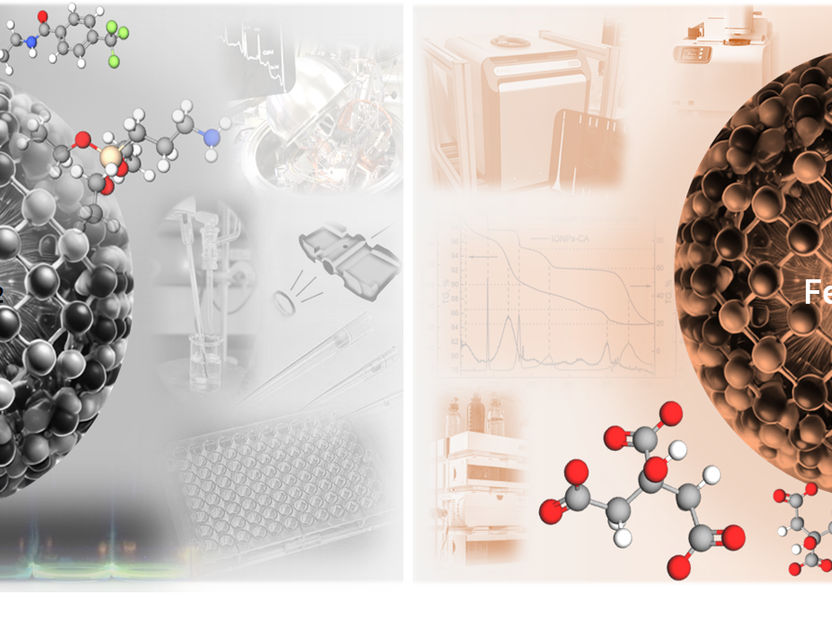
Iron oxide nanoparticles and silica particles: Only a targeted mix of methods for their characterization provides a complete and reliable picture of their surfaces.
BAM
More precise analysis of citrate-coated iron oxide nanoparticles
The first study focused on magnetic iron oxide nanoparticles with citrate as a surface ligand. This molecule binds to the particle surface and influences their stability and interactions. Citrate ensures that the particles remain stable in water - an important prerequisite for applications in the life sciences, medicine, environmental technology, sensor technology or materials research. The researchers found that conventional methods such as thermogravimetry often provide inaccurate values because they cannot reliably distinguish citrate from other substances. Only the combination of modern analytical methods, in particular high-performance liquid chromatography and quantitative nuclear magnetic resonance spectroscopy (qNMR), made it possible to determine the surface coating much more precisely. For the application of qNMR to magnetic nanomaterials, a special sample preparation had to be developed beforehand that reliably removes interfering iron compounds.
The results were published in the journal Analytical Chemistry and originate from the European metrology projects MetrINo and SMURFnano. They form an important basis for future measurement standards and applications of highly selective qNMR on challenging samples such as magnetic nanomaterials.
New approaches for the determination of functional groups on silica nanoparticles
In a second study as part of SMURFnano, the team investigated methods for characterizing and quantifying functional groups, ligands and coatings on nanomaterials. The project is funded by the European Metrology Program. The focus was on silica nanoparticles whose surfaces are provided with so-called amino groups. These groups act as small "docking sites". They enable the particles to be specifically combined or modified with other substances - for example with dyes, specific recognition structures or biomolecules. Such functional groups are crucial for the stability, compatibility and function of the particles. However, reliable methods to determine their exact number and chemical nature have been lacking until now.
The researchers showed that only a targeted mix of methods - such as optical methods, electrochemical techniques, qNMR and X-ray photoelectron spectroscopy - provides a complete and reliable picture of the particle surface. This knowledge is central to quality control, the development of new materials and the assessment of their safety. The electrochemical techniques used were presented in the journal ACS Measurement Science Au.
Basis for future standards
"Our studies show how important it is to combine different measurement methods in order to assess the actual functionality and safety of nanomaterials," explains Ute Resch-Genger, project manager at BAM and coordinator of SMURFnano. "Together with the developed and validated measurement methods and reference data, this is a decisive step for the development of sustainable and efficient nanomaterials and their safe use."
Note: This article has been translated using a computer system without human intervention. LUMITOS offers these automatic translations to present a wider range of current news. Since this article has been translated with automatic translation, it is possible that it contains errors in vocabulary, syntax or grammar. The original article in German can be found here.
Other news from the department science















Most read news









More news from our other portals


























See the theme worlds for related content
Topic World Spectroscopy
Investigation with spectroscopy gives us unique insights into the composition and structure of materials. From UV-Vis spectroscopy to infrared and Raman spectroscopy to fluorescence and atomic absorption spectroscopy, spectroscopy offers us a wide range of analytical techniques to precisely characterize substances. Immerse yourself in the fascinating world of spectroscopy!

Topic World Spectroscopy
Investigation with spectroscopy gives us unique insights into the composition and structure of materials. From UV-Vis spectroscopy to infrared and Raman spectroscopy to fluorescence and atomic absorption spectroscopy, spectroscopy offers us a wide range of analytical techniques to precisely characterize substances. Immerse yourself in the fascinating world of spectroscopy!