Digital laboratory management system for greater sustainability
Ministry of Science funds project to design environmentally friendly laboratory structures
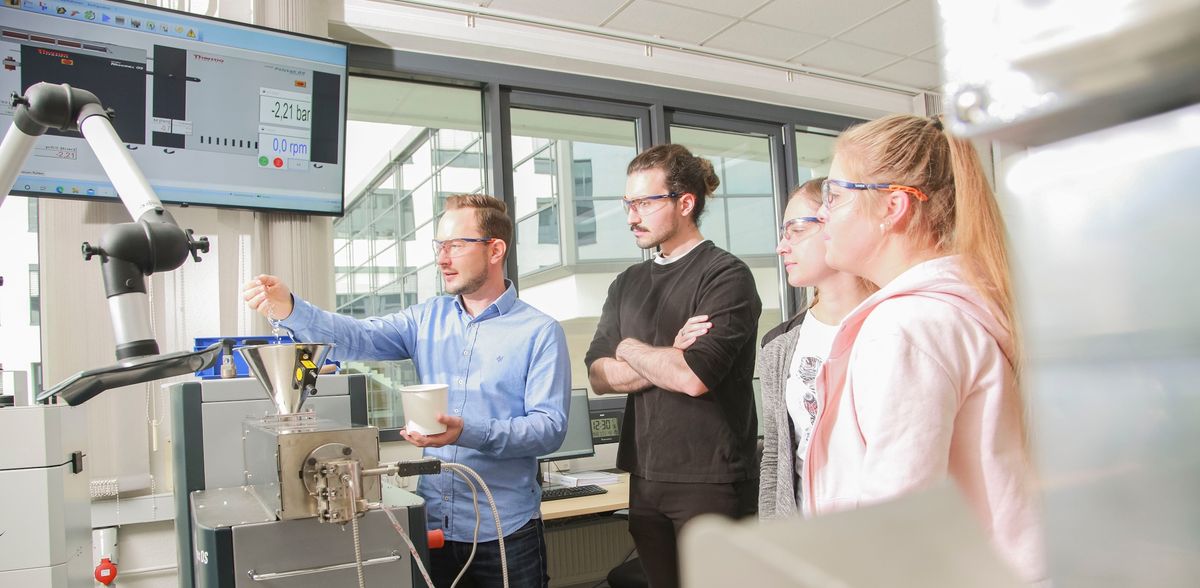
With the research project "ηNet - Cyber-Physical and Data Managed System", the Baden-Württemberg Cooperative State University (DHBW) Karlsruhe is launching an innovative initiative to reduce energy and resource consumption in university laboratories. The project is funded by the Baden-Württemberg Ministry of Science, Research and the Arts as part of the ideas competition "BWGreenLabs - Sustainable use of energy and resources in research laboratories".
Making potential savings in laboratory operations visible - a path to greater sustainability
Laboratories are central locations for research and teaching, but at the same time they require a lot of resources. An internal analysis at the plastics laboratory at DHBW Karlsruhe shows a previously untapped savings potential that adds up to a high five-digit euro amount per year - mainly due to a lack of transparency and digital control options. This is exactly where ηNet comes in: The cyber-physical laboratory management system is designed to record energy, material and equipment use in a networked manner, control it intelligently and optimize it to conserve resources.
Interdisciplinary collaboration at the DHBW Karlsruhe
Under the direction of Prof. Dr.-Ing. Marcus Strand, Head of Computer Science and Head of the Robot and Human Motion Lab, an interdisciplinary team from Computer Science, Robotics, Automation, Materials Engineering and Mechatronics is working on the implementation. Key measures include the creation of digital twins, smart energy monitoring, AI-supported planning tools and modular resource management.
Pilot project with prospects for nationwide implementation
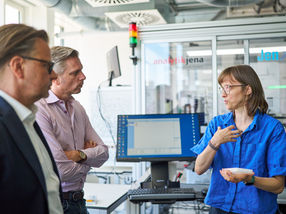
The pilot application is being carried out in the plastics laboratory at DHBW Karlsruhe. There, machines, materials and infrastructure are initially recorded digitally in order to avoid duplicate purchases and plan usage efficiently. In the medium term, intelligent control systems will reduce the energy requirements of individual devices and control the use of materials in line with demand. In the long term, ηNet will be designed as a scalable system that can be transferred to other laboratories - with the aim of creating a basis for a nationwide roll-out.
"With ηNet, we want to show that modern university laboratories can not only be places of innovation, but also role models for sustainable management," emphasizes project manager Strand. "We use digital technologies to create transparency, increase efficiency and significantly reduce resource consumption."
A significant step for sustainable laboratories
"The funding from the state of Baden-Württemberg enables DHBW Karlsruhe to take a significant step towards sustainable laboratory structures with ηNet. Digitalization and resource-efficient management are important pillars of our university. With this project, we not only want to reduce energy consumption, but also be a role model for other research institutions in the state," says Prof. Dr.-Ing. Stephan Schenkel, Rector of DHBW Karlsruhe, who is delighted that the project is among the 29 projects for climate-friendly laboratories at universities that have won the "BWGreenLabs" ideas competition organized by the Ministry of Science.
The project will run until July 2026 and is being funded with around 35,000 euros.
Note: This article has been translated using a computer system without human intervention. LUMITOS offers these automatic translations to present a wider range of current news. Since this article has been translated with automatic translation, it is possible that it contains errors in vocabulary, syntax or grammar. The original article in German can be found here.

Other news from the department science









Most read news





More news from our other portals





















See the theme worlds for related content
Topic World Sustainability in the laboratory
The main topic of sustainability in the laboratory highlights innovative approaches and technologies that reduce the ecological footprint in laboratories. These include energy-efficient equipment, resource-saving consumables, green chemistry, recycling initiatives and sustainable laboratory management solutions.

Topic World Sustainability in the laboratory
The main topic of sustainability in the laboratory highlights innovative approaches and technologies that reduce the ecological footprint in laboratories. These include energy-efficient equipment, resource-saving consumables, green chemistry, recycling initiatives and sustainable laboratory management solutions.
Topic world Digitalization in the laboratory
The topic world Digitalization in the lab presents innovations and trends from digital data systems (ELN, LIMS) to laboratory robots and networked devices (IoT) to AI and machine learning.

Topic world Digitalization in the laboratory
The topic world Digitalization in the lab presents innovations and trends from digital data systems (ELN, LIMS) to laboratory robots and networked devices (IoT) to AI and machine learning.