Rotary Evaporation: Efficiency Through Precise Temperature Control
JULABO GmbH
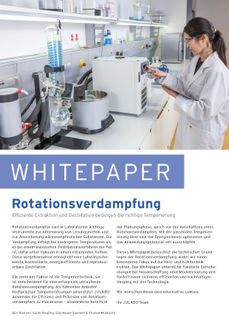
Consistent Temperature for Stable Distillation Processes
Rotary evaporators are among the most widely used instruments in research, development, and routine analysis. They enable the gentle separation of solvents under vacuum — at significantly lower temperatures than conventional distillation methods. Water, for example, boils at 40 °C under a reduced pressure of 72 mbar, rather than at 100 °C; ethanol can also be evaporated at 40 °C under a pressure of approximately 175 mbar. This lowering of the boiling point protects thermolabile substances, saves energy, and increases the process speed.However, the performance of a rotary evaporator does not depend on a single control variable. Vacuum, rotation, temperature, cooling capacity, and system tightness interact as a closed thermodynamic control loop. Only when heat input from the heating bath and heat removal by the condenser are precisely matched does evaporation proceed in a stable, reproducible, and energy-efficient manner. Temperature control to the nearest tenth of a degree is not merely an option here, but a prerequisite for process stability and product quality.
This white paper examines the technical fundamentals of rotary evaporation with a particular focus on heating and cooling technology. It explains why external recirculating coolers represent the state of the art today and which criteria are decisive when selecting a system — including temperature range, control speed, delivery pressure, and energy efficiency. It also demonstrates why tap water cooling — which was once widely used — no longer meets modern requirements due to its fluctuating temperatures and lack of controllability.
Using the VALEGRO recirculating coolers from JULABO as an example, the white paper illustrates how energy efficiency and precision can be combined in practice. Speed-controlled compressors and fans enable a reduction in energy consumption of up to 75% for units with a cooling capacity of 800 watts or more. The model series covers operating temperature ranges from -20 to +85 °C and offers pump pressures up to 3.5 bar — for standard applications as well as for large-volume or complex processes.
This white paper is intended for anyone looking to purchase new rotary evaporators, modernize existing ones, or operate them more efficiently. It supports informed decisions based on technical considerations — and demonstrates how the right temperature control solution can equally optimize process quality, energy usage, and sustainability.
Download white paper now
Rotary Evaporation: Efficiency Through Precise Temperature Control
Consistent Temperature for Stable Distillation Processes
White Paper classification
White papers on related topics
Products on related topics
You may also be interested in these white papers

See the theme worlds for related content
Topic world Extraction
Extraction is a fundamental process in the chemical laboratory that enables specific components to be isolated and concentrated from a mixture. Whether it's extracting active ingredients from natural products, removing impurities from synthesis products, or preparing analytical samples, extraction is a key step in achieving precise and efficient results in chemical research and analysis.

Topic world Extraction
Extraction is a fundamental process in the chemical laboratory that enables specific components to be isolated and concentrated from a mixture. Whether it's extracting active ingredients from natural products, removing impurities from synthesis products, or preparing analytical samples, extraction is a key step in achieving precise and efficient results in chemical research and analysis.