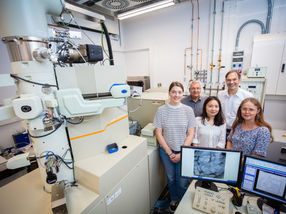
Archimedes’ screw made from a single molecule

An international team of physicists has, for the first time, developed a molecular ‘machine’ based on the principle of the Archimedes’ screw. The helical molecule is set in rotation by an electric current. When the rotation reaches a certain speed, the current increases abruptly by up to a hundredfold. Prof. Dr Fabian Pauly’s research group at the University of Augsburg used quantum mechanical computer simulations to explain the observed effects. The findings were published in the journal Nature.
Molecular machines are regarded as the next step in miniaturisation. Their models can be found in living cells, where molecular motors convert energy and generate movement. Scientists have been working for decades to artificially replicate such systems. The 2016 Nobel Prize in Chemistry was awarded for this research.
A model from antiquity
Molecular motors powered directly by an electric current have been in existence since 2011. Until now, however, they have only functioned as molecules on a surface, driven by the tip of a scanning tunnelling microscope.

For their new machine, the researchers drew inspiration from one of humanity’s oldest documented machines: the Archimedes screw, which transports water uphill. The researchers applied the principle of the Archimedes screw at the molecular level. Instead of water, electrons flow through a helical structure, setting it in rotation.
A molecular screw between two gold tips
At the heart of the machine is a helical molecule, which was produced specifically for the study by Prof. Michael Pittelkow’s team at the University of Copenhagen. The molecule, which measures just a few millionths of a millimetre, can be bound to gold surfaces via sulphur atoms. At the Weizmann Institute of Science in Israel, the team led by Prof. Oren Tal and Dr Anil Kumar Singh stretched individual molecules between two atomically fine gold tips. By precisely adjusting the distance between the electrodes, the researchers were able to stretch or compress the molecular screw.
First molecular motor with controllable direction of rotation
Measurements then showed that the molecule rotates when a voltage is applied. The direction of rotation was unambiguous and could be reversed by changing the polarity of the voltage. The study thus demonstrates, for the first time, a current-driven molecular motor with a controllable direction of rotation that is firmly attached to two metal electrodes.
The movement is driven by the electrons themselves. As they flow through the helical molecule, they transfer angular momentum to it, much like the wind drives a wind turbine. The direction is determined by the molecule’s coil, just as with a screw with a right- or left-hand thread. Above a certain voltage, this movement transitions into continuous rotation.
Augsburg calculations unravel the mechanism
But why does a rotating molecule conduct electricity significantly better than a stationary one? Prof. Dr Fabian Pauly and his PhD students Léon Martin and Yuta Ito at the Chair of Theoretical Physics I at the University of Augsburg investigated this question using quantum mechanical simulations on the LiCCA supercomputer. Their calculations showed that the molecule’s rotation is closely linked to its conductivity. Conductivity depends heavily on the molecule’s angle of rotation and can increase by up to two orders of magnitude during rotation.
“The surprising thing is that it is precisely the positions that the molecule avoids when at rest that conduct electricity best. It is only the rotation that makes these positions accessible,” explains Léon Martin.
International collaboration for research success
Building on these findings, the theoretical partners Per Hedegård from the Niels Bohr Institute in Copenhagen and Jing-Tao Lü from Huazhong University of Science and Technology in Wuhan developed a simplified model that successfully reproduced the experimentally observed rotation and the increase in current.
“In the experiment, you only see the current. Our calculations allow us to glimpse what is happening inside the nanocontact. It was only through close collaboration between experiment and theory across several countries that the mystery of the current increase could be solved,” says Yuta Ito, a PhD student originally from Japan.
Implications for future applications
The discovery holds potential for molecular electronic components, applications in spintronics and microfluidic systems. Furthermore, such miniature machines offer new opportunities for researching physical processes on an atomic scale. “We have shown that an electric current can be used to generate a directed rotation and that this rotation, in turn, controls the current. This is a new operating principle for machines at the very limits of miniaturisation,” explains Pauly.
Original publication

Other news from the department science