Molecules Build a Honeycomb
Researchers Decode the Blueprint for Molecular Fibers
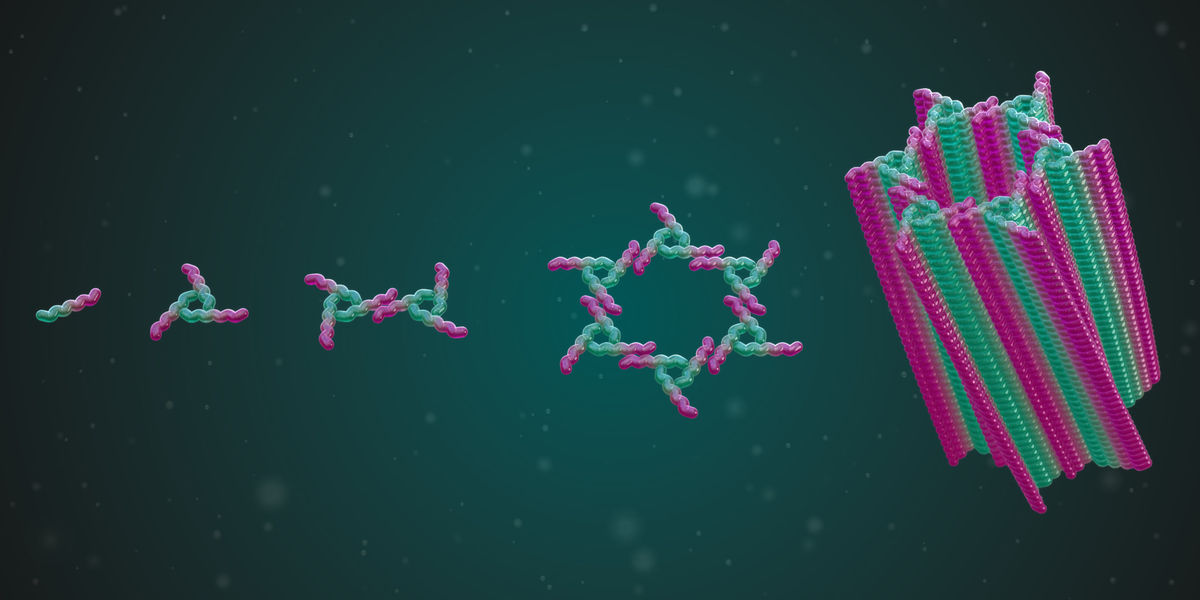
Tiny molecules, known as peptides, can assemble into honeycomb-like fibers filled with water. The blueprint for these fibers lies in a very short amino acid sequence, as researchers from the Max Planck Institute for Polymer Research, the University of Ulm, and Ulm University Hospital have now demonstrated. The blueprints provide rules for building ordered materials from very short molecular chains and a starting point for studying water in extremely confined spaces. The results have now been published in the journal Nature.
Honeycomb-shaped structures are familiar not least from beehives. Researchers have now designed molecules that self-assemble into a similar pattern on a scale that is far too small to be seen with the naked eye.
These molecules are peptides: short chains of amino acids, the building blocks of proteins. Each of these specific peptides consists of only nine amino acids. Many identical copies assemble into tiny fibers with a honeycomb-like interior filled with water.
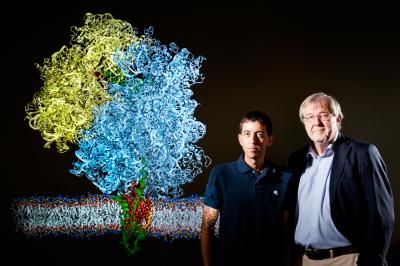
The Max Planck Institute for Polymer Research, the University of Ulm, and Ulm University Hospital are involved in the work. The study, with co-first authors Jasmina Gačanin and Francesca Mazzotta, has now been published in Nature.
“The molecules come with their own assembly instructions,” says Tanja Weil, director at the Max Planck Institute for Polymer Research, who led the study together with her colleague Katharina Landfester. “The crucial step is to understand how such a short peptide sequence gives rise to a much larger, ordered structure.”
The Honeycomb Code
The researchers designed a short peptide sequence of nine amino acids and studied it in several variants. They found that this amino acid sequence dictates how the peptides arrange themselves. Two peptides pair up, and three meet at each junction. This creates hexagonal rings that join side by side into a honeycomb and stack along the fiber. The result is fibers with many parallel, continuous channels about five nanometers across.
By systematically substituting individual segments in the amino acid sequence, the researchers were able to determine which segments are necessary for a honeycomb structure to form.
To do this, they used a special type of electron microscopy known as cryo-electron microscopy. In this technique, the sample is flash-frozen in a thin layer of ice and imaged in its natural, hydrated state. This allows scientists to determine exactly how neighboring peptides interlock. “We see not only the resulting honeycomb-shaped pattern, but also the molecular contacts behind it,” says Landfester.
A Different World for Water
The channels are not empty tubes. They are continuously filled with water, and this water behaves differently from ordinary water. Computer simulations suggest that the water inside is more tightly packed and less mobile than on the outside, and that its hydrogen bonds persist longer.
Experiments support this picture. The researchers dried the fibers under controlled conditions and used infrared spectroscopy to follow how the water escapes. Loosely bound water disappears first, while the more strongly bound water in the channels is retained considerably longer. In a control peptide that forms fibers but no channels, by contrast, the water is lost uniformly. The honeycomb structure itself remains intact during drying.
A single building block makes a remarkable difference. Exchanging the amino acid that lines the channel wall changes how tightly the water inside is bound: depending on the building block, more strongly or similar to ordinary water. Crucially, the modified peptides continue to form the honeycomb pattern. This makes it possible to tailor the environment inside the channels without changing their hexagonal geometry.
The results provide a starting point for studying water in very small spaces and exploring potential applications in the separation of substances or in chemical reactions. Such applications have not yet been demonstrated. For now, the progress lies in a set of proven rules according to which complex materials can be constructed from very short molecular chains.
Original publication
Other news from the department science














Most read news








More news from our other portals

























See the theme worlds for related content
Topic World Spectroscopy
Investigation with spectroscopy gives us unique insights into the composition and structure of materials. From UV-Vis spectroscopy to infrared and Raman spectroscopy to fluorescence and atomic absorption spectroscopy, spectroscopy offers us a wide range of analytical techniques to precisely characterize substances. Immerse yourself in the fascinating world of spectroscopy!

Topic World Spectroscopy
Investigation with spectroscopy gives us unique insights into the composition and structure of materials. From UV-Vis spectroscopy to infrared and Raman spectroscopy to fluorescence and atomic absorption spectroscopy, spectroscopy offers us a wide range of analytical techniques to precisely characterize substances. Immerse yourself in the fascinating world of spectroscopy!