A miniature magnetic resonance imager made of diamond
Quantum sensors make microscale NMR spectroscopy possible
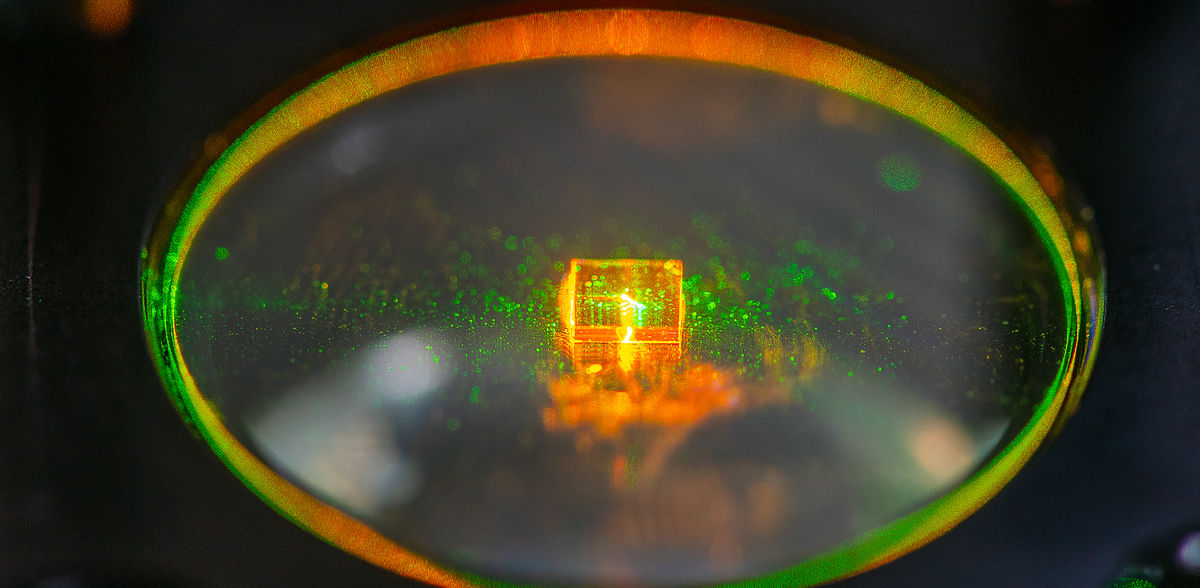
The development of tumors begins with miniscule changes within the body's cells; ion diffusion at the smallest scales is decisive in the performance of batteries. Until now the resolution of conventional imaging methods has not been high enough to represent these processes in detail. A research team lead by the Technical University of Munich (TUM) has developed diamond quantum sensors which can be used to improve resolution in magnetic imaging.
Nuclear magnetic resonance (NMR) is an important imaging method in research which can be used to visualize tissue and structures without damaging them. The technique is better known from the medical field as Magnetic Resonance Imaging (MRI), where the patient is moved into a bore of a large magnet on a table. The MRI device creates a very strong magnetic field which interacts with the tiny magnetic fields of the hydrogen nuclei in the body. Since the hydrogen atoms are distributed in a particular way amongst different types of tissues, it becomes possible to differentiate organs, joints, muscles and blood vessels.
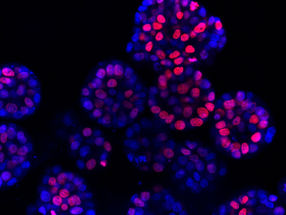
NMR methods can also be used to visualize the diffusion of water and other elements. Research for example often involves observing the behavior of carbon or lithium in order to explore the structures of enzymes or processes in batteries. "Existing NMR methods provide good results, for example when it comes to recognizing abnormal processes in cell colonies," says Dominik Bucher, Professor for Quantum Sensing at TUM. "But we need new approaches if we want to explain what happens in the microstructures within the single cells."
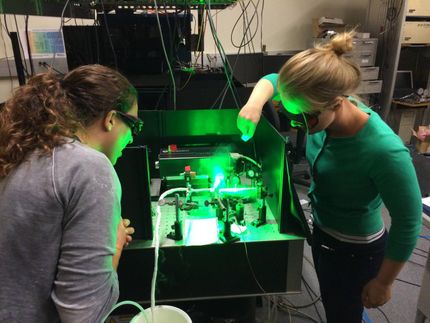
Sensors made of diamond
The research team produced a quantum sensor made of synthetic diamond for this purpose. "We enrich the diamond layer, which we provide for the new NMR method, with special nitrogen and carbon atoms already during growth," explains Dr. Peter Knittel of the Fraunhofer Institute for Applied Solid State Physics (IAF).
After growth, electron irradiation detaches individual carbon atoms from the diamond's perfect crystal lattice. The resulting defects arrange themselves next to the nitrogen atoms - a so-called nitrogen-vacancy center has been created. Such vacancies have special quantum mechanical properties needed for sensing. "Our processing of the material optimizes the duration of the quantum states, which allows the sensors to measure for longer," adds Knittel.
Quantum sensors pass the first test
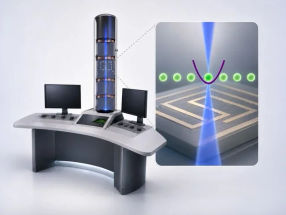
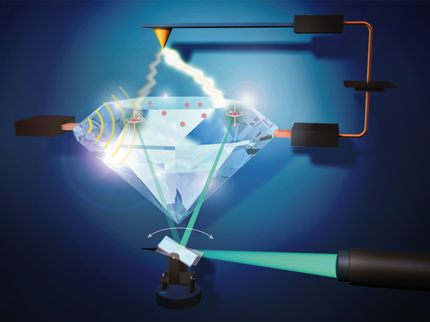
The quantum state of the nitrogen-vacancy centers interacts with magnetic fields. "The MRI signal from the sample is then converted into an optical signal which we can detect with a high degree of spatial resolution," Bucher explains.
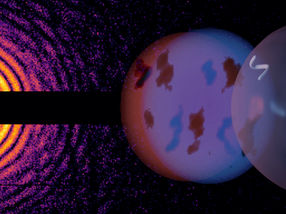
In order to test the method, the TUM scientists placed a microchip with microscopic water-filled channels on the diamond quantum sensor. "This allows us to simulate microstructures of a cell," says Bucher. The researchers were able to successfully analyze the diffusion of water molecules within the microstructure.
In the next step the researchers want to develop the method further to enable the investigation of microstructures in single living cells, tissue sections or the ion mobility of thin-film materials for battery applications. "The ability of NMR and MRI techniques to directly detect the mobility of atoms and molecules makes them absolutely unique compared to other imaging methods," says Prof. Maxim Zaitsev of the University of Freiburg. "We now have found a way, how their spatial resolution, which is currently often deemed insufficient, can be significantly improved in future."
Original publication
Other news from the department science