Quantum sensors: Measuring even more precisely
Better measurements with little extra effort
Two teams of physicists led by Peter Zoller and Thomas Monz at the University of Innsbruck, Austria, have designed the first programmable quantum sensor, and tested it in the laboratory. To do so they applied techniques from quantum information processing to a measurement problem. The innovative method promises quantum sensors whose precision reaches close to the limit set by the laws of nature.

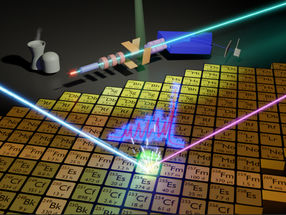
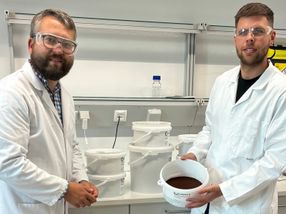
Time could be determined even more precisely with sophisticated computational methods on entangled atoms. Physicists from Innsbruck, Austria, have developed such a technique.
Harald Ritsch, Uni Innsbruck
Atomic clocks are the best sensors mankind has ever built. Today, they can be found in national standards institutes or satellites of navigation systems. Scientists all over the world are working to further optimize the precision of these clocks. Now, a research group led by Peter Zoller, a theorist from Innsbruck, Austria, has developed a new concept that can be used to operate sensors with even greater precision irrespective of which technical platform is used to make the sensor. “We answer the question of how precise a sensor can be with existing control capabilities, and give a recipe for how this can be achieved,” explain Denis Vasilyev and Raphael Kaubrügger from Peter Zoller's group at the Institute of Quantum Optics and Quantum Information at the Austrian Academy of Sciences in Innsbruck.
For this purpose, the physicists use a method from quantum information processing: variational quantum algorithms describe a circuit of quantum gates that depends on free parameters. Through optimization routines, the sensor autonomously finds the best settings for an optimal result. “We applied this technique to a problem from metrology - the science of measurement,” Vasilyev and Kaubrügger explain. “This is exciting because historically advances in atomic physics were motivated by metrology, and in turn quantum information processing emerged from that. So, we've come full circle here”, Peter Zoller enthuses. With the new approach, scientists can optimize quantum sensors to the point where they achieve the best possible precision technically permissible.
Better measurements with little extra effort
For some time, it has been understood that atomic clocks could run even more accurately by exploiting quantum mechanical entanglement. However, there has been a lack of methods to realize robust entanglement for such applications. The Innsbruck physicists are now using tailor-made entanglement that is precisely tuned to real-world requirements. With their method, they generate exactly the combination consisting of quantum state and measurements that is optimal for each individual quantum sensor. This allows the precision of the sensor to be brought close to the optimum possible according to the laws of nature, with only a slight increase in overhead. “In the development of quantum computers, we have learned to create tailored entangled states,” says Christian Marciniak from the Department of Experimental Physics at the University of Innsbruck. “We are now using this knowledge to build better sensors.”
Demonstrating quantum advantage with sensors
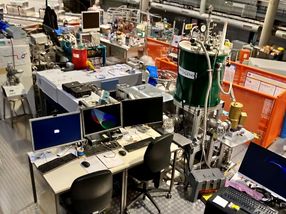
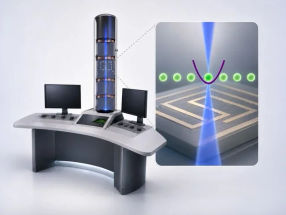
This theoretical concept was now implemented in practice for the first time at the University of Innsbruck, as the research group led by Thomas Monz and Rainer Blatt now reported in Nature. The physicists performed frequency measurements based on variational quantum calculations on their ion trap quantum computer. Because the interactions used in linear ion traps are still relatively easy to simulate on classical computers, the theory colleagues were able to check the necessary parameters on a supercomputer at the University of Innsbruck. Although the experimental setup is by no means perfect, the results agree surprisingly well with the theoretically predicted values. Since such simulations are not feasible for all sensors, the scientists demonstrated a second approach: They used methods to automatically optimize the parameters without prior knowledge. “Similar to machine learning, the programmable quantum computer finds its optimal mode autonomously as a high-precision sensor”, says experimental physicist Thomas Feldker, describing the underlying mechanism.
“Our concept makes it possible to demonstrate the advantage of quantum technologies over classical computers on a problem of practical relevance”, emphasizes Peter Zoller. “We have demonstrated a crucial component of quantum-enhanced atomic clocks with our variational Ramsey interferometry. Running this in a dedicated atomic clock is the next step. What has so far only been shown for calculations of questionable practical relevance could now be demonstrated with a programmable quantum sensor in the near future – quantum advantage.”
Original publication
Other news from the department science