Researchers “film” novel catalyst at work
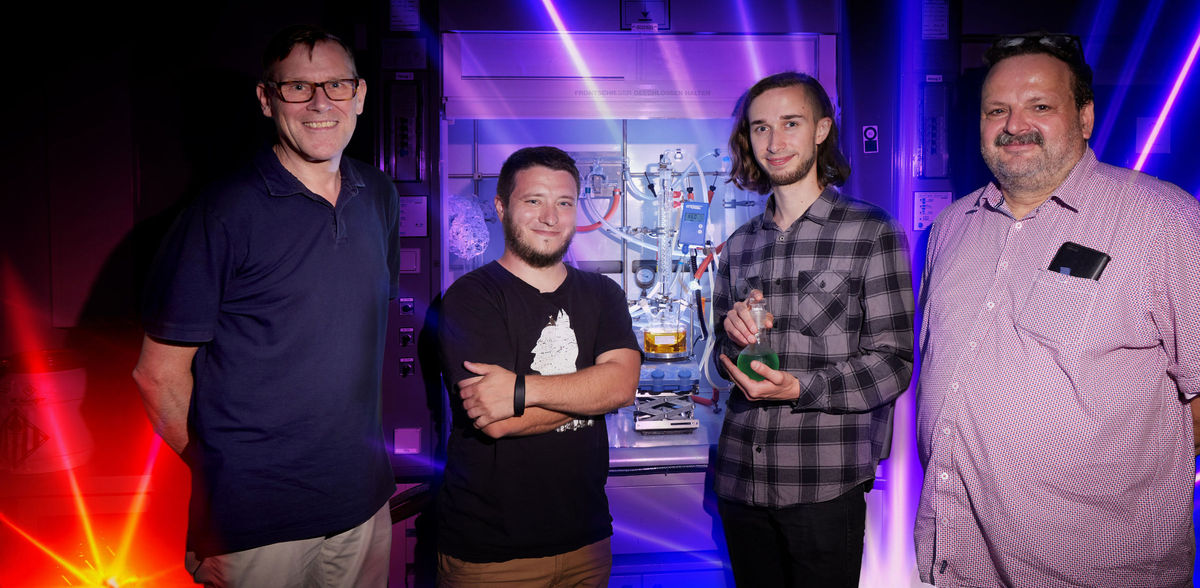
A novel catalysis scheme enables chemical reactions that were previously virtually impossible. The method developed at the University of Bonn is also environmentally friendly and does not require rare and precious metals. The researchers recorded the exact course of the catalysis in a kind of high-speed film. They did this using special lasers that can make processes visible that last only fractions of a billionth of a second. The results allow them to further optimize the catalyst.
Let’s say you are playing mini golf. There is a small hill on the course that the golf ball has to overcome in order to roll into the hole behind it. To do this, you need to hit it with enough force. Otherwise, it will not make it over the obstacle, but will roll back towards you.
It is similar for many chemical reactions: In order for them to proceed, you first have to supply them with enough energy. A catalyst reduces this activation energy. To stay in the picture: It levels the hill a bit so the ball needs less momentum to roll over it. The reaction is therefore easier and faster. “Some reactions are even only made possible by the use of catalysts,” explains Prof. Dr. Andreas Gansäuer.
Titanium instead of precious metals
The researcher works at the Kekulé Institute of Organic Chemistry and Biochemistry at the University of Bonn. He has been working for years on how to simplify the production of certain carbon compounds. The use of catalysts is usually the means of choice here. The problem: Often, the “reaction accelerators” consist of rare and precious metals such as platinum, palladium, or iridium.
“We usually use titanium compounds instead,” says Gansäuer. “This is because titanium is one of the most abundant elements in the earth’s crust and is also completely non-toxic.” However, titanium-based catalysts often still need a companion to be able to accelerate chemical reactions. Most often, this is also a metal. It activates the catalyst, (unlike the latter) is consumed in the reaction, and generates by-products as waster.
“This is both costly and not very sustainable,” emphasizes Gansäuer’s colleague Prof. Dr. Peter Vöhringer of the Clausius Institute for Physical and Theoretical Chemistry at the University of Bonn. “However, there have been attempts for some time to achieve this activation in a different way: By irradiating the catalyst with light. We have now implemented this idea. At the same time we filmed, in a sense, the processes that occur during activation and catalysis.”
Lasers create “lightning storm”
The “high-speed camera” used by the researchers was a spectrometer - this is a complex instrument that can be used to determine what a molecule looks like at a certain point in time. For this to work, you also need a flash. To do this, the researchers use a laser that switches on and off continuously. The bright moments each last only a few hundred femtoseconds (a femtosecond is the millionth part of a billionth of a second). The catalysis process is thus broken down into a sequence of individual images. “This allows us to visualize ultrafast processes,” says Vöhringer, who is a specialist in this method.
Not all molecules can be filmed easily. “We therefore had to make some modifications to the titanium catalyst we usually use,” says Gansäuer. The experiments show that the compound can be activated by light and is then able to catalyze a specific form of redox reactions. In redox reactions, electrons are passed from one reactant to the other. “This process is facilitated by the activated catalyst,” Gansäuer explains. “This allows us, for example, to produce compounds that serve as starting materials for many important drugs.”
Greedy for electrons
The “high-speed film” documents exactly what happens during light activation. “Electrons resemble a compass needle that points in a certain direction,” says Jonas Schmidt, who is doing his doctorate in Prof. Vöhringer’s research group. “This spin changes as a result of irradiation.” Figuratively speaking, the titanium compound thus becomes “greedier” to accept an electron. When it does, it starts the redox reaction.
“Thanks to the insights we have gained with our method, we can now further optimize the catalyst,” explains Vöhringer, who, like Prof. Gansäuer, is a member of the Transdisciplinary Research Area “Matter” at the University of Bonn. It is already possible to use it to carry out chemical reactions that were hardly feasible before. The success is also an expression of fruitful cooperation between organic chemistry on the one hand and laser and molecular physics on the other, Vöhringer emphasizes: “Our study shows the fruits that can come from collaboration between two research groups with completely different methodological backgrounds.”
Original publication
Other news from the department science