Advanced dosimetry phantoms improving radiotherapy verification
Scientists from Tomsk Polytechnic University are working on a technology for 3D-printing dosimetry phantoms, which present physical models of the human body or its single parts used by medical physicists for verification of radiotherapy plans. TPU scientists have developed a material which enables printing not conventional models but individual ones, taking into account the characteristics of a patient. It makes it possible to plan radiotherapy more clearly. The project is carried out in the close cooperation with the Tomsk Cancer Research Institute of Tomsk National Research Medical Center.
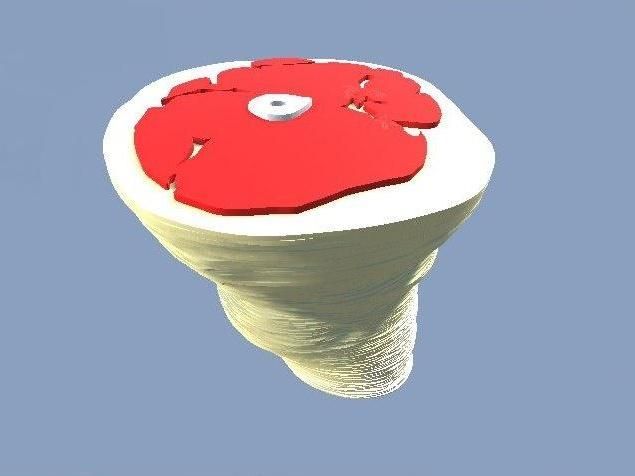
3D-printed dosimetry phantom based on MRI data.
Tomsk Polytechnic University
Dosimetry phantoms are applied prior each course of radiotherapy for verification of treatment plans. As a rule, they are conventional models of the human body or have a simple geometric shape. Modern phantoms are manufactured out of plastic approximate in density to the average index of different tissues of the body.
Senior lecturer Yuri Cherepennikov from the Division of Nuclear Fuel Cycle says: 'There is no need to explain that radiotherapy is a serious medical manipulation associated with certain risks. The more carefully treatment plan is elaborated and verified, the more efficient it will be, the less healthy tissues will be affected. Now, average human models are used for this purpose. Although everyone understands that, for example, bones and muscles have different densities and interact differently with radiation. We propose to create patient-specific models of the single body parts based on imaging data which are collected for each patient before radiotherapy, no additional manipulations are needed.
We have developed a polymer material which is identical in density to the tissues of the body, and various additives allow creating analogues of a variety of tissues: bone, muscle, fat, and others.'
Recently, the researcher has received the RF President Scholarship to develop his project.
Such 'printed' phantoms repeat the complex internal structure of the tissues of a particular patient. The experiments conducted by the scientists show that 3D-printing enables reproducing almost any structure. Additionally, the proposed approach allows creating phantoms that take into account implants and pacemakers in the patient's body.
The developers note that in the laboratory, printing of a phantom of body's part takes up to two days. According to their calculations, when the technology is ready-made, the same process will take up to 10 hours.
The scientific supervisor of the project Sergey Stuchebrov, Ass. Professor at the Research School of High-Energy Processes adds: 'Indeed, the cost of a phantom will depend on its complexity, but we are tasked to lower the cost to 10,000 rubles.'
Other news from the department science