Screening method for anti-HIV therapeutics?
A new and easy method for the detection of microRNA and RNase H activity could be used for screening anti-HIV therapeutics say Chinese scientists.
Zhengping Li and co-workers at Hebei University have developed a rapid, quantitative and sensitive method for the detection of microRNA (miRNA) and RNase H activity. 'Most of the current existing assays for the detection of miRNAs and RNase H activity need to label the oligonucleotide probes, for example where the labels are either radioactive isotopes or fluorescent dyes', explains Li. 'The label-based assays generally contain sophisticated preparation, resulting in high cost and low stability.'
miRNAs are a class of small RNA molecules that are not responsible for protein-coding, and can be found in plants, animals and viruses, and play an important role in gene regulation. Recently, distinct miRNA expression patterns have been associated with various types of tumours, and have thus been the subject of intense investigation in the diagnosis of diseases and as new drug targets. RNase H is an enzyme that specifically digests RNA, and plays a critical role in several cellular processes including DNA replication, repair and transcription. 'The RNase H activity of HIV-1 reverse transcriptase is becoming a new target for HIV-1 inhibitor and represented an exciting possibility for developing new anti-HIV therapeutics', says Li.
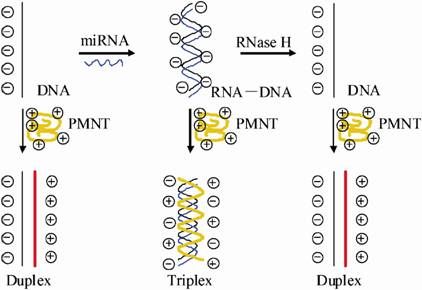
This method requires no labelling of chemical probes and the assay can be accomplished with a common spectrometer, reducing analysis costs and increasing analysis through-put. The method exploits conformational changes of an optical polymer probe in the presence of miRNA and/or RNase H, which corresponds to a change in the absorbance observed. The duplex complex leads to a red-shift absorption, while the triplex leads to an orange-shift absorption.
'In the future, this work should be applied for miRNA detection in real biological samples and especially for screening anti-HIV therapeutics', says Li. 'The future challenges facing miRNA detection should be obtaining high sensitivity and selectivity with simple operation, especially for in situ detection.'
Original article: Yali Zhang, et. al.; Chem. Commun., 2009.
Other news from the department science