Laser light produces complex nanostructures

30-May-2008

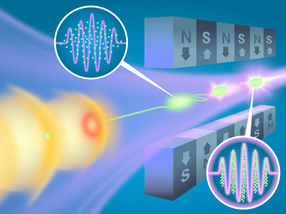
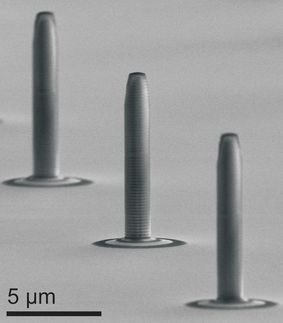
Researchers at Chalmers University of Technology in Sweden have reported that a single laser pulse can create complex, ordered nanostructure systems. This previously unobserved phenomenon has just beeen described in an article in the scientific journal Nature Photonics. "We have discovered a method for controlling the pattern into which the nanoparticles organize themselves," says physicist Dinko Chakarov, one of the authors of the article. The complex nanostructures that are created may find applications in fibre optics, optical sensors and advanced light emitting diodes and lasers.

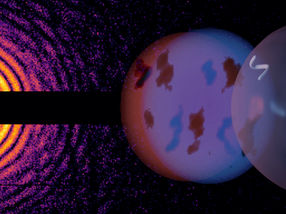
The researchers started with a layer of disordered nanoparticles of gold or silver on a membrane of nanometre thickness. The patterning is a consequence of several transformations of the light, which finally results in partial melting and moving of the nanoparticles.

First, the light is caught by the particles, resulting in resonant swinging back and forth of the particle electrons (so called localized plasmon resonances). This specific excitation gives rise to scattering and coupling of electromagnetic energy into trapped, waveguided modes of the thin membrane. The edges of the membrane cause a standing wave pattern to be formed.

The end result is hot and cold zones of a specific periodicity on the membrane surface, and if the laser light energy is high enough, the field energy in the hot zones is high enough to melt and move the gold particles. All of this occurs within a few nanoseconds or even faster, and the resulting patterns have dimensions that can be both smaller and larger than the laser wavelength.

The results demonstrate that complex nanostructured systems can be fabricated and manipulated by a single laser pulse. In addition, the study shows in a very concrete manner that assemblies of optically active nanoparticles can be used to trap light in a waveguide (membrane or fibre) with nanometer dimensions.

The researchers have shown that the pattern can be controlled by varying several parameters: the laser light angle, wavelength and polarization, as well as the membrane thickness and the type of particles on the membrane. The discovery contributes to the understanding of the fundamental interaction between light and matter.
Other news from the department science

Most read news

More news from our other portals

Last viewed contents

Scientists adapt astronomy method to unblur microscopy images - New method to generate clearer images of thick biological samples

Scientists adapt astronomy method to unblur microscopy images - New method to generate clearer images of thick biological samples

Making cars and airplanes cheaper, safer and more efficient - DFG funds 2 major instruments to test components made of fiber-reinforced composites

Enterome and Nestlé Health Science launch new diagnostics company

New wheat diversity discovery could provide an urgently-needed solution to global food security - Newly-discovered diversity in the wheat genome could offer vital new opportunities to improve and ‘climate-proof’ one of the world’s most important staple crops

New wheat diversity discovery could provide an urgently-needed solution to global food security - Newly-discovered diversity in the wheat genome could offer vital new opportunities to improve and ‘climate-proof’ one of the world’s most important staple crops

Hidden properties of solids

Raman Microspectroscopy for Microbiology - Methodology can provide new insights into a variety of key topics in microbiology

Raman Microspectroscopy for Microbiology - Methodology can provide new insights into a variety of key topics in microbiology

Norwegian Team Completes Cod Genome

Biotage AB and McMaster University sign two year extension to Molecular Imaging Development Agreement

Malvern Panalytical agrees to acquire Micromeritics, to become world leaders in materials characterization

Malvern Panalytical agrees to acquire Micromeritics, to become world leaders in materials characterization

Aignostics Raises €14m Series A to Advance AI-powered Pathology - Spin-off from Charité developing sophisticated AI models to improve understanding, diagnosis and treatment of complex diseases

Aignostics Raises €14m Series A to Advance AI-powered Pathology - Spin-off from Charité developing sophisticated AI models to improve understanding, diagnosis and treatment of complex diseases

New Clues to Mechanism for "Colossal Resistance" Effects - Understanding could lead to lower-power, increased-memory data-storage devices

New Clues to Mechanism for "Colossal Resistance" Effects - Understanding could lead to lower-power, increased-memory data-storage devices

Researchers uncover new water monitoring technique - New method simultaneously monitors clumps and the mixing intensity in a single step

Researchers uncover new water monitoring technique - New method simultaneously monitors clumps and the mixing intensity in a single step