Quantum nanoscope
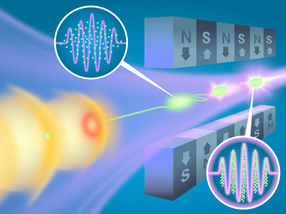
Seeing electrons surfing the waves of light on graphene
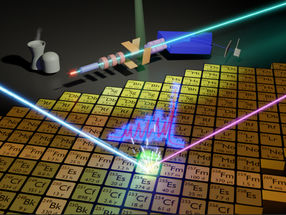
Researchers have studied how light can be used to “see” the quantum nature of an electronic material. They managed to do that by capturing light in a net of carbon atoms and slowing down light it down so that it moves almost as slow as the electrons in the graphene. Then something special happens: electrons and light start to move in concert, unveiling their quantum nature at such large scale that it could observed with a special type of microscope.
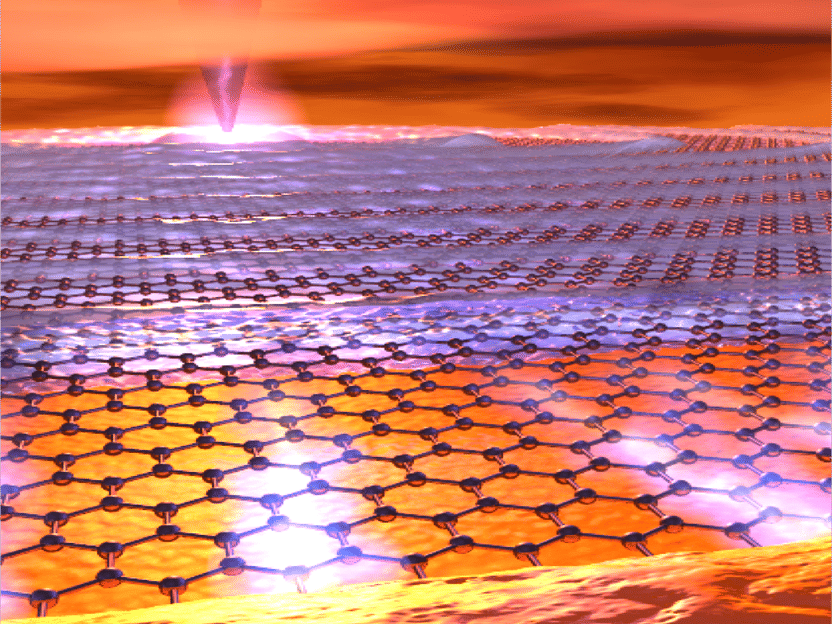
Electrons and light moving in concert along the graphene sheet
ICFO/ Fabien Vialla
The experiments were performed with ultra-high quality graphene. To excite and image the ultra-slow ripples of light in the graphene (also called plasmons), the researchers used a special antenna for light that scans over the surface at a distance of a few nanometers. With this near field nanoscope they saw that the light ripples on the graphene moved more than 300 times slower than light, and dramatically different from what is expected from classical physics laws.
The work has been published by ICFO researchers Dr. Mark Lundeberg, Dr. Achim Woessner, led by ICREA Prof. at ICFO Frank Koppens, in collaboration with Prof. Hillenbrand from Nanogune, Prof. Polini from IIT and Prof. Hone from Columbia University.
In reference to the accomplished experiments, Prof. Koppens comments: “Usually it is very difficult to probe the quantum world, and to do so it requires ultra-low temperatures; here we could just “see” it with light and even at room temperature”.
This technique paves now the way for exploring many new types quantum materials, including superconductors where electricity can flow without energy consumption, or topological materials that allow for quantum information processing with topological qubits. In addition, Prof. Hillenbrand states that “this could just be the beginning of a new era of near field nanoscopy”.
Prof. Polini adds that “This discovery may eventually lead to understanding in a truly microscopic fashion complex quantum phenomena that occur when matter is subject to ultra-low temperatures and very high magnetic fields, like the fractional quantum Hall effect”
Original publication
Lundeberg, Mark B. and Gao, Yuanda and Asgari, Reza and Tan, Cheng and Van Duppen, Ben and Autore, Marta and Alonso-Gonz{\'a}lez, Pablo and Woessner, Achim and Watanabe, Kenji and Taniguchi, Takashi and Hillenbrand, Rainer and Hone, James and Polini, Marco and Koppens, Frank H. L.; "Tuning quantum nonlocal effects in graphene plasmonics"; Science; 2017
Other news from the department science