Every Electron Counts!
FLASH study calls for a better theory of electrons in solids
Despite years of extensive research, many unconventional electrical, thermal and magnetic properties of modern materials remain a mystery. A recent study, conducted at DESY’s free-electron laser FLASH, has now concluded that a flaw in current theories of solids hinders further understanding of complex material behavior.
“High-temperature superconductors are a very good example,” says Michael Rübhausen, one of the study’s corresponding authors from the Center for Free-Electron Laser Science (CFEL) – a collaboration of DESY, the Max Planck Society and Hamburg University. “We have known these materials for almost 30 years. Yet, we still don’t understand how they work nor are we able to systematically find new and better ones.” Below certain temperatures, high-temperature superconductors transport electricity without losses and could potentially introduce new energy-conserving materials into everyday applications.
The new study, published in the journal Physical Review Letters, questions the common assumption that individual electrons have little influence on a material’s properties. It establishes that introducing minute charge differences into a solid can, in fact, have a large impact. The unexpected result may help demystify high-temperature superconductivity and other unexplained phenomena in modern materials.
Individual versus effective particles
Solids, the most important state of matter in material science, are composed of a lattice of atomic nuclei over which the atoms’ electrons are distributed. Since the number of electrons is unimaginably large, current theories do not treat electrons individually but merge them into a much smaller set of charged effective particles. “This approach works well for many conventional materials,” Rübhausen says. “However, it is failing for modern materials that we haven’t managed to understand for decades.”
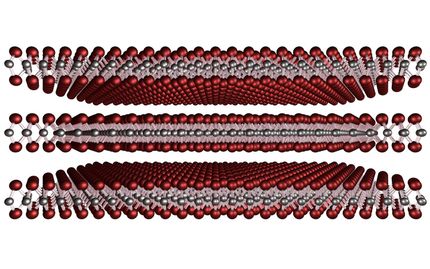
To develop a better understanding, the research team studied the interaction of electrons in spin-ladder compounds – model systems for high-temperature superconductors, in which the chemical elements copper and oxygen assume a ladder-like arrangement. Two parallel strands of alternating copper and oxygen atoms represent the ladder’s legs. Copper atoms on either side of the ladder are linked together by an oxygen atom, thereby forming the ladder rungs.
The scientists then analyzed the interactions of copper’s electrons with the electrons of the neighboring oxygen atoms. Depending on the orientation of the ladder relative to FLASH’s radiation, they were able to selectively probe copper’s interactions with oxygen either along the legs or the rungs. Due to the symmetry of the atomic arrangement, the local electron interactions are generally identical in both cases.
Unexpected effect in atomic ladders
The concept of effective electrons predicts that these interactions remain more or less the same, even if the charge on the oxygen along the rungs is altered by a small amount. “The assumption is that the electrons on copper and oxygen can be represented by ‘effective electrons’ on the copper only,” explains Andrivo Rusydi from the NUSNNI-Nanocore Institute and Department of Physics at the National University of Singapore, who led the study together with Rübhausen. Therefore, small changes of the charge along the rungs are not expected to significantly alter the effective charge on the copper. “In a sense, this approximation ignores the role of charges on the oxygen,” Rusydi says.
However, when the researchers compared the atomic ladder with one, in which the rungs’ oxygen atoms had a one-electron deficit, or electron hole, they made the surprising observation that the holes caused the interactions along the legs versus rungs to differ. “The holes on the rungs shouldn’t make a big difference,” Rusydi says. “Yet, our data show that realistic models must explicitly include individual charges on oxygen.”
Electron interactions in high definition
“The study identified a flaw in the theoretical concept of representing a large number of electrons by single effective electrons,” Rübhausen points out. “In order to understand and develop modern materials such as high-temperature superconductors, we need to significantly expand the existing descriptions of solids.”
Key to the researchers’ discovery was a unique combination of FLASH’s highly intense radiation with a novel and extremely sensitive spectrometer that acts as a high-definition camera for electron interactions in the sample. “If we are able to better understand these interactions and, one day, control them, we may be in the position to manipulate and functionalize complex material properties at will,” says Rusydi. “Our setup atFLASHopens up a new path to accomplish this goal.”
Original publication
Other news from the department science













These products might interest you










Most read news






More news from our other portals





















Last viewed contents
Improved method developed to test carcinogen risk
BORN2GROW supports biotech start-up Venneos with its further growth
Mass Analysis of DNA from Whole Populations

New deep learning algorithm can pick up genetic mutations and DNA mismatch repair deficiency in colorectal cancers more efficiently - The findings open up the possibility to select patients likely to benefit from targeted therapies at lower costs and with quicker turnaround times as compared to current methods
VWR International Acquires INTERNATIONAL P.B.I. S.p.A. - VWR strengthens its position in Italy
Molecular imaging hack makes cameras 'faster'
DataApex audited for ISO 9001 standards
Brain imaging gives new insight into mental disorders

Pain sensors specialized for specific sensations