New wave: JILA develops efficient source of terahertz radiation
JILA researchers have developed a laser-based source of terahertz radiation that is unusually efficient and less prone to damage than similar systems. The technology might be useful in applications such as detecting trace gases or imaging weapons in security screening. JILA is a joint institute of the National Institute of Standards and Technology (NIST) and the University of Colorado at Boulder.
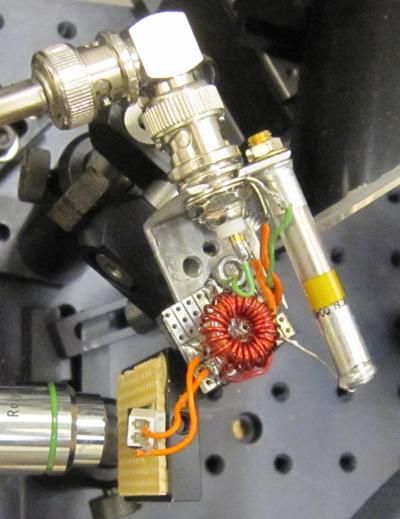
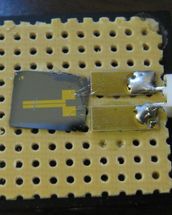
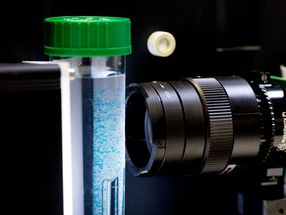
This is the JILA instrument for generating terahertz radiation. Ultrafast pulses of near-infrared laser light enter through the lens at left, striking a semiconductor wafer studded with electrodes (transparent square barely visible under the white box connected to orange wires) bathed in an oscillating electric field. The light dislodges electrons, which accelerate in the electric field and emit waves of terahertz radiation.
Zhang/JILA
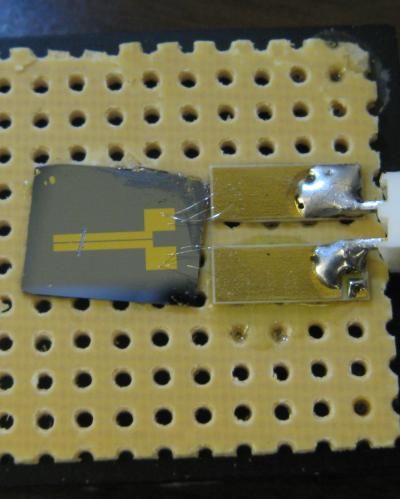
This is a close-up of the electron source.
Zhang/JILA
Terahertz radiation—which falls between the radio and optical bands of the electromagnetic spectrum—penetrates materials such as clothing and plastic but can be used to detect many substances that have unique absorption characteristics at these wavelengths. Terahertz systems are challenging to build because they require a blend of electronic and optical methods.
The JILA technology, described in Optics Letters, is a new twist on a common terahertz source, a semiconductor surface patterned with metal electrodes and excited by ultrafast laser pulses. An electric field is applied across the semiconductor while near-infrared pulses lasting about 70 femtoseconds (quadrillionths of a second), produced 89 million times per second, dislodge electrons from the semiconductor. The electrons accelerate in the electric field and emit waves of terahertz radiation.
The JILA innovations eliminate two known problems with these devices. Adding a layer of silicon oxide insulation between the gallium arsenide semiconductor and the gold electrodes prevents electrons from becoming trapped in semiconductor crystal defects and producing spikes in the electric field. Making the electric field oscillate rapidly by applying a radiofrequency signal ensures that electrons generated by the light cannot react quickly enough to cancel the electric field.
The result is a uniform electric field over a large area, enabling the use of a large laser beam spot size and enhancing system efficiency. Significantly, users can boost terahertz power by raising the optical power without damaging the semiconductor. Sample damage was common with previous systems, even at low power. Among other advantages, the new technique does not require a microscopically patterned sample or high-voltage electronics. The system produces a peak terahertz field (20 volts per centimeter for an input power of 160 milliwatts) comparable to that of other methods.
While there are a number of different ways to generate terahertz radiation, systems using ultrafast lasers and semiconductors are commercially important because they offer an unusual combination of broad frequency range, high frequencies, and high intensity output.
NIST has applied for a provisional patent on the new technology. The system currently uses a large laser based on a titanium-doped sapphire crystal but could be made more compact by use of a different semiconductor and a smaller fiber laser, says senior author Steven Cundiff, a NIST physicist.
Original publication
Other news from the department science










Most read news




More news from our other portals



























Last viewed contents
A single molecular switch reveals atomic-scale light dynamics
Novasep and instrAction enter a worldwide strategic alliance for non-chiral chromatography
Lonza and Hyglos reach agreement for endotoxin detection patents
Research will speed tracing bacteria behind salmonella outbreaks
WITec opens new regional headquarters in Singapore