Greifswald method supports diagnosis of hereditary platelet disorders
Recognizing rare diseases with a drop of blood
Impaired haemostasis, large bruises for no apparent reason since childhood: a congenital platelet disorder may be responsible for this. More than 70 of these hereditary disorders are known - but they are difficult to diagnose. Affected patients often have years of suffering behind them before the correct diagnosis is made.
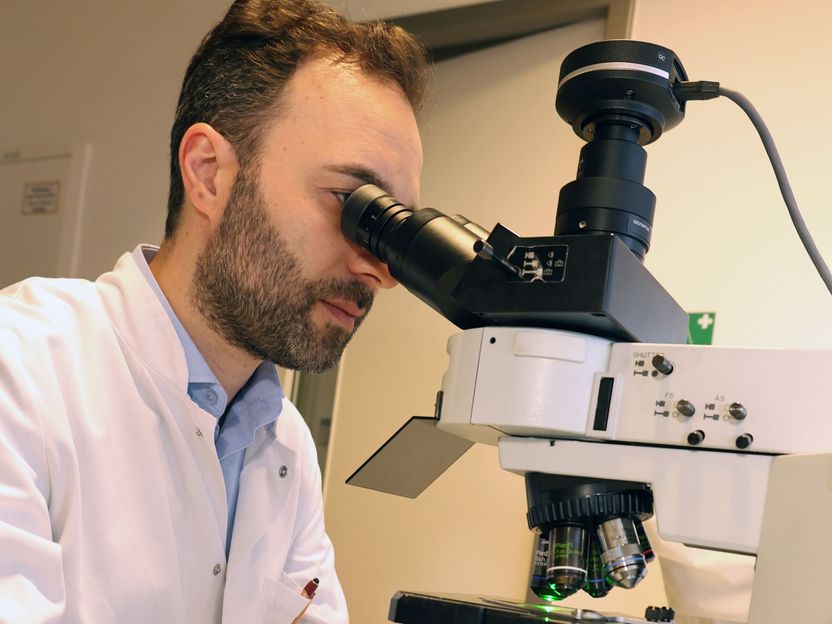
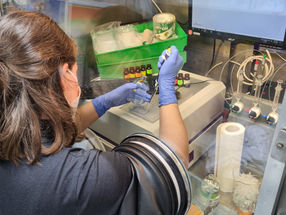
Dr. Carlo Zaninetti at the immunofluorescence microscope
Copyright: UMG
Researchers in Greifswald have now developed a promising method using a microscope that allows newborn babies to be tested with just a drop of blood. In order to test the method internationally, the Greifswald researchers have formed a worldwide network with seven centers. The project was developed under the auspices of the world's leading international specialist society for thrombosis and haemostasis (ISTH), in whose journal the Greifswald study has now been published.
"We make the platelets glow under the microscope," says Carlo Zaninetti from the Institute of Transfusion Medicine at the University Medical Center Greifswald. Thrombocytes are also known as blood platelets and play a crucial role in hemostasis and blood clotting. The Greifswald researchers use immunofluorescence microscopy to detect platelet disorders. This involves making specific platelet structures visible under the microscope using luminous, fluorescent antibodies. "We don't need more than a drop of blood for this," explains Zaninetti. "This is ideal for an initial screening examination in order to draw the right conclusions for further diagnostics."
There are also logistical advantages. "The seven specialist centers worldwide with their experience can receive the sample by post from anywhere," reports Zaninetti. This means that patients who live far away from a specialist center can also be helped. "The method is extremely promising," says Prof. Andreas Greinacher, Senior Professor at the Institute of Transfusion Medicine at the University Medical Center Greifswald. "We developed it in Greifswald so that patients from Europe don't have to make the long journey to Greifswald. Now patients worldwide can be examined with it." "Our procedure saves considerable costs," adds Dr. Zaninetti. "It provides an indication of which patients should be given a more in-depth genetic analysis." For the University Medical Center, the overall concept of this study is of outstanding importance. "Greifswald University Medicine is strengthening its reputation as a global reference center for blood coagulation and platelet disorders," says Prof. Karlhans Endlich, Scientific Director of University Medicine. "This is a real seal of approval for us and especially for our staff at the Institute of Transfusion Medicine."
Note: This article has been translated using a computer system without human intervention. LUMITOS offers these automatic translations to present a wider range of current news. Since this article has been translated with automatic translation, it is possible that it contains errors in vocabulary, syntax or grammar. The original article in German can be found here.
Other news from the department science














Most read news






More news from our other portals






















See the theme worlds for related content
Topic world Diagnostics
Diagnostics is at the heart of modern medicine and forms a crucial interface between research and patient care in the biotech and pharmaceutical industries. It not only enables early detection and monitoring of disease, but also plays a central role in individualized medicine by enabling targeted therapies based on an individual's genetic and molecular signature.

Topic world Diagnostics
Diagnostics is at the heart of modern medicine and forms a crucial interface between research and patient care in the biotech and pharmaceutical industries. It not only enables early detection and monitoring of disease, but also plays a central role in individualized medicine by enabling targeted therapies based on an individual's genetic and molecular signature.
Topic world Antibodies
Antibodies are specialized molecules of our immune system that can specifically recognize and neutralize pathogens or foreign substances. Antibody research in biotech and pharma has recognized this natural defense potential and is working intensively to make it therapeutically useful. From monoclonal antibodies used against cancer or autoimmune diseases to antibody-drug conjugates that specifically transport drugs to disease cells - the possibilities are enormous
Topic world Antibodies
Antibodies are specialized molecules of our immune system that can specifically recognize and neutralize pathogens or foreign substances. Antibody research in biotech and pharma has recognized this natural defense potential and is working intensively to make it therapeutically useful. From monoclonal antibodies used against cancer or autoimmune diseases to antibody-drug conjugates that specifically transport drugs to disease cells - the possibilities are enormous