For the first time, researchers are peering inside record-breaking superconductors
Atomic-level insights into lanthanum superhydrides are expected to enable more energy-efficient technologies in the long term

An international research team, including scientists from the Helmholtz-Zentrum Dresden-Rossendorf (HZDR), has achieved a methodological breakthrough in the study of superhydrides, a promising class of superconductors. For the first time, the team succeeded in analyzing lanthanum superhydrides under extreme pressure using nuclear magnetic resonance spectroscopy.
Superconductors are characterized by the fact that their electrical resistance vanishes below a material-specific critical temperature, allowing them to conduct electricity without loss. For most known materials, this transition temperature is below about 140 Kelvin (minus 133 degrees Celsius), which requires complex cooling technology for practical applications. Consequently, researchers are actively searching for materials that exhibit superconductivity at significantly higher temperatures.
Superhydrides are hydrogen-rich compounds, in which a metal, such as lanthanum, is embedded in a densely packed hydrogen lattice. Under extreme pressure, such as that found inside planets, they develop extraordinary electronic properties and can exhibit superconductivity near room temperature. As a result, this class of materials holds the current world record for the highest critical transition temperature at which signs of superconductivity have been observed.
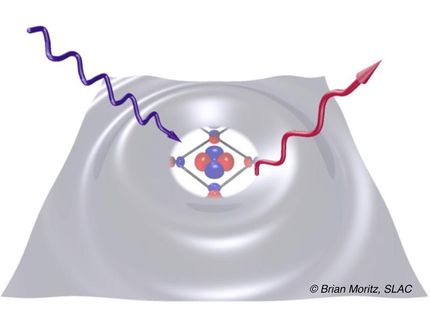
To create such conditions, the team compresses the samples in diamond anvil cells between two diamonds to pressures exceeding one million atmospheres. The challenge lies in the tiny sample size, which means the investigation requires highest level of experimental precision.
Magnetic superlenses on a microscale
This is where the current research comes in: Using so-called Lenz lenses – microstructured conductive ring elements – the researchers precisely focus the high-frequency fields required for nuclear magnetic resonance (NMR) spectroscopy within the sample volume, thereby significantly amplifying them. This focusing makes NMR measurements possible under the extreme conditions inside the diamond anvil cell.
„We had to focus the high-frequency fields precisely where the sample is located between the diamond anvils, over an area of just a few tens of micrometers, which is smaller than the diameter of a human hair,” explains Dr. Florian Bärtl from the Dresden High Magnetic Field Laboratory (HLD) at HZDR. “With the use of Lenz lenses, we were able to amplify the high-frequency signal to such an extent that, for the first time, meaningful NMR data became accessible for superhydrides.” The measurements provide direct insights into the atomic properties of the materials and help to better understand them.
Highest magnetic fields as an additional stress test
The team had previously also investigated the materials using the pulsed high-field magnets at the HLD by measuring their electrical resistance. Such magnetic fields serve as a stress test for superconductors: they reveal the maximum field strengths up to which the superconducting state remains stable.
Only the combination of both approaches – NMR investigations under high pressure and resistance measurements at highest magnetic fields – provides a comprehensive picture of the physical properties of this class of materials.
The research was conducted in close collaboration with high-pressure experts from the Center for High Pressure Science & Technology Advanced Research (HPSTAR) in Beijing. “The collaboration with the HLD was crucial to our project,” says Dr. Dmitrii Semenok. “The high-field facilities available there and the expertise in high-frequency instrumentation provide ideal conditions for these experiments.”
In the long term, the researchers aim to better understand the physical mechanisms of superconductivity in hydrogen-rich materials and thereby drive the future development of new materials for energy-efficient technologies.
Original publication
Dmitrii V. Semenok, Florian Bärtl, Di Zhou, Toni Helm, Sven Luther, Joachim Wosnitza, Ivan A. Troyan, Viktor V. Struzhkin, Hannes Kühne; "Transmission of Radio‐Frequency Waves and Nuclear Magnetic Resonance in Lanthanum Superhydrides"; Advanced Science, Volume 13, 2026-2-8
D. V. Semenok, I. A. Troyan, D. Zhou, A. V. Sadakov, K. S. Pervakov, O. A. Sobolevskiy, A. G. Ivanova, M. Galasso, F. G. Alabarse, W. Chen, C. Xi, T. Helm, S. Luther, V. M. Pudalov, V. V. Struzhkin, Ternary Superhydrides Under Pressure of Anderson’s Theorem: Near-Record Superconductivity in (La, Sc)H12, in Advanced Functional Materials, 2025
Other news from the department science













Most read news







More news from our other portals























See the theme worlds for related content
Topic World Spectroscopy
Investigation with spectroscopy gives us unique insights into the composition and structure of materials. From UV-Vis spectroscopy to infrared and Raman spectroscopy to fluorescence and atomic absorption spectroscopy, spectroscopy offers us a wide range of analytical techniques to precisely characterize substances. Immerse yourself in the fascinating world of spectroscopy!

Topic World Spectroscopy
Investigation with spectroscopy gives us unique insights into the composition and structure of materials. From UV-Vis spectroscopy to infrared and Raman spectroscopy to fluorescence and atomic absorption spectroscopy, spectroscopy offers us a wide range of analytical techniques to precisely characterize substances. Immerse yourself in the fascinating world of spectroscopy!