No need to pull all-nighters here: this laboratory plans its own experiments
KIWI Biolab at TU Berlin combines robots, analysis devices and AI - and uses them to carry out even complex experiments fully automatically
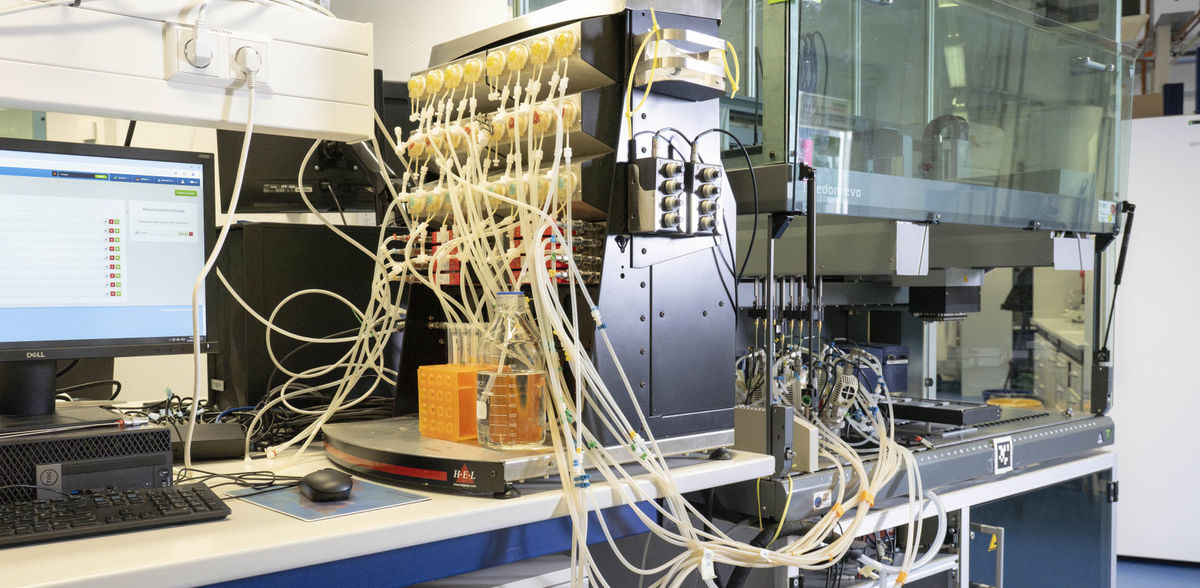
It sounds a bit like science fiction: a laboratory that can plan, carry out and evaluate its experiments largely independently. In which robots controlled by computers and artificial intelligence (AI) work together with state-of-the-art analysis equipment. And where humans no longer have to pull all-nighters to feed cells and keep the experiments going. But this is exactly what has become reality in the KIWI Biolab at TU Berlin. The developers of the fully automated high-tech laboratory will also be making their expertise available in the new research center "The Simulated Human" (Si-M) of TU Berlin and Charité - Universitätsmedizin Berlin.
"I've always been interested in how new biological processes can be brought from the laboratory into practice as quickly as possible," says Prof. Dr. Peter Neubauer, who heads the Department of Bioprocess Engineering at TU Berlin. The co-founder and head of the KIWI Biolab is a trained microbiologist. He therefore initially asked himself such questions primarily in relation to bacteria, yeasts and fungi: What is the best way to keep such organisms in bioreactors? And in such a way that they not only multiply and thrive, but also produce valuable substances such as special proteins for the pharmaceutical industry?
Finding an answer to this question is anything but easy. This is because the small producers often react very strongly to their environment. In a laboratory test on a milliliter scale, they may have behaved perfectly. However, this does not necessarily mean that they will do the same in a bioreactor with a capacity of a few hundred cubic meters. Before industrial use, it is therefore important to find out under which conditions which organisms can best perform the desired task.
Automated work in the laboratory
Model calculations can provide clues. How fast does an organism grow? How much substrate does it consume? Peter Neubauer and his team put these and many other parameters into mathematical formulas. The computer can then be used to compare how different variants of a process run and which of them delivers the best results.
"We can also link such mathematical models with robots and analysis devices," explains Peter Neubauer. In this way, work in the laboratory can be digitally organized and automated. For example, one type of robot sucks a few milliliters of liquid out of the bioreactor at certain times. One of its mobile colleagues then transports the sample to a measuring device that analyzes its properties. For this to work, however, the technical assistants have to coordinate their work so that everyone does the right thing at the right time. "We need extensive computer programs for this," says Peter Neubauer.
Extremely interesting for the pharmaceutical industry
But the effort is worth it. The KIWI Biolab is now one of the world's leading laboratories for the development of bioprocesses. By using mathematical models and artificial intelligence, even complex experiments can be carried out fully automatically. For example, the AI decides when it makes sense to take a sample and then initiates the necessary steps. It ensures that the organisms in the bioreactor have everything they need and automatically keeps the temperature, pH value and other influencing variables within the optimum range. In this way, it controls the process so that it delivers the highest possible yield or a certain quality of the desired product. It even recognizes when an experiment is not going well so that it has to be aborted, repeated or modified.
"All of this is extremely interesting for the pharmaceutical industry, for example," says Peter Neubauer. Is it worth taking a new product from the laboratory to the application stage? Which of several possible candidates is the most promising? And what will the optimum process for production look like later on? Such questions can be answered much faster and more efficiently in the KIWI Biolab than in a conventional laboratory.
Data marketplace for the biotechnology sector
It is therefore no wonder that Peter Neubauer and his team work together with drug manufacturers on many projects. "The development of a new drug costs an average of 2.5 billion US dollars and takes ten to 15 years," says the researcher. Every unnecessary experiment and every day saved therefore benefits patients and companies alike.
The TU group was also presented with a new challenge from industry. "Up to now, we have mainly worked on processes in which microorganisms play a role," explains Peter Neubauer. "But there is also great interest in similar processes for cell cultures." This is precisely what his research group will be working on in future at the Si-M research center, in which TU Berlin and Charité - Universitätsmedizin Berlin are cooperating.
Another focus will be the development of a data marketplace for the biotechnology sector: What information needs to be collected during an experiment so that it can be reproduced? How should the data be presented and offered to others so that they can understand and use it? The team has also gained a great deal of experience in such questions over the years.
"In my view, we are not a core group at Si-M," the scientist admits. This is why only a small number of his people will gradually move to the new research center. "However, our expertise is of interest to many groups working there." After all, robots and AI are likely to play an increasingly important role in other laboratories in the future. And Peter Neubauer and his team still have a lot of work to do to ensure that the technical research assistants do what they are supposed to do.
The Simulated Human (Si-M) research center
On April 22, 2026, four years after the foundation stone was laid, the doors of the five-storey research building "The Simulated Human" will open. On the campus in Berlin-Wedding, medical, natural and engineering scientists from many disciplines at TU Berlin and Charité - Universitätsmedizin Berlin will work closely together to develop new therapeutic and diagnostic approaches for diseases. Bioanalytics, organoid technologies and methods for cell measurement, single-cell genetics, bioinformatics, automation and medical technology are often interwoven with other specialist areas and clusters of excellence. Artificial mini-organs made from human cells that fit on a chip are intended to replace animal experiments; by gluing together interacting proteins, previously unknown processes in cells are to become visible.
The integrative working atmosphere and the planned dialog with the public are already laid out architecturally in the Si-M building: In the light-flooded central atrium with its café and round lecture hall, an open staircase soars imposingly upwards. It leads to the spacious laboratories full of large-scale technology such as mass spectrometry, bioprinting, laser scanning microscopy and others.
Note: This article has been translated using a computer system without human intervention. LUMITOS offers these automatic translations to present a wider range of current news. Since this article has been translated with automatic translation, it is possible that it contains errors in vocabulary, syntax or grammar. The original article in German can be found here.
Other news from the department science







These products might interest you
Most read news





More news from our other portals












See the theme worlds for related content
Topic world Digitalization in the laboratory
The topic world Digitalization in the lab presents innovations and trends from digital data systems (ELN, LIMS) to laboratory robots and networked devices (IoT) to AI and machine learning.
Topic world Digitalization in the laboratory
The topic world Digitalization in the lab presents innovations and trends from digital data systems (ELN, LIMS) to laboratory robots and networked devices (IoT) to AI and machine learning.