Researchers separate microparticles according to size and guide them on different paths
Potential applications include drug delivery and development of new materials
A team of researchers from the Universities of Tübingen, Bayreuth, and Kassel, and the Polish Academy of Sciences has developed a method for precisely controlling the movement of magnetic microparticles based on their size. These suspended particles, known as colloidal particles, range in size from a few tens of nanometers to several micrometers. Controlling them is important for applications such as drug delivery, medical laboratory tests, and the synthesis of new materials. The international team’s study has now been published in Physical Review Letters.
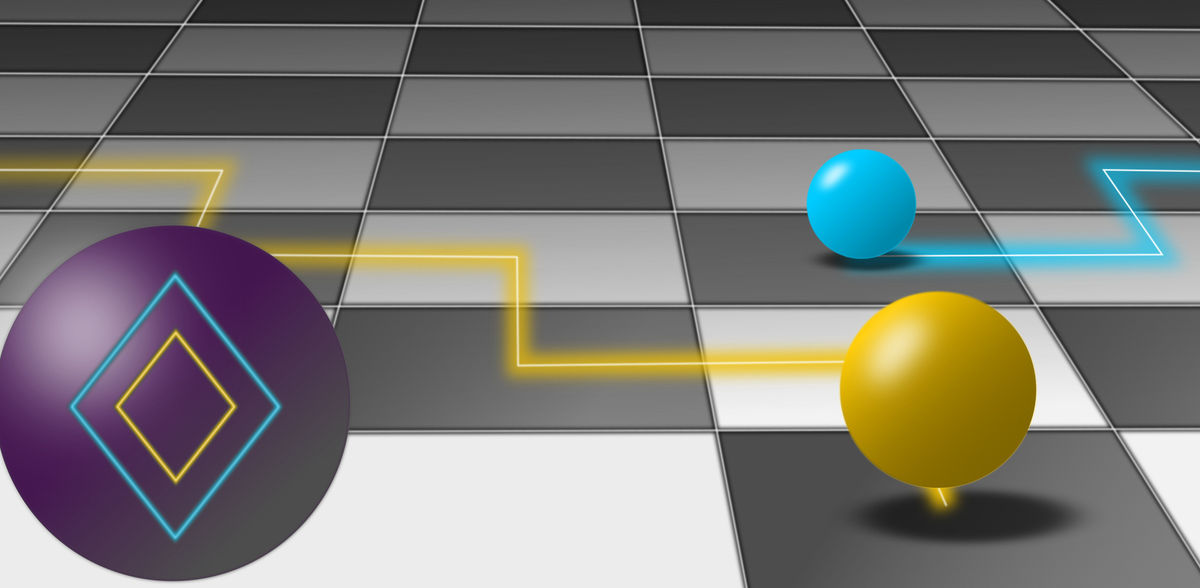
The new method involves positioning microparticles above a magnetic layer which is patterned like a chessboard. In previous studies, magnetic transportation of the colloidal particles was limited to a specific height. At this distance, although the magnetic forces appear to balance each other out, the particles move regardless of their size. Therefore, it was not possible to control the particles specifically based on their size.
When it comes to particles, size matters
The researchers have now overcome this limitation by moving the particles closer to the magnetic layer. This makes the difference in particle size more obvious. “By relaxing the high-elevation constraint, we take advantage of the fact that particles of different sizes experience the magnetic landscape differently” says Dr. Daniel de las Heras, Heisenberg Fellow at the University of Tübingen and corresponding author of the study.
The researchers can control these particles using a uniform external magnetic field and its specific orientation. They create a position- and height-dependent energy landscape for the microparticles. External magnetic field orientations which fundamentally alter the shape of the energy landscape are key. These orientations have diamond-shaped contours.
If the external magnetic field winds around these contours, particles are transported between two cells of the checkerboard pattern. Crucially, the size of these contours changes as the particle size increases. This enables researchers to precisely control particles of different sizes simultaneously and independently of one another. So one loop of the magnetic field may be big enough to encompass the path of a large particle and thus set it in motion, while missing a small particle, which remains stationary.
Particle motion resistant to external disturbances
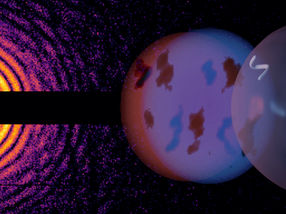
To demonstrate the method’s precision, the researchers guided two particles of different sizes so that they simultaneously traced the letters S and L across the magnetic substrate. This motion is topologically protected, meaning it is robust against external disturbances and imperfections in the pattern. “By stringing these simple circulatory motions together, we can generate arbitrarily complex trajectories for different particles at the same time,” says Sebastian Wohlrab, the study’s first author. This level of programmed control paves the way for new lab-on-a-chip technologies and the automated production of smart materials including nanomaterials such as photonic crystals.
Tübingen University President, Professor Karla Pollmann, welcomed the results of the study and pointed out the high potential of national and international collaboration for technical advances and innovation across many fields.
Original publication
Other news from the department science