The limitations of nontargeted chemical analysis
Computational approach predicts how much of the chemical space can actually be covered
In a recent study published in Analytical Chemistry, researchers from the University of Amsterdam’s Van ’t Hoff Institute for Molecular Sciences (HIMS) reveal a sobering reality regarding "nontargeted" chemical analysis. Although widely used for screening the environment for chemicals, this concept isn't nearly as broad as its name suggests, leaving massive "blind spots" in the data. To quantify these gaps, the team developed a novel computational framework: Measurable Feature Prediction. It helps predict which regions of the vast chemical space are actually measurable — before running real samples.
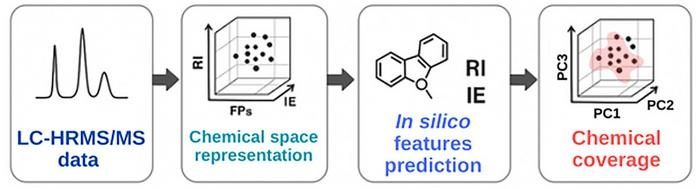
A novel computational framework: Measurable Feature Prediction
HIMS / UvA
While the aim of nontargeted analysis (NTA) is to map the full scope of chemicals that are potentially present in the environment (the chemical space), the Amsterdam research shows that method constraints significantly limit what can actually be measured. The focus of the research was on the gold standard for environmental screening known as LC–ESI–HRMS: Liquid Chromatography–Electrospray Ionisation–High-Resolution Mass Spectrometry. The team shows that physical and chemical constraints of this method, such as ionisation and retention, leave massive "blind spots" in the data. “The numbers were much smaller than we expected”, says Saer Samanipour, head of the research group Environmental Modelling and Computational Mass Spectrometry.
Measurable Feature Prediction
The research was carried out by Samanipour’s co-worker Lapo Renai under a postdoctoral fellowship funded by the EU’s Marie Skłodowska-Curie Actions and supported by the UvA Data Science Centre via its Accelerate program. Based on the analysis of internal standards in LC–ESI–HRMS, he developed a similarity-based modelling approach that combines molecular fingerprints with predicted retention indices and ionisation efficiencies. As a result, an estimate of the method-specific chemical coverage can be made.
This Measurable Feature Prediction establishes which regions of the vast chemical universe are actually visible to a specific instrument - and which will remain invisible - before a single real-world sample is even injected. For LC–ESI–HR, the actual number of chemicals that can be analysed in a single measurement turns out to be less than a few thousand. “This may sound like a lot”, Samanipour says, “but compared to the vast chemical space it is about 0.01%, which is a minute amount.” He advocates the use of so-called orthogonal approaches, applying complementary analytical methods. “We also need to map the blind spots of each method, as those are the real human and environmental health issues of the future.”
To Renai, the main takeaway is that “comprehensive” nontargeted analysis isn’t truly comprehensive. “Chemical-space-aware frameworks such as we present in the paper can help guide smarter method development and reduce method-specific measurability uncertainty in exposomics and environmental screening.”
Original publication
Other news from the department science












Most read news







More news from our other portals



















See the theme worlds for related content
Topic World Mass Spectrometry
Mass spectrometry enables us to detect and identify molecules and reveal their structure. Whether in chemistry, biochemistry or forensics - mass spectrometry opens up unexpected insights into the composition of our world. Immerse yourself in the fascinating world of mass spectrometry!

Topic World Mass Spectrometry
Mass spectrometry enables us to detect and identify molecules and reveal their structure. Whether in chemistry, biochemistry or forensics - mass spectrometry opens up unexpected insights into the composition of our world. Immerse yourself in the fascinating world of mass spectrometry!