A new technique predicts the ripeness of fruit by analyzing leaves
The method analyzes the biochemical changes in the leaves closest to the fruit without damaging it
How can you tell if fruit has reached its optimal ripeness without picking it, touching it or carrying out any test that might damage it? A research team from the Department of Analytical Chemistry and Organic Chemistry at the Universitat Rovira i Virgili (URV) has found the answer by applying near- and mid-infrared spectroscopy to the leaves closest to the fruit. They discovered that the technique allows reliable information to be obtained about the fruit’s developmental state without damaging it.
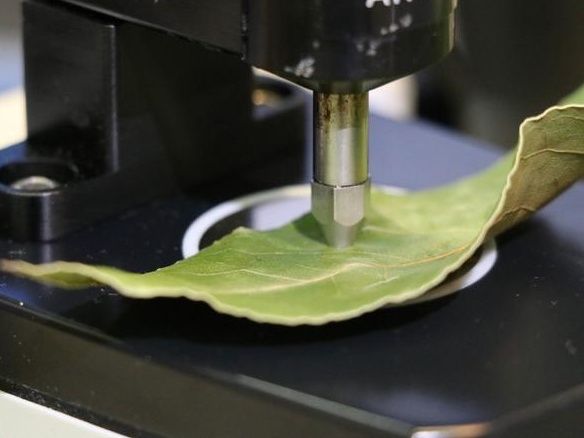
The research team has subjected the leaves near the fruit to the technique of near and mid-infrared spectroscopy.
URV
The study addresses a common challenge in the fruit sector: traditional techniques for assessing fruit quality – such as measuring firmness, sugar content or acidity – require collecting and analysing samples, which means a portion of the crop is destroyed and cannot be sold. Furthermore, spectroscopic techniques applied directly to the fruit can leave marks on its skin. This research team’s proposal focuses a little further away from the fruit by analysing instead the nearby leaves; this enables them to determine the physiological changes that occur as the fruit ripens without having to touch it.
The technique that they used in their research, near- and mid-infrared spectroscopy, directs a beam of light at a sample (in this case, the leaves) and, from the light that is absorbed or reflected, information is obtained about its composition without altering or destroying the sample. “The leaves undergo physiological and biochemical changes as the fruit ripens, due to the direct connection between the metabolism of the leaves and that of the fruit. And these changes are reflected in their spectral fingerprint,” explains Daniel Schorn, a researcher in the ChemoSens research group at URV who took part in this study. By applying this technique weekly to the leaves closest to the fruit, the research team has managed to “read” the fruit’s developmental state without touching it.
Original publication
Other news from the department science






Most read news








More news from our other portals






















See the theme worlds for related content
Topic World Spectroscopy
Investigation with spectroscopy gives us unique insights into the composition and structure of materials. From UV-Vis spectroscopy to infrared and Raman spectroscopy to fluorescence and atomic absorption spectroscopy, spectroscopy offers us a wide range of analytical techniques to precisely characterize substances. Immerse yourself in the fascinating world of spectroscopy!

Topic World Spectroscopy
Investigation with spectroscopy gives us unique insights into the composition and structure of materials. From UV-Vis spectroscopy to infrared and Raman spectroscopy to fluorescence and atomic absorption spectroscopy, spectroscopy offers us a wide range of analytical techniques to precisely characterize substances. Immerse yourself in the fascinating world of spectroscopy!