Researchers develop ultrasmall, light-sensitive nanoparticles that could serve as contrast agents

A novel class of light-sensitive nanoparticles may one day enable new approaches to medical imaging. They were developed by a research team at Martin Luther University Halle-Wittenberg (MLU). The particles absorb laser light and convert them into heat thereby changing their internal structure, similar to folded proteins. The research was published in the journal “Communications Chemistry”.
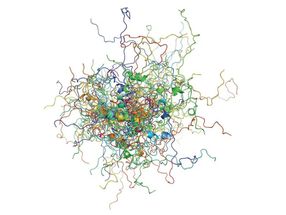
The newly developed particles are known as single-chain nanoparticles (SCNPs) and consist of individually folded polymer chains. The scientists embedded molecules of the substance polypyrrole into these chains, which absorb light in the near-infrared range and convert it into heat. Laser irradiation not only causes the nanoparticles to heat up, they also change their internal structure. “When exposed to light, each individual nanoparticle clumps together to form a spherical structure that is only a few nanometres in diameter. This opens up the possibility of concentrating them in specific areas of the body – precisely where there is light,” says MLU-chemist Professor Wolfgang Binder. He led the study together with Dr Justus Friedrich Thümmler, Professor Karsten Mäder from the Institute of Pharmacy, and Professor Jan Laufer from the Institute of Physics.
SCNPs have a remarkable thermoresponsivity; their structure reacts to changes in temperature. This property is based on the specific molecular design of the particles, which also allows them to convert light into heat very efficiently. Experiments in the lab have shown that even a weak laser beam and relatively few nanoparticles are enough to generate very high local temperatures – up to 85 degrees Celsius.
This effect is important, for example, for imaging techniques used in medical diagnostic testing. The rapid heating of the tissue releases sound waves. These can be measured with photoacoustic imaging techniques, which, in turn, can be used to create 3D models of the inside of the body. The team hopes that the newly developed particles could help study the development of cancer in a few years’ time, for example by using photoacoustic imaging to make tumours and their response to treatment more visible and easier to track.
But the potential goes even further: “In the future, we want to use the nanoparticles to transport an active ingredient into the body in a targeted manner and activate it there using light and heat,” explains Binder. The particles could possibly even be used to kill cancer cells through light-controlled heat, a process known as „hyperthermia“. However, more extensive studies are needed to explore the therapeutic potential of the new particles.
Original publication
Justus Friedrich Thümmler, Farzin Ghane Golmohamadi, Daniel Schöffmann, Jan Laufer, Henrike Lucas, Julia Kollan, Karsten Mäder, Wolfgang Hubertus Binder; "Photo-thermoresponsive polypyrrole-crosslinked single-chain nanoparticles for photothermal therapy"; Communications Chemistry, Volume 8, 2025-4-25

Other news from the department science