Structure of liquid carbon measured for the first time
Research team completes groundbreaking experiment at the European XFEL
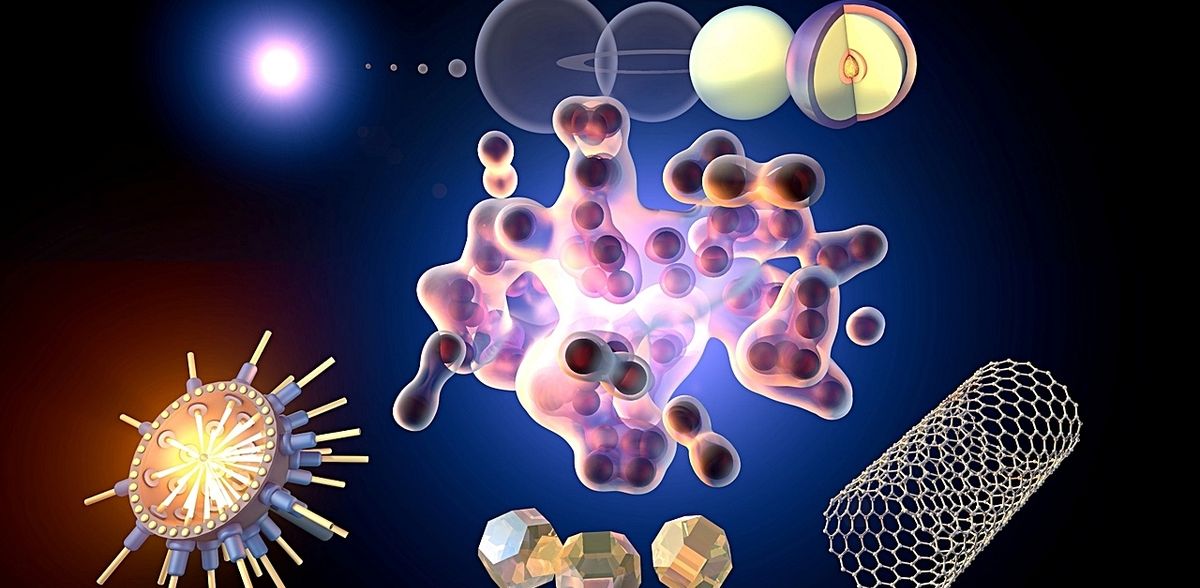
With the declared aim of measuring matter under extreme pressure, an international research collaboration headed by the University of Rostock and the Helmholtz-Zentrum Dresden-Rossendorf (HZDR) used the high-performance laser DIPOLE 100-X at the European XFEL for the first time in 2023. With spectacular results: In this initial experiment they managed to study liquid carbon – an unprecedented achievement as the researchers report in the journal Nature.
Liquid carbon can be found, for example, in the interior of planets and plays an important role in future technologies like nuclear fusion. To date, however, only very little was known about carbon in its liquid form because in this state it was practically impossible to study in the lab: Under normal pressure carbon does not melt but immediately changes into a gaseous state. Only under extreme pressure and at temperatures of approximately 4,500 degrees Celsius – the highest melting point of any material – does carbon become liquid. No container would withstand that.
Laser compression, on the other hand, can turn solid carbon into liquid for fractions of a second. And the challenge was to use these fractions of a second to take measurements. In a previously unimaginable way, this has now become reality at the European XFEL, the world’s largest x-ray laser with its ultrashort pulses, in Schenefeld, near Hamburg.
Unique measuring technology in this combination
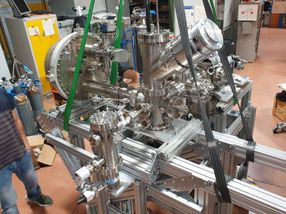
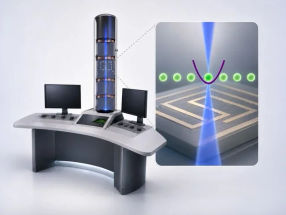
The unique combination of the European XFEL with the high-performance laser DIPOLE100-X was crucial for the success of the experiment. It was developed by the British Science and Technology Facilities Council and made available to scientists from all over the world by the HIBEF User Consortium (Helmholtz International Beamline for Extreme Fields). A community of leading international research institutions at the HED-HIBEF (High Energy Density) experimental station at the European XFEL has now combined powerful laser compression with ultrafast X-ray analysis and large-area X-ray detectors for the first time.
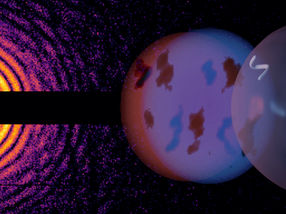
In the experiment, the high-energy pulses of the DIPOLE100-X laser drive compression waves through a solid carbon sample and liquefy the material for nanoseconds, that is, for a billionth of a second. During this nanosecond, the sample is irradiated with the ultrashort x-ray laser flash of the European XFEL. The carbon atoms scatter the x-ray light – similar to the way light is diffracted by a grating. The diffraction pattern allows inferences to be drawn about the current arrangement of the atoms in the liquid carbon.
The whole experiment only lasts a few seconds but is repeated many times: every time with a slightly delayed x-ray pulse or under slightly different pressure and temperature conditions. Many snapshots combine to make a movie. Researchers have thus been able to trace the transition from solid to liquid phase one step at a time.
Water-like structure and accurate melting point determined
The measurements revealed that with four nearest neighbors each, the systemics of liquid carbon are similar to solid diamond. “This is the first time we have ever been able to observe the structure of liquid carbon experimentally. Our experiment confirms the predictions made by sophisticated simulations of liquid carbon. We are looking at a complex form of liquid, comparable to water, that has very special structural properties,” explains the head of the research collaboration’s Carbon Working Group, Prof. Dominik Kraus from the University of Rostock and HZDR.
The researchers also managed to precisely narrow down the melting point. Up to now, the theoretical predictions on the structure and melting point had diverged significantly. But precise knowledge is crucial for planet modelling and certain concepts for power generation through nuclear fusion.
The first DIPOLE experiment at the European XFEL also ushers in a new era in measuring matter under high pressure, as HED group leader, Dr. Ulf Zastrau, emphasizes, “We now have the toolbox to characterize matter under highly exotic conditions in incredible detail.” And the experiment’s potential is far from being exhausted. In the future, results that currently take several hours’ experiment time could be available in a few seconds – as soon as the complex automatic control and data processing work fast enough.
Original publication
D. Kraus, J. Rips, M. Schörner, M. G. Stevenson, J. Vorberger, D. Ranjan, J. Lütgert, B. Heuser, J. H. Eggert, H.-P. Liermann, I. I. Oleynik, S. Pandolfi, R. Redmer, A. Sollier, C. Strohm, T. J. Volz, B. Albertazzi, S. J. Ali, L. Antonelli, C. Bähtz, O. B. Ball, S. Banerjee, A. B. Belonoshko, C. A. Bolme, V. Bouffetier, ... J. T. Willman, L. Wollenweber, U. Zastrau, E. Brambrink, K. Appel, M. I. McMahon; "The structure of liquid carbon elucidated by in situ X-ray diffraction"; Nature, 2025-5-21
Other news from the department science