‘Strange metal’ is strangely quiet in noise experiment
True to form, a “strange metal” quantum material proved strangely quiet in recent quantum noise experiments at Rice University. The measurements of quantum charge fluctuations known as “shot noise” provide the first direct evidence that electricity seems to flow through strange metals in an unusual liquidlike form that cannot be readily explained in terms of quantized packets of charge known as quasiparticles.
“The noise is greatly suppressed compared to ordinary wires,” said Rice’s Douglas Natelson, the study’s corresponding author. “Maybe this is evidence that quasiparticles are not well-defined things or that they’re just not there and charge moves in more complicated ways. We have to find the right vocabulary to talk about how charge can move collectively.”
The experiments were performed on nanoscale wires of a quantum critical material with a precise 1-2-2 ratio of ytterbium, rhodium and silicon (YbRh2Si2), which has been studied in great depth during the past two decades by Silke Paschen, a solid-state physicist at the Vienna University of Technology (TU Wien). The material contains a high degree of quantum entanglement that produces a very unusual (“strange”) temperature-dependent behavior that is very different from the one in normal metals such as silver or gold.
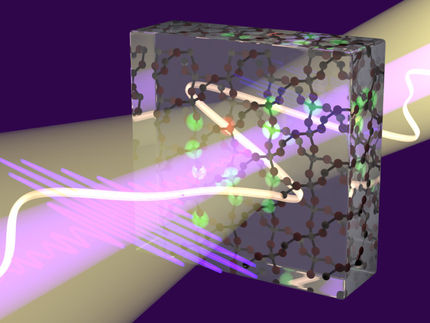
In such normal metals, each quasiparticle, or discrete unit, of charge is the product of incalculable tiny interactions between countless electrons. First put forward 67 years ago, the quasiparticle is a concept physicists use to represent the combined effect of those interactions as a single quantum object for the purposes of quantum mechanical calculations.
Some prior theoretical studies have suggested that the charge in a strange metal might not be carried by such quasiparticles, and shot noise experiments allowed Natelson, study lead author Liyang Chen, a former student in Natelson’s lab, and other Rice and TU Wien co-authors to gather the first direct empirical evidence to test the idea.
“The shot noise measurement is basically a way of seeing how granular the charge is as it goes through something,” Natelson said. “The idea is that if I’m driving a current, it consists of a bunch of discrete charge carriers. Those arrive at an average rate, but sometimes they happen to be closer together in time, and sometimes they’re farther apart.”
Applying the technique in YbRh2Si2 crystals presented significant technical challenges. Shot noise experiments cannot be performed on single macroscopic crystals but, rather, require samples of nanoscopic dimensions. Thus, the growth of extremely thin but nevertheless perfectly crystalline films had to be achieved, something that Paschen, Maxwell Andrews and their collaborators at TU Wien managed after almost a decade of hard work. Next, Chen had to find a way to maintain that level of perfection while fashioning wires from these thin films that were about 5,000 times narrower than a human hair.
Rice co-author Qimiao Si, the lead theorist on the study and the Harry C. and Olga K. Wiess Professor of Physics and Astronomy, said he, Natelson and Paschen first discussed the idea for the experiments while Paschen was a visiting scholar at Rice in 2016. Si said the results are consistent with a theory of quantum criticality he published in 2001 that he has continued to explore in a nearly two-decade collaboration with Paschen.
“The low shot noise brought about fresh new insights into how the charge-current carriers entwine with the other agents of the quantum criticality that underlies the strange metallicity,” said Si, whose group performed calculations that ruled out the quasiparticle picture. “In this theory of quantum criticality, the electrons are pushed to the verge of localization, and the quasiparticles are lost everywhere on the Fermi surface.”
Natelson said the larger question is whether similar behavior might arise in any or all of the dozens of other compounds that exhibit strange metal behavior.
“Sometimes you kind of feel like nature is telling you something,” Natelson said. “This ‘strange metallicity’ shows up in many different physical systems, despite the fact that the microscopic, underlying physics is very different. In copper-oxide superconductors, for example, the microscopic physics is very, very different than in the heavy-fermion system we’re looking at. They all seem to have this linear-in-temperature resistivity that’s characteristic of strange metals, and you have to wonder is there something generic going on that is independent of whatever the microscopic building blocks are inside them.”
Original publication
Other news from the department science