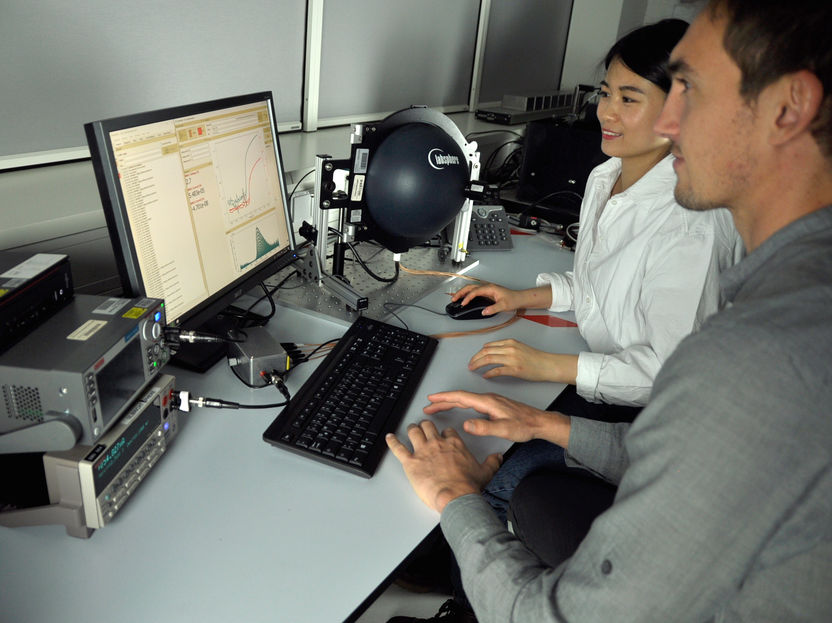
Researchers from Poland, France and Italy are honored for their work in cell biology, biomineralization and photonics
WITec Paper Award 2023 Recognizes Outstanding Publications

The WITec Paper Awards 2023 have been presented to scientists from Poland, France and Italy for their work in cell biology, biomineralization and the development of photonic devices, respectively. The competition recognizes three scientific publications per year that contain results acquired with a WITec microscope and the jury has again chosen their favorites from among more than 100 submissions. WITec congratulates the winners and thanks all the participants for sending in their fascinating work.

Aïcha Badou (middle), PhD Engineer from the Muséum National d’Histoire Naturelle (MNHN), Direction Générale Déléguée à la Recherche, à l'Expertise, à la Valorisation et à l'Enseignement (DGD-REVE), Station marine de Concarneau, and Jean-François Bardeau (right), CNRS Director of Research at the Institut des Molécules et Matériaux du Mans (IMMM, UMR CNRS no. 6283), Le Mans Université, receive the WITec Paper Award Silver certificate from Maxime Tchaya, WITec Directeur France and Manager Poland (left).
WITec

The WITec Paper Award Bronze winners receive the certificate. From left to right: I Komang Januariyasa, Francesco Reda and Stefano Oscurato from University of Naples Federico II, Italy; WITec representative Diego Vitaglione (Managing Director at Quantum Design Italy); Pasqualino Maddalena, Marcella Salvatore and Fabio Borbone from University of Naples Federico II, Italy.
WITec


- GOLD: Ewa Stanek, Marta Z. Pacia, Agnieszka Kaczor, Krzysztof Czamara (2022) The distinct phenotype of primary adipocytes and adipocytes derived from stem cells of white adipose tissue as assessed by Raman and fluorescence imaging. Cellular and Molecular Life Sciences 79: 383.
- SILVER: Aïcha Badou, Sylvain Pont, Stéphanie Auzoux-Bordenave, Morgane Lebreton, Jean-François Bardeau (2022) New insight on spatial localization and microstructures of calcite-aragonite interfaces in adult shell of Haliotis tuberculata: Investigations of wild and farmed abalones by FTIR and Raman mapping. Journal of Structural Biology 214: 107854.
- BRONZE: Stefano L. Oscurato, Francesco Reda, Marcella Salvatore, Fabio Borbone, Pasqualino Maddalena, Antonio Ambrosio (2022) Shapeshifting diffractive optical devices. Laser & Photonics Reviews 16: 2100514.
The Paper Award GOLD: Characterization of cell development
As the world-wide incidence of obesity-related health issues increases, adipose tissue is of growing interest to researchers. In vitro investigations of biochemical processes require model cell lines that resemble the in vivo state as closely as possible and different protocols exist for obtaining model adipocytes from stem cells. Ewa Stanek and her colleagues Marta Z. Pacia, Agnieszka Kaczor and Krzysztof Czamara from the Jagiellonian Centre for Experimental Therapeutics and the Faculty of Chemistry of the Jagiellonian University (Kraków, Poland) win the Gold Paper Award 2023 for comparing primary and stem cell-derived adipocytes. The authors used Raman and fluorescence imaging for characterizing the maturation of adipocytes from brown and white adipose tissue. 2D and 3D Raman microscopy visualized changes in cell morphology and the distribution of lipids, DNA, and proteins that occur during adipogenesis. The formation of lipid droplets was observed and Raman spectral analysis enabled the quantification of lipid unsaturation levels. Comparing the results revealed no difference between stem cell-derived adipocytes from different tissue types. However, differences in chemical composition were found for primary adipocytes and those derived from stem cells. “Our study reveals limitations of existing model systems and that the chosen protocols can impact the experimental results,” observed Ewa Stanek. “These findings are relevant for metabolic studies and applications of tissue engineering.”
The Paper Award SILVER: Biomineralization of abalone shells
New materials for technological applications are often inspired by nature and researchers thus strive to understand how biomaterials are produced. The Silver Paper Award 2023 honors a study that investigates the biomineralization process of abalone shells, which was published by Aïcha Badou, PhD Engineer from the Muséum National d’Histoire Naturelle (MNHN, Station marine de Concarneau-DGD-REVE), and her colleagues Sylvain Pont, Stéphanie Auzoux-Bordenave, Morgane Lebreton and Jean-François Bardeau from the MNHN and Le Mans Université in France. The authors investigated the spatial distribution of the calcium carbonate (CaCO3) polymorphs aragonite and calcite in abalone shells with Raman imaging and Fourier-transform infrared spectroscopy (FTIR). Detailed analysis of the Raman spectra distinguished zones of differing degrees of order within areas of the same polymorph. Additionally, scanning electron microscopy (SEM) analyzed the shells’ microstructure and energy-dispersive X-ray spectroscopy (EDS) detected trace elements in the different zones. Based on their results, the authors proposed a model for microstructure and layer composition in relation to the direction of shell growth in thickness and length. “Our model explains different observations regarding shell structure reported in the past. The findings highlight the need for accurate sample documentation in order to ensure comparability,” said Dr. Badou. Future studies will investigate the influence of environmental factors on the growth patterns.
The Paper Award BRONZE: Development of shapeshifting planar optical elements
From microbiology to astronomy, imaging systems are important tools in various fields of research. Depending on their intended application, they contain different optical elements for structuring and manipulating light. Stefano L. Oscurato from the University of Naples, Italy, wins the Bronze Paper Award 2023 for his work on shapeshifting optical devices together with his colleagues Francesco Reda, Marcella Salvatore, Fabio Borbone, Pasqualino Maddalena and Antonio Ambrosio. The authors created planar diffractive optical elements, such as lenses and gratings, using a photoresponsive polymer that can be shaped into a desired morphology by incident light. The morphology defines the devices’ optical properties and was verified by atomic force and scanning electron microscopy. A custom-built holographic setup was able to shape the polymer surface, and visualize the resulting diffraction properties in real-time. The same polymer surface can be reshaped repeatedly while remaining in the beam path. “There are many applications that can profit from the ability to change imaging parameters without physically exchanging or moving optical elements,” commented Dr. Oscurato. Examples described in the paper include: gratings with variable diffraction properties, and a diffractive lens with an adjustable focal length that could serve to alter the magnification of a microscope.
Original publication
Ewa Stanek, Marta Z. Pacia, Agnieszka Kaczor, Krzysztof Czamara (2022) The distinct phenotype of primary adipocytes and adipocytes derived from stem cells of white adipose tissue as assessed by Raman and fluorescence imaging. Cellular and Molecular Life Sciences 79: 383.
Aïcha Badou, Sylvain Pont, Stéphanie Auzoux-Bordenave, Morgane Lebreton, Jean-François Bardeau (2022) New insight on spatial localization and microstructures of calcite-aragonite interfaces in adult shell of Haliotis tuberculata: Investigations of wild and farmed abalones by FTIR and Raman mapping. Journal of Structural Biology 214: 107854.
Stefano L. Oscurato, Francesco Reda, Marcella Salvatore, Fabio Borbone, Pasqualino Maddalena, Antonio Ambrosio (2022) Shapeshifting diffractive optical devices. Laser & Photonics Reviews 16: 2100514.

Other news from the department science













These products might interest you

Most read news






More news from our other portals



























See the theme worlds for related content
Topic World Spectroscopy
Investigation with spectroscopy gives us unique insights into the composition and structure of materials. From UV-Vis spectroscopy to infrared and Raman spectroscopy to fluorescence and atomic absorption spectroscopy, spectroscopy offers us a wide range of analytical techniques to precisely characterize substances. Immerse yourself in the fascinating world of spectroscopy!

Topic World Spectroscopy
Investigation with spectroscopy gives us unique insights into the composition and structure of materials. From UV-Vis spectroscopy to infrared and Raman spectroscopy to fluorescence and atomic absorption spectroscopy, spectroscopy offers us a wide range of analytical techniques to precisely characterize substances. Immerse yourself in the fascinating world of spectroscopy!
Topic world Fluorescence microscopy
Fluorescence microscopy has revolutionized life sciences, biotechnology and pharmaceuticals. With its ability to visualize specific molecules and structures in cells and tissues through fluorescent markers, it offers unique insights at the molecular and cellular level. With its high sensitivity and resolution, fluorescence microscopy facilitates the understanding of complex biological processes and drives innovation in therapy and diagnostics.

Topic world Fluorescence microscopy
Fluorescence microscopy has revolutionized life sciences, biotechnology and pharmaceuticals. With its ability to visualize specific molecules and structures in cells and tissues through fluorescent markers, it offers unique insights at the molecular and cellular level. With its high sensitivity and resolution, fluorescence microscopy facilitates the understanding of complex biological processes and drives innovation in therapy and diagnostics.
Last viewed contents
The CEO of Wyatt Technology receives 2009 American Physical Society Prize for Industrial Application of Physics
Philips and BG Medicine partner in molecular medicine for early detection and monitoring of diseases
Epigenomics: Licensee ARUP Laboratories Launches Septin9 Colorectal Cancer Blood Test in the United States
Novel German Research Alliance to Detect Precursors of Colorectal Cancer - Munich Technical University, Epigenomics AG and KVB to develop novel approaches to cancer prevention
Tecan appoints Martin Brusdeilins as Chief Scientific Officer and Member of the Group Management Board
Midatech Group announces the opening of cGMP standard facility for the production of nanoparticles
European Mass Spectrometry Award : Shimadzu awarded for Exceptional Product Line Strategy
Galapagos wins 2011 Scrip Award for Biotech Company of the Year
25 Leading Healthcare Institutions and Clinical Laboratories to Evaluate tm Bioscience's Test for Respiratory Viruses - Early Access Program to test unique product that can identify 20 respiratory viruses
Symyx Named Top 10 Life Science Software Vendor by IDC's Health Industry Insights
New Analytica Research Prize from Roche and the GBM Strengthens Research in Germany