New technology detects bacteria on surfaces in five minutes using a smartphone
UMass spun off HertZ Innovation launches smartphone-based bacterial test
A smartphone-based technology to detect bacteria contamination, developed by food scientists at the University of Massachusetts Amherst, sets a new benchmark in efforts to quickly and reliably understand how clean a surface is in places such as food processing plants, hospitals, gyms and other public environments.
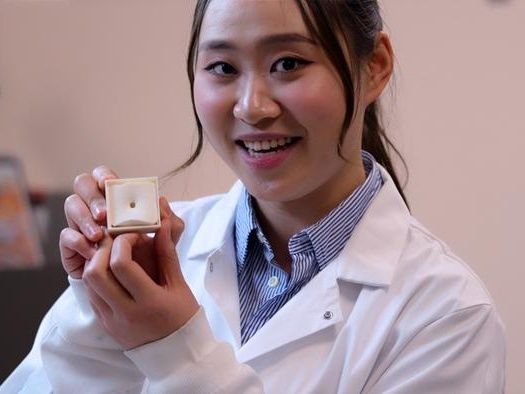
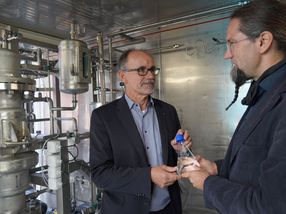
Yuzhen Zhang and the chemically coated chip that is at the heart of BactiSee.
UMass Amherst
The technology, called BactiSee and based on well over a decade of research, has been spun off into a company called HertZ Innovation, Inc., which is seeking to bring it to market to help meet the need for controlling the transmission of bacterial risks.
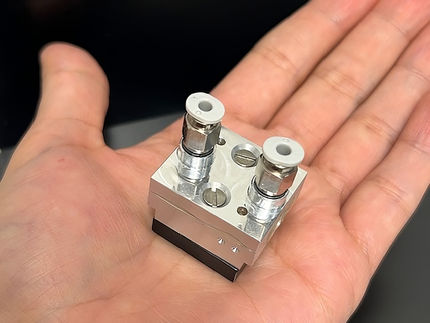
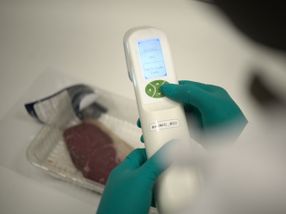
“BactiSee looks like a COVID test crossed with a smartphone,” says Yuzhen Zhang, a postdoctoral researcher at UMass Amherst whose work helped transform the research conducted with her advisor and now business partner, Lili He, professor and head of the Food Science Department at UMass Amherst, into a marketable technology.
Currently, the most reliable way to measure bacterial contamination on surfaces is through swab-and-culture testing in a laboratory—a process that can take one to two days, making it impractical for routine, on-site decision-making.
A faster alternative, ATP monitoring, can deliver results in seconds. However, it measures overall organic residue rather than bacteria specifically, which can lead to inconsistent or misleading assessments of cleanliness.
“BactiSee provides a direct and reliable measurement of bacterial contamination, with results available in about five minutes,” Zhang explains. “This rapid, on-site microbial risk check gives users greater confidence in surface cleanliness, supports more effective sanitization decisions and helps reduce preventable cross-contamination.”
The heart of the technology is a chemical coating that one of He’s lab members accidentally discovered. “We were awarded a research grant to develop a complex system that would allow us to detect bacteria,” says He, “and the coating was supposed to be just one step in the process.” But the student discovered that the coating itself allowed the researchers to see the single bacterial cells without all the other complicated intervening steps. The coating also enables bacterial-specific capture, which minimizes interference from food residues and sanitizers that plagues the ATP method. The technology is protected by multiple patents, with additional intellectual property and trademark protection secured for BactiSee.
Zhang and He partnered with UMass Amherst’s Dining Commons, Environmental Health and Safety and University Health Services to evaluate BactiSee’s real-world performance at 29 different spots in seven different locations across campus.
After one collects a sample, BactiSee provides a visual image of single-cell-level bacteria on the coated substrate, a quantitative cell count, and a simple readout assessment. In these field tests, the system demonstrated strong agreement with traditional culture-based methods while delivering results in a fraction of the time.
“We believe this collaboration is a strong example of how the UMass ecosystem supports UMass-developed technologies by helping bridge the gap between laboratory innovation and real-world impact,” say Zhang and He. “Ultimately, by working across campus our research can help further the common good by giving inspectors the tools they need to protect public health.”
The development and advancement of BactiSee has been supported in part by UMass Amherst’s Institute for Applied Life Sciences which has played a critical role in enabling the transition from foundational research to real-world validation and early commercialization.
The BactiSee team is currently working with a select group of early adopters and is looking to expand these collaborations while also seeking strategic partners and investors to support bringing the technology to market.
Other news from the department science











Most read news






More news from our other portals





















Something is happening in the life science industry ...
This is what true pioneering spirit looks like: Plenty of innovative start-ups are bringing fresh ideas, lifeblood and entrepreneurial spirit to change tomorrow's world for the better. Immerse yourself in the world of these young companies and take the opportunity to get in touch with the founders.