The World’s Smallest Impedance Spectroscopy System in the Form of a Pill Finds Weak Spots in Machines and People
Small as a candy: Waterproof IoT sensor reliably measures the properties of liquids even in hard-to-reach places
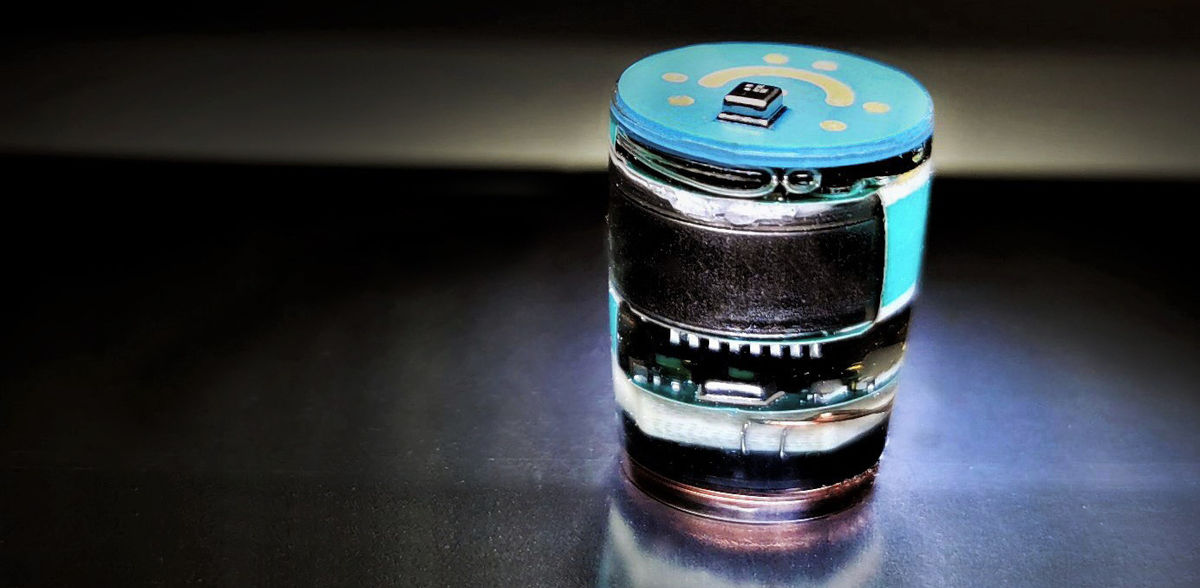
Imagine a scenario where you simply just throw in a pill to identify an error—this is now one step closer to reality thanks to the work done by researchers at Fraunhofer IZM in cooperation with Micro Systems Technologies (MST) and Sensry GmbH. As small as a piece of candy, the waterproof IoT sensor can reliably measure the properties of liquids even in hard-to-reach places. This can make the maintenance of industrial machines much easier and even help to identify diseases.
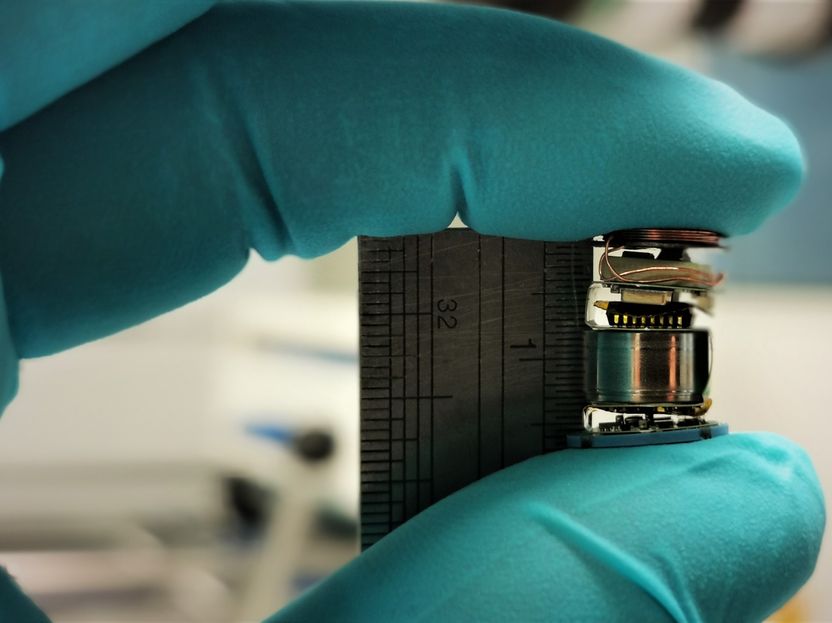
The core of the spectroscopy capsule contains the system-in-package, a flexible circuit board, and a ceramic pcb
© Fraunhofer IZM
The larger an industrial machine, the more difficult it is to troubleshoot malfunctions by detecting unwanted oil pressure deviations or even line leaks from the outside. It often takes a long time for specialist staff to find what seems to be the equivalent of a needle in a haystack. This can lead to production losses and high costs. The situation is similar with the identification of disease causes in humans. If a patient complains about abdominal pain, there is usually no way around a complex gastroscopy or colonoscopy. Electrochemical impedance spectroscopy can be very helpful in such cases.
In this process, radio waves are sent through a medium from one electrode to a second electrode in order to derive the frequency spectrum (i.e., the specific fingerprint) of the medium. If any changes in the properties of a material or a liquid are identified, this can indicate the fast-progressing corrosion of a component or the presence of a specific clinical picture. Previously, impedance analyzers were not small and portable enough to be used for this purpose. With these applications in mind, researchers at the Fraunhofer Institute for Reliability and Microintegration IZM in Berlin, with support from MST and Sensry, worked to develop a compact and modular IoT sensor that can measure impedances and transmit them wirelessly. As a result, the sensor is not only waterproof but also biomedically compatible.
The sensor consists of a biocompatible polymer, and despite its small surface area of just 11 × 16 square millimeters, it accommodates the two necessary electrodes, as well as numerous components for the analysis of environmental properties, including six sensors for measuring a wide variety of data parameters. In addition to environmental temperature, pressure, humidity, and sound, this small but extremely versatile device can also keep track of its own acceleration behavior, as well as rotation and ambient noise. Light and color properties can be detected via an integrated light sensor.
In a more concrete scenario, if a machine malfunction occurs, the sensor can be inserted into an oil line, for example, so that it flows through the entire system. Precise data on the properties of the environment is transmitted wirelessly in real time to a custom-made software with a web interface for PCs and smartphones. If the sensor reaches a point where the pressure or the liquid spectrum deviates from the requirements, this is an indication that the cause of the problem has been successfully localized. To make it easier for users to analyze the collected data, the frequency spectra of certain liquids, such as oil and water, are already included in the software.
The main challenge encountered during the manufacturing of the sensor was the miniaturization of the components. In particular, reducing the diameter of the coil for wireless charging to 10 millimeters proved to be a significant obstacle. However, a sophisticated system design made it possible to overcome this challenge. At the beginning of the project, Sensry GmbH provided their circuit diagrams and the firmware Kalisto as the basis for developing the sensor.
In order to ensure that a total of over 70 passive and active components could be fitted on a flexible and biocompatible printed circuit board, the circuit board was designed using a liquid crystal polymer and manufactured in four layers by DYCONEX, an MST company. Despite its multilayered design, the circuit board’s thickness is a mere 175 micrometers, which makes it about as thick as a human hair. A system-in-package was fabricated on a six-layer interposer and constitutes the core of the sensor, as this is where the IoT system is integrated. Thanks to a built-in induction coil, the device can be charged wirelessly using Qi technology without ever opening the capsule. However, classic DC charging is also possible via a docking station that is used for calibrating and programming the sensor. In order to prevent overheating of the components during operation, the sensor is filled with an epoxy resin that insulates the components from each other and dissipates heat to the outside. At the bottom, the sensor features a 0.5 millimeter thin four-layer ceramic board manufactured by Micro Systems Engineering GmbH, an MST company, which accommodates the electrodes for impedance spectroscopy as well as the pressure sensor. As a trade fair demonstration unit, the IoT sensor showcases how intelligent system design and semiconductor packaging can be used to greatly miniaturize electronics without sacrificing any functionality.
Research into electrochemical impedance spectroscopy is well underway, and the possibilities for medical technology are far from exhausted. The project has been running since April 1, 2021.
Other news from the department science














These products might interest you



Most read news








More news from our other portals

























See the theme worlds for related content
Topic world Diagnostics
Diagnostics is at the heart of modern medicine and forms a crucial interface between research and patient care in the biotech and pharmaceutical industries. It not only enables early detection and monitoring of disease, but also plays a central role in individualized medicine by enabling targeted therapies based on an individual's genetic and molecular signature.

Topic world Diagnostics
Diagnostics is at the heart of modern medicine and forms a crucial interface between research and patient care in the biotech and pharmaceutical industries. It not only enables early detection and monitoring of disease, but also plays a central role in individualized medicine by enabling targeted therapies based on an individual's genetic and molecular signature.
Topic World Spectroscopy
Investigation with spectroscopy gives us unique insights into the composition and structure of materials. From UV-Vis spectroscopy to infrared and Raman spectroscopy to fluorescence and atomic absorption spectroscopy, spectroscopy offers us a wide range of analytical techniques to precisely characterize substances. Immerse yourself in the fascinating world of spectroscopy!

Topic World Spectroscopy
Investigation with spectroscopy gives us unique insights into the composition and structure of materials. From UV-Vis spectroscopy to infrared and Raman spectroscopy to fluorescence and atomic absorption spectroscopy, spectroscopy offers us a wide range of analytical techniques to precisely characterize substances. Immerse yourself in the fascinating world of spectroscopy!