A Close Look at Lithium Batteries
Fluorescence probe shows the distribution of active lithium species on lithium metal anodes
batteries with metallic lithium anodes offer enhanced efficiency compared to conventional lithium-ion batteries because of their higher capacity. However, safety concerns and a short lifespan stand in the way. To better analyze the causes of malfunctions and premature failure of such batteries, researchers have developed a technique that visualizes the distribution of active lithium on the anode and differentiates between dendrites and “dead” lithium. As reported in the journal Angewandte Chemie, the technique makes use of a fluorescent dye.
© Wiley-VCH
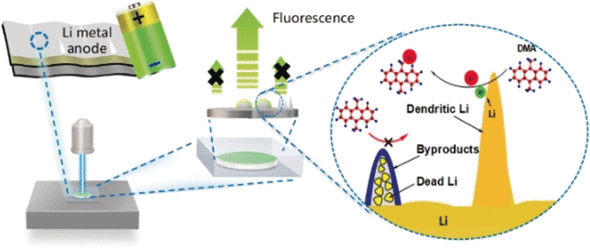
As a lithium anode battery discharges, the anode releases electrons to the circuit and positively charged lithium ions to the electrolyte. As the battery is recharged, this process is reversed, depositing lithium back onto the anode. Unfortunately, deposition is not uniform and can lead to the formation of branched structures known as dendrites, which can become so large that they cause a short circuit. In addition, their higher surface area increases undesired side reactions between lithium and the components of the electrolyte, which deactivates the lithium. In the end, some dendrites consist entirely of this “dead” lithium. Although both dendrites and dead lithium impede the power of the battery, they each have a completely different effect on the anode. Because the morphology is the same in both cases, it has not previously been possible to differentiate between them with conventional microscopy techniques.
To better understand the undesirable processes that occur at lithium anodes, researchers working with Shougang Chen, Shanmu Dong, and Guanglei Cui at the Chinese Academy of Sciences and the Ocean University of China in Qingdao (China), have now developed a novel technique that allows them to analyze the distribution of active lithium species on the surface of the anode and to differentiate between lithium dendrites and side products.
The surfaces of used lithium anodes are coated with a fluorescent dye called 9,10-dimethylanthracene (DMA). Lithium reacts with DMA, quenching its fluorescence. Areas with active lithium therefore appear dark, while areas with inactive lithium species continue to fluoresce. The morphology of the anode is not affected.
For lithium metal batteries to be used safely, it is very important to identify the causes of potentially dangerous malfunctions. With this new method, it is possible to detect dendrites that have led to the failure of a lithium battery. In the development of new batteries, this technique also aids the search for better electrolytes and provides predictions regarding the irregular deposition of lithium. Identifying the locations where lithium dendrites form preferentially may help to optimize the structure of new batteries.
Original publication

Other news from the department science