Enduring cold temperatures alters fat cell epigenetics
A new study in fat cells has revealed a molecular mechanism that controls how lifestyle choices and the external environment affect gene expression. This mechanism includes potential targets for next-generation drug discovery efforts to treat metabolic diseases including diabetes and obesity.
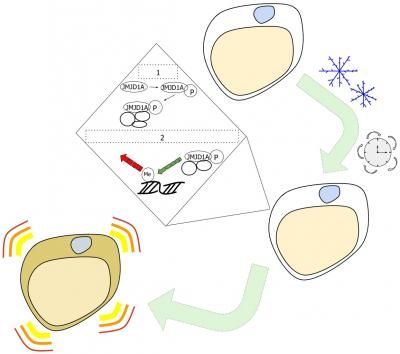
Researchers hope to use this signaling pathway to find treatments for diseases such as diabetes and obesity. Environmental signals can change the epigenetic code of white fat cells in a two-step process. Long-term exposure to cold initiates a change in one protein, JMJD1A. The altered JMJD1A then combines with other protein partners to change the epigenetic code on a gene involved in heat production. White fat cells that have undergone this epigenetic change are called beige fat cells and can contribute to keeping the body warm.
The University of Tokyo
Researchers tracked how the epigenome changes after long-term exposure to cold temperatures, and how those changes cause energy-storing white fat cells to become heat-producing brown-like, or "beige," fat cells.
"We believe that this is the first time that anyone has collected data to prove that there are two steps between the environmental stimuli and epigenetic changes," said Professor Juro Sakai from the University of Tokyo and Tohoku University, an expert in the epigenetics of metabolism.
Gene expression is regulated by epigenetics - patterns of chemical signals that are "above" the gene sequence. An individual's gene sequence is determined at conception, but the external environment and an individual's lifestyle can change the epigenetic sequence throughout a lifetime, continually altering how genes are expressed. The scientific community has long suspected that there may be a stepwise process inside the cell to manage environmental influences on the epigenome, but no specific molecular mechanisms had been identified previously.
Shivering creates body heat short-term by warming up the muscles, but thermogenesis is the chemical process by which brown fat cells can use lipids (fat) to create heat to keep the body warm long-term. Brown fat is regarded as healthier and is not associated with the metabolic diseases linked to excess white fat.
When organisms are cold for a long time, the sympathetic nervous system responds by releasing adrenaline. If cold temperatures persist, those adrenaline signals eventually reach white fat cells. Step one of the environmental epigenetic control pathway is that the cell initiates a specific change to one amino acid in a protein named JMJD1A and this altered JMJD1A recruits other proteins. In step two, this JMJD1A protein complex is recruited to genes that initiate thermogenesis and changes their epigenetic pattern so that they are active. Those epigenetic changes transform white fat cells into what researchers refer to as "beige fat cells," which perform thermogenesis like brown fat cells.
More beige fat cells and fewer white fat cells could reduce the symptoms or negative health outcomes of metabolic diseases like diabetes, obesity. Although transforming white fat cells into beige fat cells and increasing thermogenesis is naturally a stress response to chronic cold exposure involving adrenaline, researchers report that the same white-to-beige fat cell transition can be caused without adrenaline or cold stress.
"Understanding how the environment influences metabolism is scientifically, pharmacologically, and medically interesting. Our next experiments will look more closely at epigenetic modifications within the thermogenesis signaling pathway so that we may manipulate it," said Sakai.
Current drugs for metabolic diseases rely on hormones that are systemic throughout the entire body or drugs that target entire proteins. Sakai's research team imagines a future where metabolic diseases can be treated by targeting single amino acids.
The JMJD1A protein is involved in a wide variety of other processes, including cancer, infertility, stem cell renewal, and sex determination of an embryo. However, Sakai's research team has discovered sites within the protein sequence that are extremely specific for controlling different activities of the protein. Manipulating those specific amino acids may provide precision drug targets.
The published study included research using mice and mouse cells. Chronic cold exposure in humans can include living in places that are often below 4°C. In addition to living in cold environments, brown fat thermogenesis is essential for newborn infants anywhere in the world as they acclimatize from the 37°C temperature in the uterus to common room temperature of approximately 23°C.
Original publication
Yohei Abe, Yosuke Fujiwara, Hiroki Takahashi, Yoshihiro Matsumura, Tomonobu Sawada, Shuying Jiang, Ryo Nakaki, Aoi Uchida, Noriko Nagao, Makoto Naito, Shingo Kajimura, Hiroshi Kimura, Timothy F. Osborne, Hiroyuki Aburatani, Tatsuhiko Kodama, Takeshi Inagaki & Juro Sakai; "Histone demethylase JMJD1A coordinates acute and chronic adaptation to cold stress via thermogenic phospho-switch"; Nature Comm.; 2018
Other news from the department science