New technology detects chemical weapons in seconds
EPSRC-funded research develops advanced sensors for detection of chemicals and illegal drugs
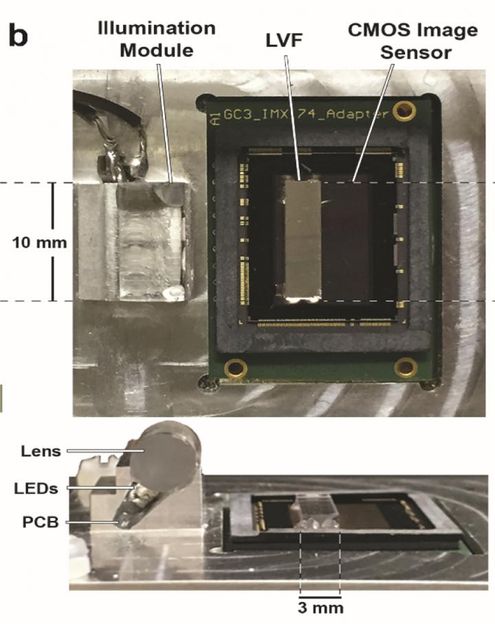
Scientists at Queen's University Belfast are developing new sensors to detect chemical agents and illegal drugs which will help in the fight against the threat of terrorist attacks. The devices will use special gel pads to 'swipe' an individual or crime scene to gather a sample which is then analysed by a scanning instrument that can detect the presence of chemicals within seconds. This will allow better, faster decisions to be made in response to terrorist threats.
The scanning instrument will use Raman Spectroscopy which involves shining a laser beam onto the suspected sample and measuring the energy of light that scatters from it to determine what chemical compound is present. It is so sophisticated it can measure particles of a miniscule scale making detection faster and more accurate. Normally this type of spectroscopy is not sensitive enough to detect low concentrations of chemicals, so here the sample is mixed with nanoscale silver particles which amplify the signals of compounds allowing even the smallest trace to be detected.
Dr Steven Bell from Queen's University Belfast who is leading the research said: "Although we are still in the middle of the project we have finished much of the preliminary work and are now at the exciting stage where we put the various strands together to produce the integrated sensor device. For the future, we hope to be able to capitalise on this research and expand the range of chemicals and drugs which these sensors are able to detect."
It is hoped the new sensors will also be the basis for developing 'breathalyzer' instruments that could be of particular use for roadside drugs testing in much the same way as the police take breathalyzer samples to detect alcohol.
To ensure the technology is relevant, senior staff members from FSNI (Forensic Science Northern Ireland) will give significant input into the operational aspects of the technology and give feedback as to how it might be used in practice by the wider user community."
Other news from the department science













Most read news








More news from our other portals
























See the theme worlds for related content
Topic World Spectroscopy
Investigation with spectroscopy gives us unique insights into the composition and structure of materials. From UV-Vis spectroscopy to infrared and Raman spectroscopy to fluorescence and atomic absorption spectroscopy, spectroscopy offers us a wide range of analytical techniques to precisely characterize substances. Immerse yourself in the fascinating world of spectroscopy!

Topic World Spectroscopy
Investigation with spectroscopy gives us unique insights into the composition and structure of materials. From UV-Vis spectroscopy to infrared and Raman spectroscopy to fluorescence and atomic absorption spectroscopy, spectroscopy offers us a wide range of analytical techniques to precisely characterize substances. Immerse yourself in the fascinating world of spectroscopy!