Faster, sharper, easier imaging with “self-blinking dyes”
Research team develops new approach for using nanobodies in super-resolution microscopy
Nanobodies are extremely small antibody fragments which bind to specific molecules. When nanobodies are labelled with dyes, they can be used as probes to enhance super-resolution microscopy. However, conventional blinking dyes often perform poorly when attached to nanobodies, limiting their practical advantages. An international research team led by the University of Göttingen and the University Medical Center Göttingen (UMG) has now shown that self-blinking dyes – which can switch between bright and dark states on their own – bypass this limitation. The new approach combines the high labelling accuracy of nanobodies with robust and straightforward imaging of self-blinking dyes – simplifying experiments, improving reproducibility and high-throughput of super-resolution microscopy. The results were published in Nano Letters.
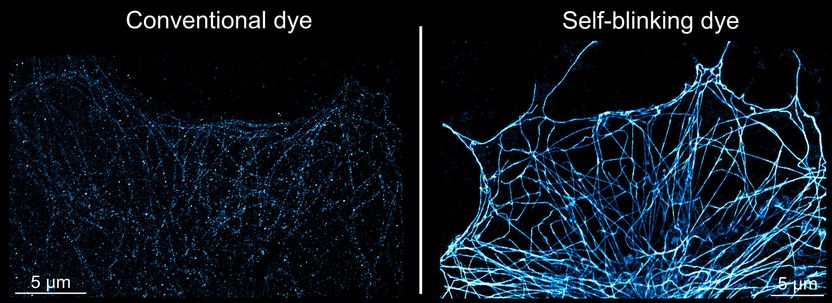
The image on the left shows super-resolution imaging using nanobodies with conventional blinking dye (where the blinking is poor), the image on the right shows self-blinking dye resulting in en-hanced image quality. Both images show microtubules, part of the internal structural network that helps cells maintain their shape and organize transport, in human U2OS cells, a widely used laboratory cell line.
Roman Tsukanov and the original publication in Nano Letters (2026) DOI: 10.1021/acs.nanolett.6c02799
A self-blinking dye is a fluorescent molecule that switches spontaneously between a bright "on" state and a dark "off" state. This blinking is essential for super-resolution microscopy because it allows individual fluorescent molecules to be detected one after another and localized very precisely. Conventional dyes can also blink, but they usually need specially prepared chemical buffers and carefully controlled imaging conditions. In addition, one of the most widely used dyes performs poorly when attached to nanobodies resulting in the poor image quality. “Nanobodies offer excellent precision, but their use in super-resolution microscopy has been limited by the poor performance of conventional blinking dyes,” says Dr Felipe Opazo at the Center for Biostructural Imaging of Neurodegeneration (BIN) at UMG. “Combining nanobodies with self-blinking dyes preserves high labeling accuracy while restoring robust blinking, making super-resolution imaging simpler, more reproducible, and easier to use.”
The team demonstrated that the approach works across different super-resolution microscopy techniques, including some of the most precise fluorescence microscopy techniques currently available. The successful application in the MINFLUX microscope highlights the potential of the method – from conventional super-resolution microscopy to cutting-edge nanoscopy.
"Our goal is to make super-resolution microscopy easier to use beyond specialized microscopy labs,” says Dr Roman Tsukanov, senior Postdoctoral researcher at Göttingen University. “Self-blinking dyes make the imaging workflow much more straightforward and lower the entrance barrier into the super-resolution microscopy field for researchers who are not microscopy experts – including biologists, chemists, clinicians, and those in other fields of research." The work establishes self-blinking nanobody dyes as a versatile method for accurate, robust, and accessible nanoscale imaging.
Original publication

Other news from the department science