Two attosecond flashes reveal the motion of electrons

Researchers at the Max Born Institute have developed a laboratory-based method in which attosecond pulses are used both to excite and to observe electronic motion. Using a technique known as all-attosecond transient absorption spectroscopy, the team was able to resolve the oscillatory motion of an electron hole in xenon ions with a period of about three femtoseconds. The results have now been published in *Nature Communications*.
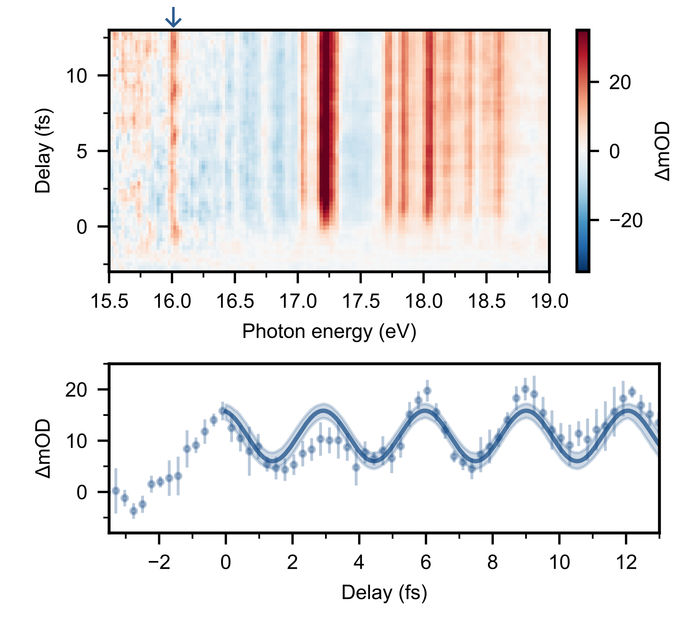
Observation of the motion of an electron hole in Xe⁺ ions. The top figure shows the delay-dependent change in XUV absorption; the arrow marks an oscillating structure at approximately 16 eV. The bottom figure shows the temporal evolution of this structure with a period of approximately 3 fs.
MBI | Evaldas Svirplys
Researchers at the Max Born Institute have developed a laboratory-based method in which attosecond pulses are used both to excite and to observe electronic motion. Using what is known as all-attosecond transient absorption spectroscopy, the team succeeded in resolving the oscillatory motion of an electron hole in xenon ions with a period of approximately three femtoseconds. The results have now been published in *Nature Communications*.
Electronic motions determine the earliest stages of virtually all light-induced processes in nature—from the first step of a chemical reaction to charge transport in a solid. However, these processes occur so rapidly that they can only be observed using flashes of light lasting a few hundred attoseconds. One attosecond corresponds to one billionth of a billionth of a second. In most previous attosecond experiments, an attosecond pulse in the extreme ultraviolet (XUV) was combined with a longer and often intense near-infrared pulse. Such fields can influence the system under investigation and mask its intrinsic electronic response. In the new approach, however, both the pump and probe pulses are XUV attosecond pulses. This allows for a potentially much more unadulterated view of the underlying dynamics.
Using a laboratory-based higher-harmonic source, the researchers generated attosecond pulses with a duration of approximately 270 attoseconds. The first pulse removed an electron from a xenon atom and left the remaining ion in a coherent superposition of two electronic states that are closely spaced in energy. The resulting gap in the electron shell—a so-called “electron hole”—did not remain stationary but moved periodically within the ion.
The second attosecond pulse recorded this motion based on changes in the extreme ultraviolet absorption spectrum. The measured period of about three femtoseconds corresponds to the oscillation period expected from the energy gap between the two spin-orbit states. “By using attosecond pulses in both steps, we can excite and observe electronic motions without applying an additional strong infrared field,” explains Bernd Schütte, who led the study. “This brings us closer to our goal of observing electronic processes as they unfold without significantly influencing them.”
The experiment is an important step toward a new generation of attosecond spectroscopy that can be performed in the laboratory using intense attosecond light sources. By combining extreme temporal resolution with the ability to distinguish between individual electronic states, the method could reveal how charges move through molecules, how electronic energy is redistributed, and how the first crucial steps of a photochemical reaction arise from the coupled interaction of electrons and atomic nuclei.
The method’s potential extends far beyond atoms and molecules. When applied to solids, the method could reveal how electronic screening, scattering processes, charge carrier multiplication, exciton formation, and charge transfer across interfaces evolve on timescales ranging from attoseconds to femtoseconds. Such measurements could provide new microscopic insights into the processes that determine the performance of semiconductors, quantum materials, two-dimensional systems, and future optoelectronic devices. In the long term, all-attosecond spectroscopy could open the way not only to observing the fastest electronic processes that govern matter’s response to light, but ultimately also to specifically controlling them.
Note: This article has been translated using a computer system without human intervention. LUMITOS offers these automatic translations to present a wider range of current news. Since this article has been translated with automatic translation, it is possible that it contains errors in vocabulary, syntax or grammar. The original article in German can be found here.
Original publication
Other news from the department science













Most read news








More news from our other portals


























See the theme worlds for related content
Topic World Spectroscopy
Investigation with spectroscopy gives us unique insights into the composition and structure of materials. From UV-Vis spectroscopy to infrared and Raman spectroscopy to fluorescence and atomic absorption spectroscopy, spectroscopy offers us a wide range of analytical techniques to precisely characterize substances. Immerse yourself in the fascinating world of spectroscopy!

Topic World Spectroscopy
Investigation with spectroscopy gives us unique insights into the composition and structure of materials. From UV-Vis spectroscopy to infrared and Raman spectroscopy to fluorescence and atomic absorption spectroscopy, spectroscopy offers us a wide range of analytical techniques to precisely characterize substances. Immerse yourself in the fascinating world of spectroscopy!