The Art of Sensing within the Skin
Dermal tattoo sensors for the detection of blood pH change and metabolite levels
The art of tattooing may have found a diagnostic twist. A team of scientists in Germany have developed permanent dermal sensors that can be applied as artistic tattoos. As detailed in the journal Angewandte Chemie, a colorimetric analytic formulation was injected into the skin instead of tattoo ink. The pigmented skin areas varied their color when blood pH or other health indicators changed.
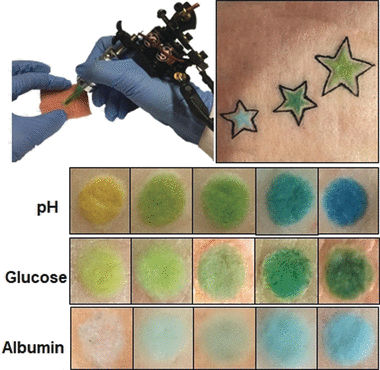
© Wiley-VCH
A tattooist places ink directly in the dermis, a roughly one-millimeter-thick layer of tissue that hosts nerves, blood vessels, and hair follicles. The tattoo needle punctures the epidermis, the uppermost layer of skin, and releases the pigments into the dermis below, where the pigments stain the skin permanently.
Using tattoos for diagnostic rather than cosmetic purposes is a new concept. Researcher Ali K. Yetisen, who works at the Technical University of Munich, Germany, and his colleagues thought the technique could be helpful to place sensor formulations at spots in the body where they can record changes in metabolic substances directly, without any spatial distance or time delay, and perhaps for a very long period of time.
The researchers then identified and adapted three colorimetric chemical sensors that produce a color change in response to biomarkers. The first sensor was a rather simple pH indicator consisting of the dyes methyl red, bromothymol blue, and phenolphthalein. If injected into a model skin patch—a piece of pig skin—the resulting tattoo turned from yellow to blue if the pH was adjusted from five to nine.
The other two sensors probed the levels of glucose and albumin. Albumin is a carrier and transport protein in the blood. High glucose levels in the body may indicate diabetic dysfunction, whereas falling albumin levels can indicate liver or kidney failure. The glucose sensor consisted of the enzymatic reactions of glucose oxidase and peroxidase, which, depending on the glucose concentration, led to a structural change of an organic pigment, and a yellow to dark green color change. The albumin sensor was based on a yellow dye that, upon association with the albumin protein, turned green.
The scientists then applied several sensor tattoos onto patches of pig skin. When they changed the pH or the glucose or albumin concentrations, the colors of the decorated areas changed accordingly. They quantified these visible effects by evaluating the colors with a simple smartphone camera and an app.
The authors claim that such sensor tattoos could allow permanent monitoring of patients using a simple, low-cost technique. With the development of suitable colorimetric sensors, the technique could also extend to recording electrolyte and pathogen concentrations or the level of dehydration of a patient. Further studies will explore whether tattoo artwork can be applied in a diagnostic setting.
Original publication
Other news from the department science













Most read news






More news from our other portals























See the theme worlds for related content
Topic world Diagnostics
Diagnostics is at the heart of modern medicine and forms a crucial interface between research and patient care in the biotech and pharmaceutical industries. It not only enables early detection and monitoring of disease, but also plays a central role in individualized medicine by enabling targeted therapies based on an individual's genetic and molecular signature.

Topic world Diagnostics
Diagnostics is at the heart of modern medicine and forms a crucial interface between research and patient care in the biotech and pharmaceutical industries. It not only enables early detection and monitoring of disease, but also plays a central role in individualized medicine by enabling targeted therapies based on an individual's genetic and molecular signature.