Beckman Coulter
OptiMATE
Automate your density gradient workflows using the OptiMATE Gradient Maker
Beckman Coulter France S.A.S.
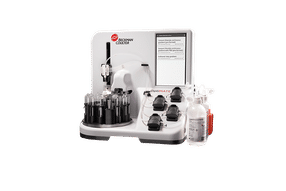
The OptiMATE Gradient Maker is the first product of its kind designed specifically for the automation of density gradient ultracentrifugation (DGUC). The system automates nearly every step of gradient preparation, delivering exceptional consistency, significantly reduced run times and a seamless plug-and-play experience.
Dramatic time savings in purification
Isopycnic (linear) gradients typically require long centrifugation run times because the gradient must first form under centrifugal force. By using pre-formed linear gradients, the OptiMATE Gradient Maker eliminates the waiting time for gradient formation - you only wait for particle migration. This leads to a reduction in centrifugation time of over 75%. For example, the run time for AAV purification is reduced from 20 hours to just 5 hours.
Maximum reproducibility and consistency
Automated dispensing and sealing of tubes minimizes manual handling, significantly reducing variability between different users and runs. Volume accuracy is ±4%, while homogeneity within a section reaches ≤1% variation when using OptiMATE Cesium Chloride and ≤6% with OptiMATE Iodixanol.
User-friendly workflow
The intuitive user interface enables quick method setup and easy user training. The four-step workflow is self-explanatory:
- Create method: Specify tubes, reagents and gradient settings via the intuitive user interface
- Insert tubes and connect accessories: step-by-step guide for seamless setup
- Run method: Integrated checks make operation easier, even for inexperienced users
- Tubes ready for centrifugation: Visualization of gradient profiles for easy evaluation
Versatile application possibilities
The OptiMATE Gradient Maker supports a wide range of applications in research, process development and manufacturing. The system is suitable for the purification of adeno-associated viruses (AAV), adenoviruses (AdV), virus-like particles (VLPs), bacteriophages, extracellular vesicles (EVs), proteins and protein complexes, ribosomes, nucleic acids, lipid nanoparticles (LNPs), lipoproteins, synthetic nanoparticles, cells and organelles.
The system is compatible with various rotors (SW 32 Ti, Type 45 Ti, VTi 50.1, Type 50.2, VTi 65.1, NVT 65, Type 70 Ti, Type 70.1 Ti, Type 90 Ti) and density gradient materials (sucrose, cesium chloride, iodixanol). It supports tubes with volumes of 13.5 mL, 39 mL and 94 mL in various formats (Open-Top, Quick-Seal, OptiSeal) made of polypropylene and Ultra-Clear.
With its compact design (47.2 x 29.8 x 46.0 cm) and a weight of 15.42 kg, the system fits easily into a biosafety cabinet or on the lab bench next to your Optima X Series ultracentrifuge. The throughput is six tubes in 30 minutes for linear gradients and 35 minutes for step gradients.
Product classification OptiMATE
Find OptiMATE and related products in the theme worlds
Topic world Centrifugation
Centrifugation is an indispensable process in the life sciences. By using centrifugal forces, it enables the separation of cells, proteins and other biomolecules according to size and density. Whether in the purification of therapeutic proteins, the isolation of DNA/RNA or the separation of cell cultures - centrifugation plays a central role in biological and pharmaceutical research and production.

Topic world Centrifugation
Centrifugation is an indispensable process in the life sciences. By using centrifugal forces, it enables the separation of cells, proteins and other biomolecules according to size and density. Whether in the purification of therapeutic proteins, the isolation of DNA/RNA or the separation of cell cultures - centrifugation plays a central role in biological and pharmaceutical research and production.