Record for fastest light pulse set
A research team at the University of Central Florida has demonstrated the fastest light pulse ever developed, a 53-attosecond X-ray flash.

University of Central Florida Professor Zenghu Chang broke the record for the fastest light pulse.
University of Central Florida
The group led by Professor Zenghu Chang beat its own record set in 2012: a 67-attosecond extreme ultraviolet light pulse that was the fastest at the time.
At one-quintillionth of a second, an attosecond is unimaginably fast. In 53 attoseconds, light travels less than one-thousandth of the diameter of a human hair.

In the same way high-speed cameras can record slow-motion video of flying bullets, attosecond light pulses allow scientists to capture images of fast-moving electrons in atoms and molecules with unprecedented sharpness.
The pulses Chang has now demonstrated are not just shorter in duration, but also in wavelength. The new light reaches an important spectral region, the so called "water window," where carbon atoms absorb strongly but water does not.
"Such attosecond soft X-rays could be used to shoot slow-motion video of electrons and atoms of biological molecules in living cells to, for instance, improve the efficiency of solar panels by better understanding how photosynthesis works," said Chang, a UCF Trustee Chair Professor in CREOL, The College of Optics & Photonics, and the Department of Physics. Chang is the director of the Institute for the Frontiers of Attosecond Science and Technology (iFAST), located in the Physics Department, where the experiments were carried out.
X-rays interact with the tightly bound electrons in matter and may reveal which electrons move in which atoms, providing another way to study fast processes in materials with chemical element specificity. That capability is invaluable for the development of next-generation logic and memory chips for mobile phones and computers that are a thousand times faster than those in use today.
Producing attosecond X-rays requires a new type of high power driver: femtosecond lasers with a long wavelength. It's an approach that Chang and his team have pioneered.
Original publication
Other news from the department science






Most read news



More news from our other portals
















See the theme worlds for related content
Topic World Spectroscopy
Investigation with spectroscopy gives us unique insights into the composition and structure of materials. From UV-Vis spectroscopy to infrared and Raman spectroscopy to fluorescence and atomic absorption spectroscopy, spectroscopy offers us a wide range of analytical techniques to precisely characterize substances. Immerse yourself in the fascinating world of spectroscopy!

Topic World Spectroscopy
Investigation with spectroscopy gives us unique insights into the composition and structure of materials. From UV-Vis spectroscopy to infrared and Raman spectroscopy to fluorescence and atomic absorption spectroscopy, spectroscopy offers us a wide range of analytical techniques to precisely characterize substances. Immerse yourself in the fascinating world of spectroscopy!
Last viewed contents
Researchers develop sensors for the “charge” of biological cells - Biosensors show the ratio of NADPH to NADP⁺ in living cells in real time for the first time
CSHL scientists harness logic of 'Sudoku' math puzzle to vastly enhance genome-sequencing capability - 'DNA Sudoku' pools multitude of DNA samples for sequencing in manner analogous to solving a Sudoku grid
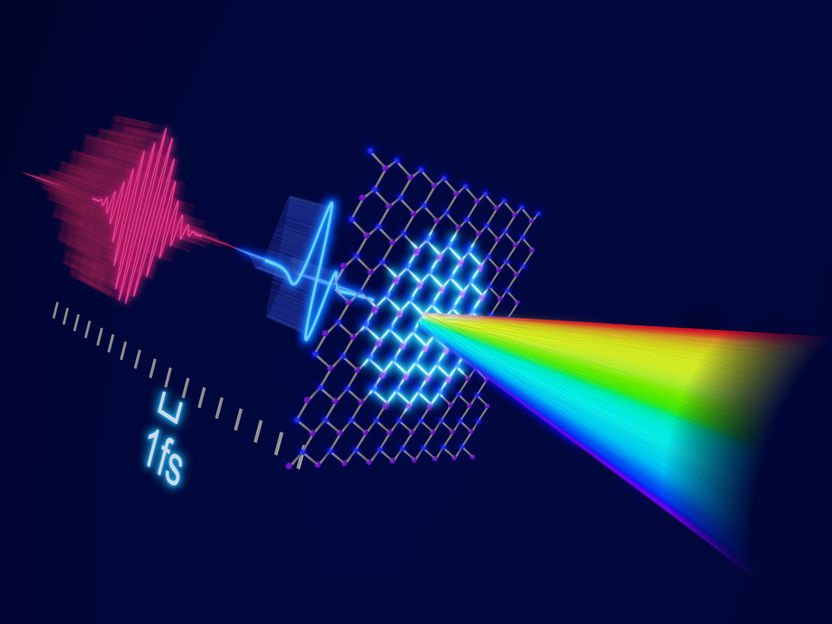
High harmonics illuminate the movement of atoms and electrons - Detailed new insights into atomic motions
Resistance to the anti-cancer medication cetuximab - Insights into mechanisms
Zoom in to watch DNA code being read
New technology to study virus infections - "It may be possible to rapidly address emerging pandemics in the future by tailoring our tool to recognize novel viral strains"
New test opens path for better 2-D catalysts
Nanobiosensor Developed for Detecting SARS-CoV-2 - New sensor technology breakthrough against the pandemic
DNA from extinct humans discovered in cave sediments - New method retrieve hominin DNA from cave sediments – even in the absence of skeletal remains
Researchers have succeeded for the first time in analyzing nanovesicles and proteins in parallel - This is important to determine the quality of a sample and to clearly attribute effects to the transport vesicles
Physicists create giant trilobite molecules - Results are important to understand the chemical binding mechanisms of them, which is distinct from all other chemical bonds