Opening the Way to Mobile Olfaction with Nanomechanical Sensors
An alliance between six organizations is setting a de facto standard for smell sensors employing a small, sensitive and versatile sensor element called the Membrane-type Surface stress Sensor (MSS)
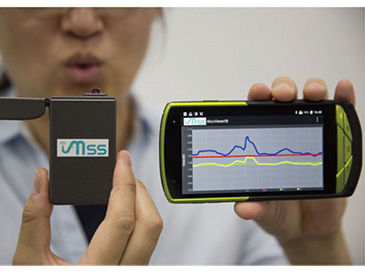
Image of a mobile olfaction device with the MSS
International Center for Materials Nanoarchitectonics(WPI-MANA)
Six organizations including NIMS, Kyocera, Osaka University, NEC, Sumitomo Seika and NanoWorld jointly launched the MSS Alliance on September 25, 2015 in order to establish a de facto standard for odor analysis and sensor systems employing a sensor element called the Membrane-type Surface stress Sensor (MSS).
The MSS is a sensor element which was jointly developed in 2011 by Genki Yoshikawa (Group Leader, MANA, NIMS), the late Dr. Heinrich Rohrer and Ecole polytechnique federale de Lausanne (EPFL). It is a versatile, small and sensitive sensor element capable of measuring diverse molecules in the atmosphere and in liquids, including gas molecules and biomolecules. Unlike conventional nanomechanical sensors, the MSS can achieve high sensitivity with a compact system thanks to the comprehensive structural optimization with electric read-out based on piezoresistors. Its sensitivity is more than 100 times higher than that of conventional piezoresistive nanomechanical sensors, even surpassing that of optical read-out.
The MSS will be utilized for the development of “mobile olfaction” compatible with the emerging “IoT society,” contributing in various fields such as foods, cosmetics, medicine, the environment and safety, anytime, anywhere and for anybody.
To speed up the popularization and practical application of the MSS technology in society, NIMS launched an industry-government-academia joint research framework, the MSS Alliance, in collaboration with the above-mentioned partners, who possess the key technologies for development of practical olfaction sensor systems and related services. Through this framework, Dr. Yoshikawa’s research group is working on the challenging tasks of optimizing element technologies and establishing a reliable measurement system toward a de facto standard for an olfaction sensor.
Other news from the department science















Most read news





More news from our other portals




















Last viewed contents

Ticks on migratory birds found to carry newly discovered hemorrhagic fever virus

New organ-on-chip pilot seeks to reduce animal testing in consumer health industry - Cooperation between Bayer, the start-ups esqLABS and Dynamic42, and Placenta Lab of Jena University Hospital
New method provides more precise information on types of leukaemia - Optical genome mapping could become a component of routine diagnostics
Oxford Nanopore Announces Licence Agreement with Harvard University for Graphene DNA sequencing

Waters and BD's Biosciences & Diagnostic Solutions Business to Combine - Creating a Life Science and Diagnostics Leader Focused on Regulated, High-Volume Testing

World's first toxicology testing strategy without animal testing adopted by OECD - Success for long-standing collaboration between BASF and Givaudan to develop and validate alternative methods
Three Eyes See More than Two - monitoring a catalytic reaction with three different microscopies under exactly the same conditions in real time - Information is obtained that none of the methods alone could reveal

(How) Cells Talk to Each Other - ISTA Scientists Successfully Model Cell Dynamics
NIST sensor improvement brings analysis method into mainstream
Tracking of individual catalyst nanoparticles during heating