A protein that makes you do the twist
The origins of asymmetry
Asymmetry plays a major role in biology at every scale: think of DNA spirals, the fact that the human heart is positioned on the left, our preference to use our left or right hand ... A team from the Institute of biology Valrose (CNRS/Inserm/Université Côte d'Azur), in collaboration with colleagues from the University of Pennsylvania, has shown how a single protein induces a spiral motion in another molecule. Through a domino effect, this causes cells, organs, and indeed the entire body to twist, triggering lateralized behaviour.
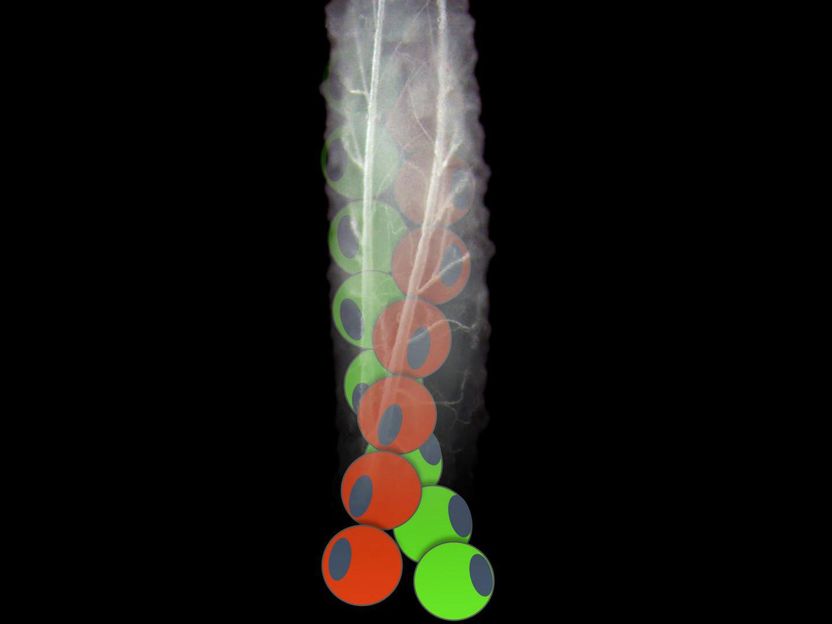
The molecular motor Myosin 1D creates asymmetry at all levels, from the movement of actin molecules (red and green filaments) to respiratory trachea (white tube-like structures), to the organism itself (here a Drosophila larva).
Photo of larva: Gaëlle Lebreton; photo editing by Stéphane Noselli / iBV / CNRS
Our world is fundamentally asymmetrical: think of the double helix of DNA, the asymmetrical division of stem cells, or the fact that the human heart is positioned on the left ... But how do these asymmetries emerge, and are they linked to one another?
At the Institute of biology Valrose, the team led by the CNRS researcher Stéphane Noselli, which also includes Inserm and Université Cote d'Azur researchers, has been studying right-left asymmetry for several years in order to solve these enigmas. The biologists had identified the first gene controlling asymmetry in the common fruit fly (Drosophila), one of the biologists' favoured model organisms. More recently, the team showed that this gene plays the same role in vertebrates: the protein that it produces, Myosin 1D, controls the coiling or rotation of organs in the same direction.
In this new study, the researchers induced the production of Myosin 1D in the normally symmetrical organs of Drosophila, such as the respiratory trachea. Quite spectacularly, this was enough to induce asymmetry at all levels: deformed cells, trachea coiling around themselves, the twisting of the whole body, and helicoidal locomotive behavior among fly larvae. Remarkably, these new asymmetries always develop in the same direction.
In order to identify the origin of these cascading effects, biochemists from the University of Pennsylvania contributed to the project too: on a glass coverslip, they brought Myosin 1D into contact with a component of cytoskeleton (the cell's "backbone"), namely actin. They were able to observe that the interaction between the two proteins caused the actin to spiral.
Besides its role in right-left asymmetry among Drosophila and vertebrates, Myosin 1D appears to be a unique protein that is capable of inducing asymmetry in and of itself at all scales, first at the molecular level, then, through a domino effect, at the cell, tissue, and behavioral level. These results suggest a possible mechanism for the sudden appearance of new morphological characteristics over the course of evolution, such as, for example, the twisting of snails' bodies. Myosin 1D thus appears to have all the necessary characteristics for the emergence of this innovation, since its expression alone suffices to induce twisting at all scales.
Other news from the department science






Most read news




More news from our other portals
















Last viewed contents
Synthetic Production of Potential Pharmaceuticals Dramatically Simplified by Scripps Research Team - Findings Could Expand Interest in Natural Products by Making Production More Cost-Effective
Light-induced shape shifting of MXenes - Femtosecond light creates switchable nano-waves in MXenes and moves the materials’ atoms at a record-breaking speed
Brooks Instrument Joins Major Biotechnology Consortium Focused on Regenerative Drug Manufacturing - Brooks Instrument will contribute insights and precision fluid control technology to the Advanced Regenerative Manufacturing Institute’s BioFabUSA program
Promising discovery for a non-invasive early detection of Alzheimer's disease
Innovations through hair-thin optical fibres - Study shows what miniaturised optical filters make possible
Wave of the future - Terahertz chips a new way of seeing through matter
Using PETRA III to watch the disabling of a penicillin killer - Scientists observe in detail the binding and formation of covalent bonds of an inhibitor to a bacterial enzyme that disables common antibiotics
Eurofins acquires LGC Forensics
How pathogenic bacteria prepare a sticky adhesion protein