More detailed analysis of how cells react to stress
stress in the body’s cells is both the cause and consequence of inflammatory diseases or cancer. The cells react to stress to protect themselves. Researchers at the University of Zurich have now developed a new technique that allows studying a fundamental response to stress in much more detail than previously possible: the ADP-ribosylation of chromatin. In the long term, this method could help finding ways of blocking disease-causing processes.
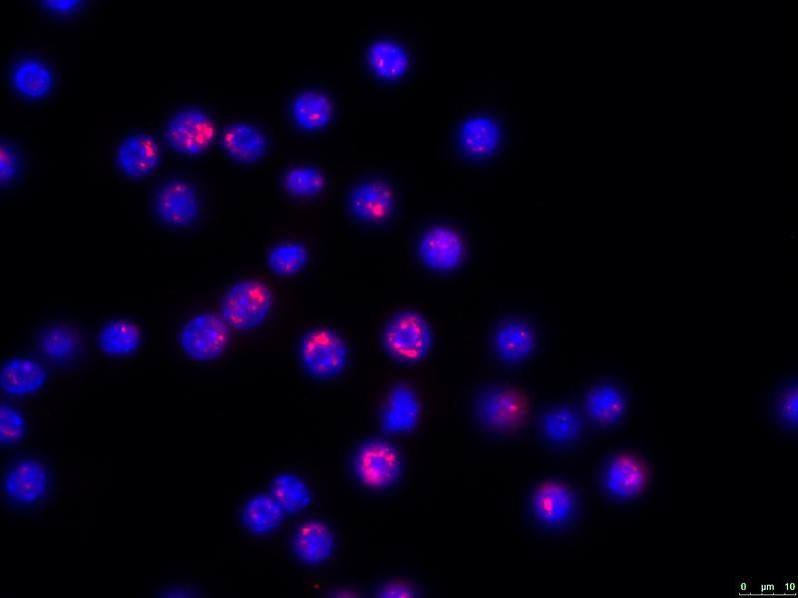
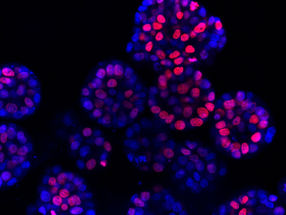
Cells in culture react to stress by massive ADP-ribosylation (red) in the nucleus (blue).
University of Zurich
When cells are exposed to stress, different repair and detoxification mechanisms are triggered to protect the cells from being damaged. Stress is caused either by environmental factors or the the body’s reaction to inflammation, and can lead to cancer or cardiovascular diseases. The cells react by chemically modifying different proteins, which changes their activity and function. ADP-ribosylation is a central response in this stress reaction: enzymes place small molecules onto specific parts of a protein or remove them, thereby activating or deactivating the protein. This reaction turns on a cascade of processes that allows the cell to adapt to the stress and survive.
Maintaining health of the chromosomes, which carry the genetic information, is a vital aspect in this regard. Chromosomes are organized in such a way that the genetic information in the form of DNA is wrapped around proteins, the chromatin. It has been known for a long time that some of these proteins become ADP-ribosylated under certain stress conditions, which helps the cell to deal with stress-induced damages. However, it has been so far unclear, where precisely on the chromatin this ADP-ribosylation occurs. Suitable methods to answer this question did not exist.
New method permits a better understanding of the cellular stress reaction
A group of researchers from the Department of Molecular Mechanisms of Disease (formerly Institute of Veterinary Biochemistry and Molecular Biology) of the University of Zurich have now established a new technique called "ADPr-ChAP" that allows the identification of the chromatin sites that become modified after a cell stress. "This new technique will now allow more closely investigating where and how ADP-ribosylation of the chromatin regulates its structure and chromatin-associated processes such as DNA replication, DNA repair or transcription," says Professor Michael O. Hottiger, who lead the study.
"The technique will now allow us to much more precisely identify which proteins become ADP-ribosylated on the genome-wide level and at specific loci. This will help us to better understand how a cell responds to a certain stress", Hottiger concludes. With this new method, the scientific community now has a reliable tool to identify the molecular signaling pathways that play a central role in cellular stress responses. Eventually, the researchers want to find new ways of interfering with disease-making processes in the body, such as those prevailing in chronic inflammation and cancer.
Other news from the department science