A non-invasive intracellular 'thermometer' with fluorescent proteins has been created
A team from the Institute of Photonic Sciences (ICFO) has developed a technique to measure internal cell temperatures without altering their metabolism. This finding could be useful when distinguishing healthy cells from cancerous ones, as well as learning more about cellular processes.
temperature controls many of the cell's life processes, such as splitting and metabolism. A European research team led by the Institute of Photonic Sciences (ICFO), which has the Severo Ochoa mark of excellence, has published a non-invasive method that offers quicker, more precise data from measuring intracellular heat from green fluorescent proteins (GFP) in the journal 'Nano Letters'.
"A unique characteristic of our method is that it does not alter any cellular process" Romain Quidant, ICFO researcher and study coordinator, explains to SINC. Unlike other techniques, this method does not stress or alter the behaviour of the cell as it does not need to be inserted into any molecules or any other synthetic nano-object that is sensitive to the internal temperature.
One of the most promising outcomes is a better understanding of cellular processes, such as those involved in metastasis. Furthermore, the possibility of obtaining information about intracellular temperature could be used to "differentiate normal cells from cancerous ones in a quick, non-invasive manner" Sebastian Thompson Parga, ICFO researcher and co-author of the project.
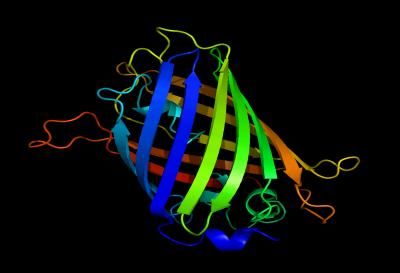
The green fluorescent proteins help measure intracellular heat.
Richard Wheeler
Information deduced from temperature
From intracellular temperature, we can deduce how the energy used by the body in the uncontrolled spreading of cancer cells flows.
In this interdisciplinary study, biology uses physical measurements of energy transmission to study processes such as gene expression, metabolism and cell splitting.
The technique used is known by the name of 'fluorescence polarisation anisotropy' (FPA) as it allows the difference in polarization between light that fluorescent molecules receive, and that which they emit later, to be measured. In the words of Quidant, "this difference in polarization (anisotropy) is directly connected to the rotating of the GFP molecules and therefore with temperature".
The green fluorescence of the proteins has a reward
The authors of the study ensure that biologists will be able to implement this technique in experimental set-ups and obtain the cell temperature as another observable detail. In 2008, when Osamu Shimomura, Martin Chalfie and Roger Y. Tsien won the Nobel Chemistry Prize for discovering and developing GFP, they resolved many complications in biomedical research.
In the field of molecular biology, different techniques have been suggested to monitor internal cell temperature, these researchers found limitations in measuring the intensity and spectrum of its fluorescence.
Furthermore, the option of measuring intracellular activity could establish the basis to develop a field that has not been widely studied: thermal biology at cellular level.
According to the authors of the study, the following step is to improve the method's sensitivity and resolution. In order to achieve that, the researchers work to fine tune the properties of the fluorescent proteins and optimise the detection method of its 'thermometer'.
Original publication
Other news from the department science














Most read news






More news from our other portals



























Last viewed contents
454 Life Sciences and Roche NimbleGen Announce Collaboration with Eli Lilly and SeqWright - Sequencing Genomic Regions Associated with Psychiatric Disease
Portable, point-of-care COVID-19 test could bypass the lab - Researchers developed a microfluidic cartridge for a 30-minute COVID-19 test
Duquesne University, Agilent Technologies Establish Mass Spectrometry Centre of Excellence to Study Diseases

Australian and German Researchers awarded Young Scientist 2016 for Dispersion Analysis & Materials Testing - For the first time two awardees
PerkinElmer Elects Samuel Chapin to Board of Directors
Expansion of High Content Screening Capabilities at the National Center for Drug Screening in China
Sigma-Aldrich and MorphoSys Enter Into a Collaboration and Licensing Agreement for Recombinant Research Antibodies - AbD Serotec will use proprietary technology to generate antibodies against novel research targets provided by Sigma-Aldrich

Raman spectroscopy allows fast analysis of vaccines
Corning Completes Acquisition of Plaslab S.A.S.
Agilent Technologies completes acquisition of Seahorse Bioscience