How cells export and embed proteins in the membrane

EMBL scientists first to visualise crucial step

16-Dec-2010 - France

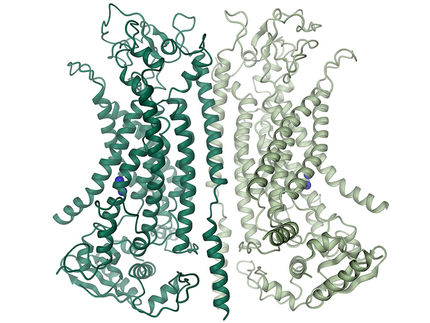
Like an overprotective parent on the first day of school, a targeting factor sometimes needs a little push to let go of its cargo. Scientists at the European Molecular Biology Laboratory (EMBL) in Grenoble, France, have visualised one such hand-over. They were the first to determine the structure of a ribosome-protein complex involved in carrying nascent proteins out of the cell. Their work, published in Nature Structural and Molecular Biology, could increase understanding of illnesses such as cystic fibrosis and some forms of Parkinson's disease, in which improper protein targeting leads proteins to harmfully accumulate inside cells. In most organisms, proteins destined to cross or be embedded in a membrane contain a polypeptide sequence that is recognized during translation by a targeting factor known as the signal recognition particle (SRP). SRP binds to the ribosome synthesizing the polypeptide, and subsequently also binds an SRP receptor, located next to the machinery that transfers proteins across the membrane and out of the cell. EMBL scientists have now generated the first-ever structural image of this important step in the process. "The SRP receptor acts as a switch between the cargo binding and the release," says Christiane Schaffitzel, who led the research at EMBL, "Now we have seen for the first time how the release can happen at a molecular level." Schaffitzel's group is taking structural snapshots of entire pathways by which proteins are synthesized and targeted to their final positions. To capture this hand-over step, the scientists had to overcome the fact that the link between SRP and its receptor is usually transient, chemically unstable. They engineered the SRP receptor so that it would bind more stably to SRP, then introduced ribosomes and observed the resulting complexes using cryo-electron microscopy (cryo-EM). Cryo-EM can be performed in roughly physiological conditions, providing a picture that closely resembles what happens in living cells. This picture can then be combined with higher-resolution crystallography data and biochemical studies – an exciting hybrid approach the EMBL scientists will further exploit to follow protein targeting all the way from start to finish.
Other news from the department science

Most read news

More news from our other portals

Last viewed contents

New Method for Analysing Nanoporous Materials - Innovative method opens up new possibilities for materials science
New Method for Analysing Nanoporous Materials - Innovative method opens up new possibilities for materials science
A milestone on the pathway to Lab 4.0: A new standard for the smart lab - SPECTARIS presents the first industrial communication standard for laboratory and analytical devices

A milestone on the pathway to Lab 4.0: A new standard for the smart lab - SPECTARIS presents the first industrial communication standard for laboratory and analytical devices

Fish and seafood - improved trace detection of life-threatening allergy sources - "AQUALLERG-ID": Researchers develop methods for detecting potential food allergens

Fish and seafood - improved trace detection of life-threatening allergy sources - "AQUALLERG-ID": Researchers develop methods for detecting potential food allergens

PerkinElmer appoints President & Chief Operating Officer

ECHA calls for information to avoid unneccessary animal testing

Newly improved NIST reference material targets infant formula analysis
LAUDA appoints Dr. Ralf Hermann as the new General Manager Constant temperature equipment

LAUDA appoints Dr. Ralf Hermann as the new General Manager Constant temperature equipment

A relative from the Tianyuan Cave - Ancient DNA has revealed that humans living some 40,000 years ago in the area near Beijing were likely related to many present-day Asians and Native Americans

A relative from the Tianyuan Cave - Ancient DNA has revealed that humans living some 40,000 years ago in the area near Beijing were likely related to many present-day Asians and Native Americans

Measurable for the first time: How bio molecules react to lack of space - Sensor demonstrates lack of space in living cells

Measurable for the first time: How bio molecules react to lack of space - Sensor demonstrates lack of space in living cells

Using AI to identify genetic perturbations from cell images - Newly founded start-up aims to use findings to treat previously incurable fibrosis

Using AI to identify genetic perturbations from cell images - Newly founded start-up aims to use findings to treat previously incurable fibrosis

Researchers can measure distances in molecules optically - MINFLUX microscopy allows the determination of distances within biomolecules using an optical microscope

Researchers can measure distances in molecules optically - MINFLUX microscopy allows the determination of distances within biomolecules using an optical microscope

You can't teach old materials new tricks - Decades-old challenge has researchers seeking new materials for radiation detection