A new Concept in Microscopy: Self-reconstructing Laser Beams
Researchers at the University of Freiburg are developing a microscope with illuminating beams that actively refocus in a light-scattering medium
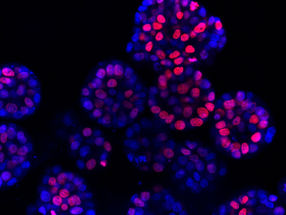
It’s a familiar situation for all car drivers. In the autumn, when the roads are foggy, visibility drops below 50 metres. The light of the car’s headlights are scattered by the drops of fog, meaning we can’t see objects further away because the light can’t reach them. This everyday example illustrates a key problem of light microscopy. When used in modern cell biology, the dense clusters of thousands of cells scatter the light so strongly that the cells located in the back of an object can hardly be seen. Although better known from science fiction, the concept of self-reconstructing laser beams offers a promising solution to the problem.
Together with his team of scientists, Dr. Alexander Rohrbach, Professor for Bio- and Nano-photonics at the University of Freiburg’s Department of Microsystems Engineering – IMTEK, is developing new, unconventional techniques in microscopy “whose physical concepts are at least as exciting as their technical realisation,” Rohrbach said. His doctoral student, Florian Fahrbach, whose research focuses on self-reconstructing laser beams, added, “We’ve been working on this for the last four years. Without the support of the Freiburg Cluster of Excellence BIOSS – Centre for Biological Signalling Studies and Carl Zeiss MicroImaging GmbH, it would have been very difficult to realise the concept we’re now presenting!”
In the forthcoming November issue of Nature Photonics the scientists describe their new light microscope, which relies on beams that reconstruct themselves in light-scattering media. The new method not only provides novel insights into the physics of complex light scattering, but it also enables, for example, to look about 50 percent deeper into human skin tissue than with conventional laser beams. The scientists have named their new invention MISERB (microscope with self-reconstructing beams).
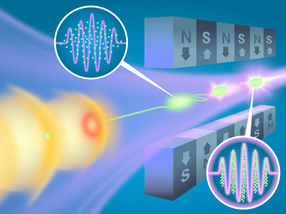
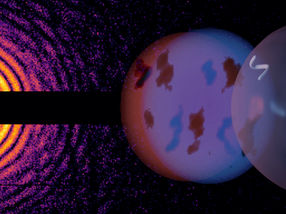
The researchers from Freiburg were able to demonstrate in several experiments that specially formed laser beams are able to self-reconstruct even in the presence of various obstacles, for example a high number of light-scattering biological cells, which repeatedly destroy the laser beam’s profile. Self-reconstruction works because the scattered photons (light quanta) at the centre of the beam are constantly replaced by new photons from the side. What is so astounding is that the photons from the side all converge at the centre of the beam nearly in phase in order to build a new beam profile, undeterred by considerable lags from the scattering. The scientists therefore used a computer hologram (a device that changes the phase of light) to modify conventional laser beams into so-called Bessel beams whose phase profile has the shape of a cone. Although Bessel beams are known to be diffraction-free in free space, it has been completely unclear whether, and to what degree, they are able to regain their original beam shape also in inhomogeneous media, where light scattering is considerable.
Not only do the results of this study have the potential to generate more exciting physical experiments in the field of nonlinear optics, but the BIOSS Cluster of Excellence also has reason to hope that it will make new biological signal cascades deep inside living organisms more visible than ever before.
Original publication: lorian O. Fahrbach, Philipp Simon und Alexander Rohrbach; "Microscopy with self-reconstructing beams”; Nature Photonics
Other news from the department science