Schizophrenia manifests itself in the brain structure
The symptoms of schizophrenia vary greatly from person to person
schizophrenia is a complex mental illness that affects perception, thinking and feeling. This complexity is reflected in the individual manifestations of the illness: for some patients, the main focus is on perceptual disorders, while for others it is cognitive impairments. "In this sense, there is not one schizophrenia, but many schizophrenias, each with different neurobiological profiles," says Wolfgang Omlor, lead author of the study and senior physician at the Psychiatric University Hospital Zurich.

Symbol image
Computer-generated image
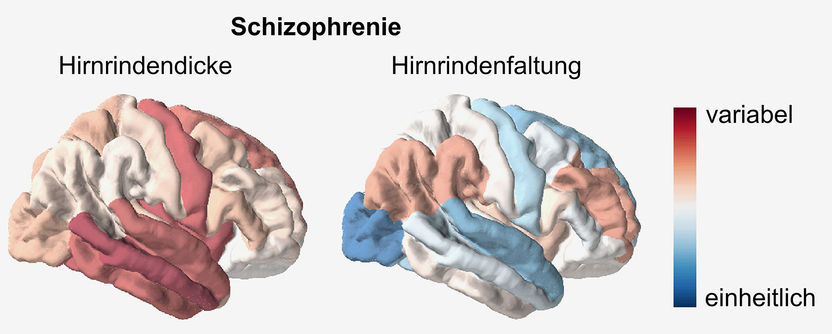
There were similarities in the folding of the cerebral cortex, particularly in the anterior part of the brain.
Wolfgang Omlor

In order to do justice to each of these schizophrenias, a precision medicine approach would have to be chosen - for example through therapies that exactly match the respective neurobiological profile. "This requires approaches that look for individual differences as well as similarities at the neurobiological level," explains Omlor.
International study examines brain structure
In an international multi-center study, Wolfgang Omlor and the research team at the University of Zurich investigated the variability of the brain structure of those affected: On the one hand, which brain networks show a particularly high degree of individuality and which show a particularly high degree of commonality? To this end, the researchers examined various characteristics, including the thickness and surface area of the cerebral cortex, as well as the folding pattern and volume of deeper brain regions.
The data came from the ENIGMA collaboration, an international research project that brought together imaging data from over 6,000 people from 22 countries in this study. By comparing the brain structures of several thousand patients with schizophrenia and healthy individuals, the variability of brain structure could be examined with a high degree of reliability.
Less flexible brain development in early childhood
There were similarities in the folding of the cerebral cortex, particularly in the anterior brain area. (Image: Wolfgang Omlor)
While variable brain structures in schizophrenia may reflect symptom differences between patients, the uniform brain folding in the middle anterior brain area indicates a developmental biological feature shared by schizophrenia patients. Since most brain folding is completed in early childhood, brain development during this period appears to be less flexible in schizophrenia patients, particularly in areas responsible for connecting thought and feeling processes.
"These findings expand our understanding of the neurobiological basis of schizophrenia," says Philipp Homan, professor at the University of Zurich and last author of the study. "While uniform brain convolutions point to possible mechanisms of disease development, regions with high variability in brain structure could be relevant for the development of individualized treatment strategies."
Literature
Wolfgang Omlor, Finn Rabe, et al, Philipp Homan. Estimating Multimodal Structural Brain Variability in Schizophrenia Spectrum Disorders: A Worldwide ENIGMA Study. Am J Psychiatry 2025; 0:1-16; DOI: 10.1176/appi.ajp.20230806
Note: This article has been translated using a computer system without human intervention. LUMITOS offers these automatic translations to present a wider range of current news. Since this article has been translated with automatic translation, it is possible that it contains errors in vocabulary, syntax or grammar. The original article in German can be found here.
Original publication

Other news from the department science