High-resolution microscope built from LEGO and bits of phone
Research shows constructing microscope improves children’s understanding - enlightening, educational and fun
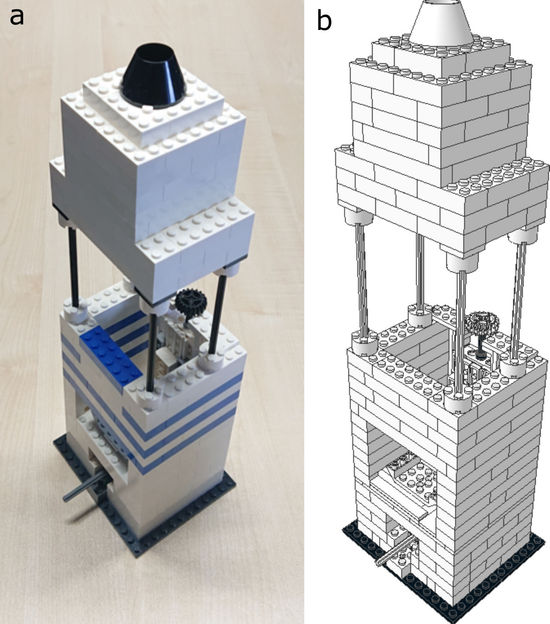
microscopy is an essential tool in many fields of science and medicine. However, many groups have limited access to this technology due to its cost and fragility. Now, researchers from the Universities of Göttingen and Münster have succeeded in building a high-resolution microscope using nothing more than children’s plastic building bricks and affordable parts from a mobile phone. They then went on to show that children aged 9-13 had significantly increased understanding of microscopy after constructing and working with the LEGO® microscope. Their results were published in The Biophysicist.
Timo Betz
The researchers designed a fully functional, high-resolution microscope with capabilities close to a modern research microscope. Apart from the optics, all parts were from the toy brick system. The team realized that the lenses in modern smartphone cameras, which cost around €4 each, are of such high quality that they can make it possible to resolve even individual cells. The scientists produced instructions for building the microscope as well as a step-by-step tutorial to guide people through the construction process whilst learning about the relevant optical characteristics of a microscope. The researchers measured children’s understanding through questionnaires given to a group of 9-13 year olds. The researchers found that children given the parts and plans to construct the microscope themselves significantly increased their knowledge of microscopy. For this particular study, the researchers, whose day-to-day research focusses on fundamental biophysical processes, benefitted from the input and enthusiasm of their 10-year-old co-author.
“An understanding of science is crucial for decision-making and brings many benefits in everyday life, such as problem-solving and creativity,” says Professor Timo Betz, University of Göttingen. “Yet we find that many people, even politicians, feel excluded or do not have the opportunities to engage in scientific or critical thinking. We wanted to find a way to nurture natural curiosity, help people grasp fundamental principles and see the potential of science.” The researchers stayed in contact with the children and monitored their progress: after they had constructed the main parts, they discovered that the lenses can act as magnifying glasses. After exploring this, and realizing that a good light source was important, they initially found it tricky to align two magnifying glasses. However, once they had achieved this, the lenses generated tremendous magnification. This enabled the children to literally “play” with the microscope: make their own adaptations; explore how the magnification works; and discover the exciting world of the micro-cosmos for themselves.
“We hope that this modular microscope will be used in classrooms and homes all over the world to excite and inspire children about science,” continues Betz. “We have shown that scientific research does not need to be separate from everyday life. It can be enlightening, educational and fun!”
Original publication

Other news from the department science














These products might interest you

Most read news








More news from our other portals

























Last viewed contents

Capturing ultrasharp images of multiple cell components at once - New DNA-based, super-resolution microscopy method could simultaneously spot dozens of distinct types of biomolecules

Ardena Expands Bioanalytical Services in Europe