DNA molecules engineered to detect pathogens and deliver drugs
First, Cornell researchers created DNA "bar codes" - strands of the genetic material that quickly identify the presence of different molecules by fluorescing. Now, they have created new DNA molecules that can detect pathogens and deliver drugs to cells when they form long chains called polymers.
Cornell researcher Dan Luo and colleagues describe in Nature Nanotechnology that their simple DNA molecules, or monomers, link into polymers under ultraviolet light and in the presence of such pathogens as SARS and HIV.
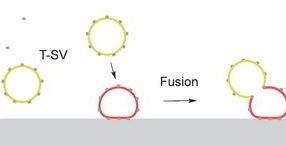
The research team, which included first author and postdoctoral associate Jong B. Lee and David Muller, associate professor of applied and engineering physics, report that the polymers, made up of thousands of monomers, allow for the fast detection of pathogens. The researchers used asymmetric strands of DNA, characterized by unique sequences at the ends of each branch, which they call zip codes. Each zip code can link to a corresponding sequence, including the DNA of such pathogens as HIV. When the zip codes and pathogens find each other, they form chains that curl up into spheres and are visible under a microscope.
Using the same principle, the researchers also demonstrated attaching multiple nucleic acid-based drugs, along with tracers, to the DNA strands, which were then absorbed by cells.
Luo, associate professor of biological and environmental engineering, explained that such work illustrates how DNA is not only a genetic material, but can be a useful structure to carry drugs or other substances.
"The genetic part is the recognition of the pathogen," he said. "The generic part is making the nanostructure.".
Other news from the department science







These products might interest you

Most read news





More news from our other portals


















Last viewed contents
Wiley InterScience Launches the Analytical Sciences Backfile Collection
Eurofins expands food and feed testing business in the US
QIAGEN launches coronavirus test kit in Germany following derogation by BfArM
Unexpected flexibility found in odorant molecules - High resolution rotational spectroscopy reveals an unprecedented number of conformations of an odorant molecule – a new world record!

How environmental changes affect the shapes of RNA in living cells - Results raises the possibility that we may use this knowledge to fine-tune crops or develop RNA-based therapies for diseases such as COVID-19
New analysis of the structure of silks explains paradox of super-strength - Could lead to even stronger synthetic materials

Verder Group acquires specialist for particle characterization