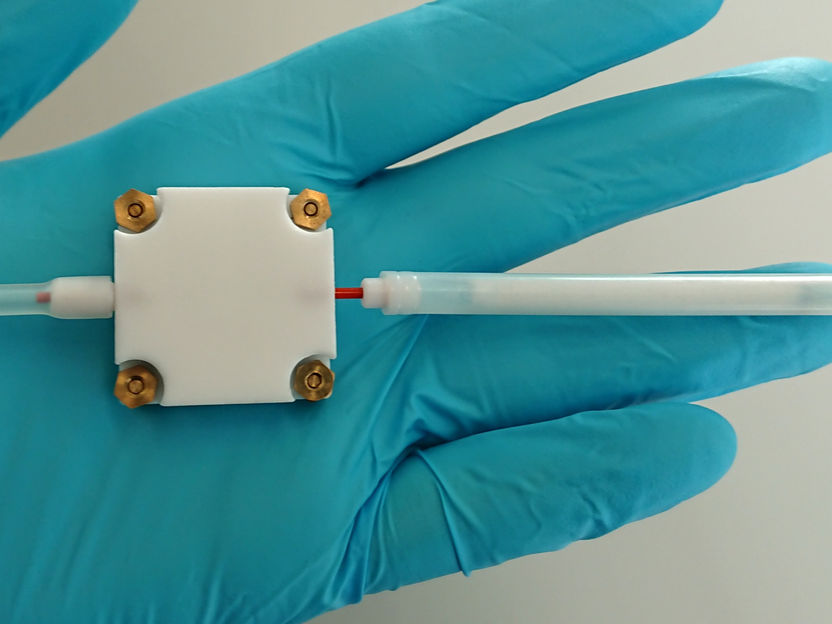
Varian, Inc. Announces Unique Probe Technology Breakthrough for Biological Solids NMR
Varian, Inc. has introduced a new design for nuclear magnetic resonance (NMR) probes used to determine the molecular structures of proteins and other biomolecules in the solid state. Developed in collaboration with scientists at the University of Illinois at Urbana-Champaign (UIUC), the new Bio-MAS(TM) Probe incorporates a patent-pending scroll coil design to reduce unwanted heating by three orders of magnitude compared to a standard probe. Heating can destroy valuable biological solids samples. The new probe also has been shown to extend a sample's viable experimental lifetime by more than an order of magnitude.
The breakthrough scroll coil technology of the Bio-MAS probe facilitates scientists' research efforts to determine and better understand protein structures by solid state NMR, such as those associated with Alzheimer's disease and Type 2 diabetes. For bio-solids NMR studies, many samples are analyzed in the presence of salts; however the presence of these salts leads to undesirable heating that can denature the sample proteins, compromising experiment results and efficacy. Unlike the solenoid coils used in all current solid state NMR probes, Varian's new Bio-MAS probe's unique scroll coil design is more tolerant of high sample salt concentrations and causes less sample heating, which prolongs the sample's integrity. The new coil design also provides excellent RF homogeneity, which contributes to outstanding sensitivity for complex bio-solids experiments.
Bio-solids NMR experiments allow access to the 70% of all cellular proteins, such as membrane proteins, that are considered solids because they are not free floating in intracellular fluid. These studies can provide researchers with unparalleled insight into proteins and biomarker molecules associated with a wide variety of diseases.

Other news from the department research and development












Most read news






More news from our other portals



















Last viewed contents
Promising discovery for a non-invasive early detection of Alzheimer's disease
Innovations through hair-thin optical fibres - Study shows what miniaturised optical filters make possible
Wave of the future - Terahertz chips a new way of seeing through matter

Using PETRA III to watch the disabling of a penicillin killer - Scientists observe in detail the binding and formation of covalent bonds of an inhibitor to a bacterial enzyme that disables common antibiotics
Eurofins acquires LGC Forensics
How pathogenic bacteria prepare a sticky adhesion protein
How the brain might compensate stress during learning
The Combined Nanoscopy Technique - Scientists develop a combined technique for studying cellular structures via high-resolution imaging
Thermo Fisher Scientific Strengthens Life Sciences Portfolio With the Addition of Spectronex and Flux Instruments