Tiny light detectors work like gecko ears
geckos and many other animals have heads that are too small to triangulate the location of noises the way we do, with widely spaced ears. Instead, they have a tiny tunnel through their heads that measures the way incoming sound waves bounce around to figure out which direction they came from.
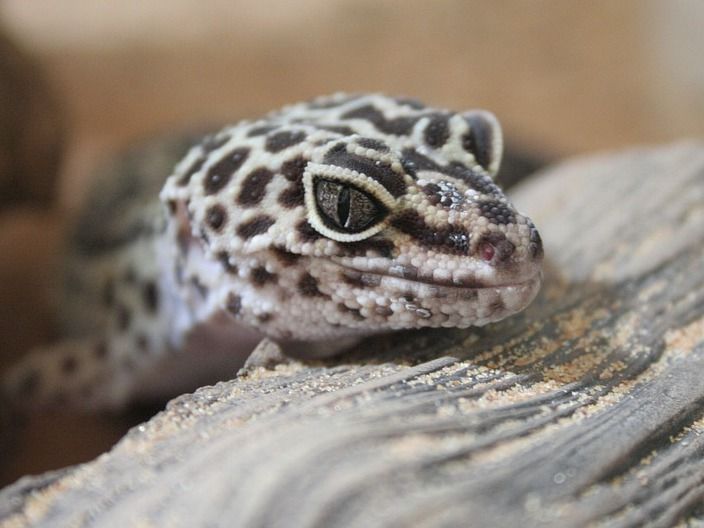
Leopard gecko, symbolic picture
Dany112; pixabay.com; CC0
Facing their own problem of minuscule size and triangulation, researchers from Stanford University have come up with a similar system for detecting the angle of in-coming light. Such a system could let tiny cameras detect where light is coming from, but without the bulk of a large lens.
"Making a little pixel on your photo camera that says light is coming from this or that direction is hard because, ideally, the pixels are very small - these days about 1/100th of a hair," said Mark Brongersma, professor of materials science and engineering. "So it's like having two eyes very close together and trying to cross them to see where the light is coming from."
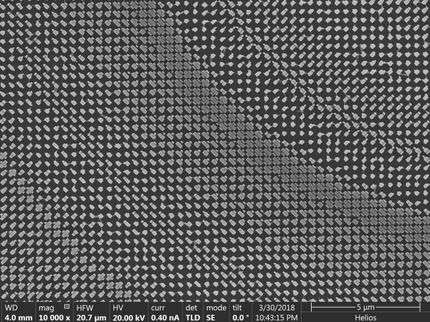
These researchers are working on tiny detectors that could record many characteristics of light, including color, polarity and, now, angle of light. As far as they know, the system they've described in this paper is the first to demonstrate that it's possible to determine angle of light with a setup this small.
"The typical way to determine the direction of light is by using a lens. But those are big and there's no comparable mechanisms when you shrink a device so it's smaller than most bacteria," said Shanhui Fan, professor of electrical engineering, who is a co-author on the paper.
More detailed light detection could support advances in lens-less cameras, augmented reality and robotic vision, which is important for autonomous cars.
From atoms to geckos
If a sound isn't coming from directly over the top of the gecko, one eardrum essentially steals some of the sound wave energy that would otherwise tunnel through to the other. This inference helps the gecko - and about 15,000 other animal species with a similar tunnel - understand where a sound is coming from.
The researchers mimic this structure in their photodetector by having two silicon nanowires - each about 100 nanometers in diameter or about 1/1000th as wide as a hair - lined up next to each other, like the gecko's eardrums. They are positioned so closely that, when a light wave comes in at an angle, the wire closest to the light source interferes with the waves hitting its neighbor, basically casting a shadow. The first wire to detect the light would then send the strongest current. By comparing the current in both wires, the researchers can map the angle of incoming light waves.
Geckos weren't the inspiration for the initial construction of this system. Soongyu Yi, a graduate student in electrical and computer engineering at the University of Wisconsin-Madison who is lead author of the paper, came upon the likeness between their design and geckos' ears after the work had already begun. They were all surprised by the deep level of similarity. As it turns out, the same math that explains both the gecko ears and this photodetector describes an interference phenomenon between closely arranged atoms as well.
"On the theory side, it's actually very interesting to see many of the basic interference concepts that go all the way to quantum mechanics show up in a device that can be practically used," said Fan.
A long-term commitment
This project began when one of the paper's co-authors, Zongfu Yu, was a student in the Fan lab and took the initiative to combine his work there with research by Brongersma and his lab. They made progress but had to put the work on hold while Yu applied for faculty positions and, subsequently, established his lab at the University of Wisconsin-Madison, where he is now an assistant professor of electrical and computer engineering and in whose lab Soongyu Yi works.
Many years later, and after publishing the current proof-of-concept, the researchers said they look forward to building on their results. Next steps include deciding what else they might want to measure from light and putting several nanowires side-by-side to see if they can build an entire imaging system that records all the details they're interested in at once.
"We've worked on this for a long time - Zongfu has had a whole life story between the start and end of this project! It shows that we haven't compromised on quality," Brongersma said. "And it's fun to think that we might be here for another 20 years figuring out all the potential of this system."
Original publication

Other news from the department science