New method for exhaustively isolating olfactory receptors responding to specific odorants
A research group led by Osaka University and Panasonic Corporation developed a method for making a prompt, exhaustive isolation of olfactory receptors (ORs) responding to the odorant of interest. This achievement will enable quick and easy exhaustive analysis of ORs responding to specific odorants, which previously required a great deal of time and effort. These results may be applied to biosensors capable of highly detecting only desired odorants.
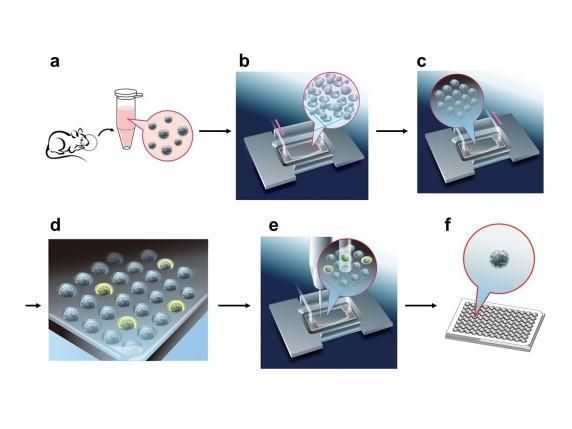
Mouse olfactory epithelium-derived cells were labeled with Fluo4-AM (a), and applied to a 10-μm microchamber array chip equipped with a flow chamber, followed by brief centrifugation (b). Floating and untrapped cells were removed by circulating Ringer solution and stimulated with an odorant (c). OSNs expressing odorant-specific ORs showed transient fluorescence from the increase of intracellular Ca2+ concentration (d). Each activated cell was retrieved (e), transferred to the 96-well PCR plate (f), and subjected to single-cell RT-PCR.
Osaka University
Paying attention to the fact that each olfactory sensory neuron (OSN) expresses an OR, Shun'ichi Kuroda, Professor and Nobuo Yoshimoto, Specially Appointed Associate Professor at the Department of Biomolecular Science and Reaction, The Institute of Scientific and Industrial Research, Osaka University in cooperation with Masato Suzuki, Chief Researcher, Advanced Research Division, Panasonic Corporation made a system in which OSNs from mice were applied to a microchamber array on a microscope slide and fluorescence was yielded when ORs responded to odorants. Using the Single-Cell Automatic Analysis and Isolation System developed in 2013, this group isolated single OSNs responding to specific odorants in a time-lapse single-cell-array cytometric manner and identified the OR gene through single cell polymerase chain reaction (PCR).
As a result, this group succeeded in isolating ORs which respond to three types of volatile organic compounds (2-pentanone, pyridine, 2-butanone) respectively in urine samples from lung cancer patients. Like OSNs, animal cells expressing ORs responded to the odorant of interest, emitting fluorescence.
Original publication
Other news from the department science
















These products might interest you