ORNL scientists help explain graphene mystery
Nanoscale simulations and theoretical research performed at the Department of Energy's Oak Ridge National Laboratory are bringing scientists closer to realizing graphene's potential in electronic applications.
A research team led by ORNL's Bobby Sumpter, Vincent Meunier and Eduardo Cruz-Silva has discovered how loops develop in graphene, an electrically conductive high-strength low-weight material that resembles an atomic-scale honeycomb.
Structural loops that sometimes form during a graphene cleaning process can render the material unsuitable for electronic applications. Overcoming these types of problems is of great interest to the electronics industry.
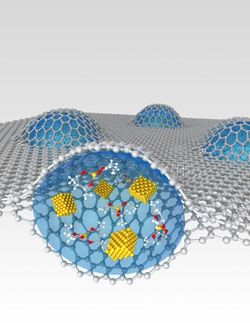
"Graphene is a rising star in the materials world, given its potential for use in precise electronic components like transistors or other semiconductors," said Bobby Sumpter, a staff scientist at ORNL.
The team used quantum molecular dynamics to simulate an experimental graphene cleaning process, as discussed in a paper published in Physical Review Letters. Calculations performed on ORNL supercomputers pointed the researchers to an overlooked intermediate step during processing.
Imaging with a transmission electron microscope, or TEM, subjected the graphene to electron irradiation, which ultimately prevented loop formation. The ORNL simulations showed that by injecting electrons to collect an image, the electrons were simultaneously changing the material's structure.
"Taking a picture with a TEM is not merely taking a picture," Sumpter said. "You might modify the picture at the same time that you're looking at it."
The research builds on findings discussed in a 2009 Science paper (Jia et al.), where Meunier and Sumpter helped demonstrate a process that cleans graphene edges by running a current through the material in a process known as Joule heating. Graphene is only as good as the uniformity or cleanliness of its edges, which determine how effectively the material can transmit electrons. Meunier said the ability to efficiently clean graphene edges is crucial to using the material in electronics.
"Imagine you have a fancy sports car, but then you realize it has square wheels. What good is it? That's like having jagged edges on graphene," Meunier said.
Recent experimental studies have shown that the Joule heating process can lead to undesirable loops that connect different graphene layers. The PRL paper provides an atomistic understanding of how electron irradiation from a transmission electron microscope affects the graphene cleaning process by preventing loop formation.
"We can clean the edges, and not only that, we're able to understand why we can clean them," Meunier said.
Other news from the department science








Most read news




More news from our other portals

















Last viewed contents
Altmann Analytik acquires lab supplier Dinkelberg analytics

New organ-on-chip pilot seeks to reduce animal testing in consumer health industry - Cooperation between Bayer, the start-ups esqLABS and Dynamic42, and Placenta Lab of Jena University Hospital
New method provides more precise information on types of leukaemia - Optical genome mapping could become a component of routine diagnostics
Oxford Nanopore Announces Licence Agreement with Harvard University for Graphene DNA sequencing

Waters and BD's Biosciences & Diagnostic Solutions Business to Combine - Creating a Life Science and Diagnostics Leader Focused on Regulated, High-Volume Testing

World's first toxicology testing strategy without animal testing adopted by OECD - Success for long-standing collaboration between BASF and Givaudan to develop and validate alternative methods
Three Eyes See More than Two - monitoring a catalytic reaction with three different microscopies under exactly the same conditions in real time - Information is obtained that none of the methods alone could reveal

(How) Cells Talk to Each Other - ISTA Scientists Successfully Model Cell Dynamics
NIST sensor improvement brings analysis method into mainstream
Tracking of individual catalyst nanoparticles during heating