High-precision frequency measurement
Many scientific experiments require highly precise time measurements with the help of a clearly defined frequency. Now, a new approach allows the direct comparison of frequency measurements in the lab with the atomic clock in Bern, Switzerland.
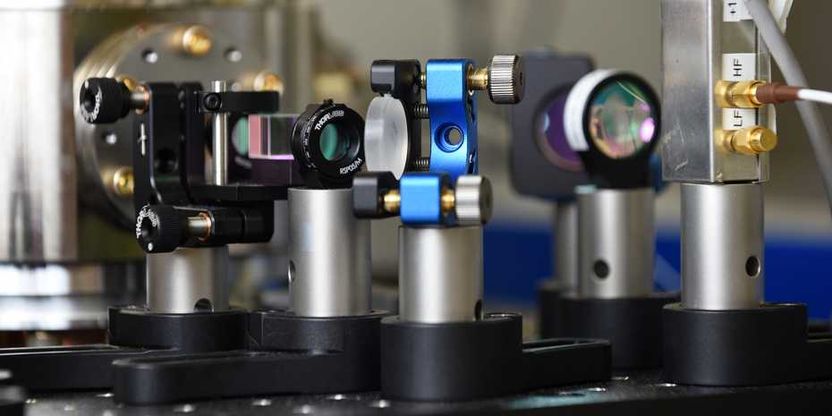
Close-up of the optical components used to stabilise the light of the infrared laser for the precise reference frequency.
Metas
For many scientific experiments, today’s researchers require a precise reference frequency that allows them to calibrate the time measurements made by their equipment. Such experiments include spectroscopy investigations – in which chemical reactions between molecules are examined in real time – and physical studies on natural constants.
Access to exactly this kind of highly precise reference frequency could soon become standard for Swiss research institutions. In a joint project funded as part of the Swiss National Science Foundation’s Sinergia programme, researchers at ETH Zurich, the University of Basel, the Swiss Federal Institute of Metrology (METAS) – Switzerland’s “guardian of measurement units” – and the SWITCH Foundation, which operates Switzerland's academic data network, have demonstrated that such a precision reference signal can be sent via conventional telecommunications infrastructure.

"Initial results show that this permits chemical spectroscopy analyses that are 100 times more accurate than before", reports Stefan Willitsch, Professor of Physical Chemistry at the University of Basel and coordinator of the project. "With this precision, the laws of nature are verified by spectroscopic measurements on molecules with unprecedented accuracy," adds Frédéric Merkt, Professor of Physical Chemistry at ETH Zurich.
Continuous correction
Specifically, the project established a trial network that connects the METAS site in Wabern near Bern with the University of Basel and ETH Zurich. A clever process synchronises the output signal with the METAS atomic clock. This signal is transmitted via the fibre-optic network operated by SWITCH – which manages IT network infrastructures for Swiss universities – to Basel and Zurich, where researchers can use it to calibrate their measuring devices.
"To ensure that the signal reaches the researchers with the desired level of precision, transmission must be continuously adjusted. Even the slightest variation in the length of the fibre-optic cable – caused by vibrations or temperature changes – affect the frequency", explains Jacques Morel, Head of the Photonics, Time and Frequency Laboratory at METAS. Therefore the signal is bounced back from Basel and Zurich to Bern, where the output signal is corrected as required.
High quality, lower costs
“In Switzerland, we’re only now beginning to establish this kind of network,” says Jérôme Faist, Professor at the Institute for Quantum Electronics at ETH Zurich, who contributed his expertise in laser technology to the project. “Other countries like Italy, Germany and France are already a step ahead in this area.”
In these countries, the reference frequencies have, up to now, been transmitted in one of two ways – each with its own specific drawbacks. Either the signal is sent via a dedicated cable, which produces an optimum physical result but is expensive, or the signal is transmitted via the telecommunications provider’s existing infrastructure. While this is much cheaper, it is technically inferior because the reference signal for measuring time is transmitted within the C band, in other words at a similar base frequency to data traffic. Not only does this leave the reference signal open to potential disruption by the rest of the data traffic, it blocks a channel that would normally be used for data transmission, which in turn complicates operation.
“We’ve now developed a third option,” explains Fabian Mauchle, project manager at Switch: “For reasons of cost, we use the existing SWITCH network. But instead of transmitting the reference signal within the physically optimum C band – which is largely taken up by data traffic – we use the L band, which is still mostly uncongested and has a different base frequency.” The results now show that the L band is also a viable option for transmitting reference signals at excellent quality without encountering disruption from data traffic. This did, however, require SWITCH to make certain modifications to its network infrastructure.
Original publication

Other news from the department science









Most read news




More news from our other portals
















See the theme worlds for related content
Topic World Spectroscopy
Investigation with spectroscopy gives us unique insights into the composition and structure of materials. From UV-Vis spectroscopy to infrared and Raman spectroscopy to fluorescence and atomic absorption spectroscopy, spectroscopy offers us a wide range of analytical techniques to precisely characterize substances. Immerse yourself in the fascinating world of spectroscopy!

Topic World Spectroscopy
Investigation with spectroscopy gives us unique insights into the composition and structure of materials. From UV-Vis spectroscopy to infrared and Raman spectroscopy to fluorescence and atomic absorption spectroscopy, spectroscopy offers us a wide range of analytical techniques to precisely characterize substances. Immerse yourself in the fascinating world of spectroscopy!
Last viewed contents

Plants transformed into detectors of dangerous chemicals - Scientists engineer plants to speak in color
New NMR method enables monitoring of chemical reactions in metal containers - Analysis of heterogeneous samples in metal containers using zero- to ultralow-field NMR spectroscopy
BioFluidix wins STEP award
Watching complex molecules at work
GE Healthcare and BAC start collaboration in biopharmaceutical purification
Oxford Medical Diagnostics and Michell Instruments launch gas analysis partnership - Oxford Medical Diagnostics and Michell Instruments will jointly develop new industrial gas detection and measurement devices for a number of industrial applications
Wiley InterScience Launches the Analytical Sciences Backfile Collection
Eurofins expands food and feed testing business in the US
QIAGEN launches coronavirus test kit in Germany following derogation by BfArM
Unexpected flexibility found in odorant molecules - High resolution rotational spectroscopy reveals an unprecedented number of conformations of an odorant molecule – a new world record!