Analysing molecular structures in more detail
New NMR methods for investigating paramagnetic complexes and supramolecular cages developed
Chemistry and structural biology use the standard methods of NMR spectroscopy (NMR = nuclear magnetic resonance) to examine the structure of molecules including large molecules like proteins in solution. The NMR active nuclei, such as hydrogen atoms, are excited using radiofrequency pulses in spectrometers with strong magnetic fields. The different environments of the nuclei can be detected and conclusions about the molecular structure can be drawn from analysis of the generated spectra.
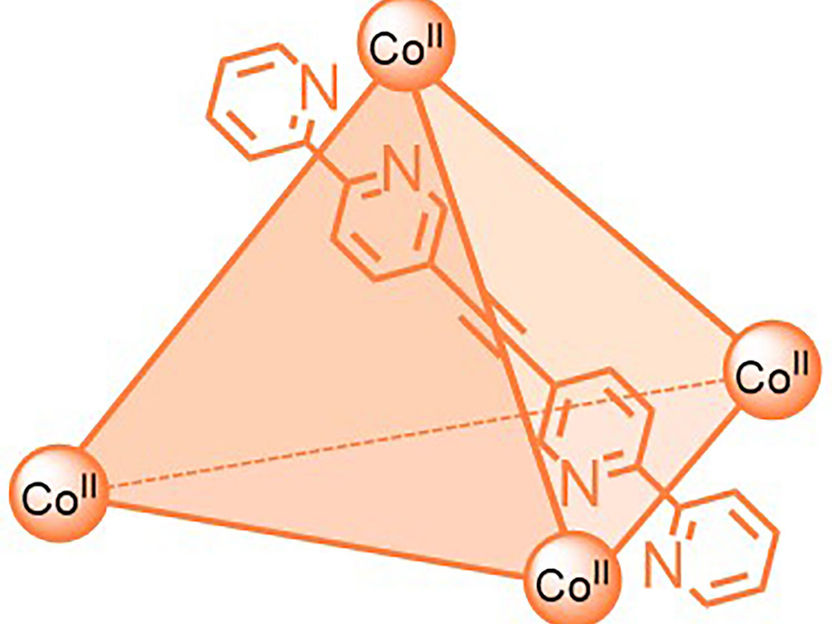
“Molecular cages" are nano-sized structures that can bind and transport other molecules like medicinal compounds. In order to release them again in a targeted manner, information about their structure and properties is needed, but these paramagnetic compounds are difficult to analyse.
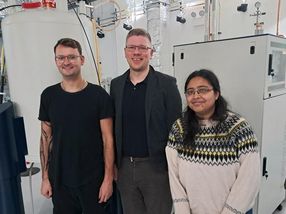
© Anna McConnell
With such NMR methods the structure of diamagnetic molecules can already be studied very well. In these molecules the electrons are paired together and their NMR spectra are straightforward to analyse since the signals are usually sharp and in distinctive regions according to the structure of the molecule. However, with NMR methods it is difficult to investigate the structure of paramagnetic compounds, which have unpaired electrons. These include, for example, some medical contrast agents. They are attracted to external magnetic fields and interfere with the measurements. Chemists at Kiel University (CAU) have now succeeded in developing a toolbox of NMR methods which, for the first time, enable detailed structural analysis of paramagnetic complexes in solution. They recently demonstrated the extensive application possibilities of their toolbox in various fields of chemistry and beyond in the journal Angewandte Chemie.
Even complex "molecular cages" can be analysed in more detail than ever before
"The number of suitable NMR methods for paramagnetic complexes has been limited so far. Structural information is typically lost since the signals are broad and in less predictable regions," explains Anna McConnell, Junior Professor in the Otto Diels Institute of Organic Chemistry at CAU. She is investigating paramagnetic "molecular cages", where several molecules self-assemble into more complex structures with a cavity that can bind other molecules. As a long-term goal, these molecules could be, for example, medicinal substances that are transported and released at particular parts of the body. "But for this we first need more information about the structures of these paramagnetic complexes," McConnell continues.
Together with a research team from the Institutes of Organic and Inorganic Chemistry, McConnell has developed various NMR methods to reliably obtain and interpret NMR data on paramagnetic compounds. Used in combination, the methods of their toolbox provide a comprehensive picture of such molecular structures. In some cases, the results are even better than those with comparable standard methods for conventional diamagnetic compounds, the team found. "Data acquisition for the paramagnetic compounds was much faster and, in some cases, we obtained the structural information in one paramagnetic experiment instead of several experiments for a diamagnetic compound," said McConnell.
The instruction manual allows easy adaptation to any spectrometer
The research team carried out detailed investigations on the 500 and 600 MHz spectrometers in the spectroscopy department of the Otto Diels Institute of Organic Chemistry to determine how to adapt the standard experiments for analysis of the paramagnetic complexes. With this, they produced an instruction manual on how to apply the toolbox to other paramagnetic complexes and spectrometers. "The development of these paramagnetic NMR methods is a big breakthrough for our day-to-day research and we are hopeful that they will help other researchers as much as us," said Marc Lehr, PhD student in McConnell’s group and first author of the paper. The research team hopes that this will contribute to the application of these methods in different areas of chemistry and beyond. In their study they demonstrated the toolbox’s broad versatility for at least fields from coordination chemistry and spin-crossover complexes to supramolecular chemistry.
As the next step, the research team plans to apply these methods to the analysis of larger and even more complex paramagnetic cages. "Molecular cages whose structures can be changed by irradiation with light are one example of a more complex cage. Using light-responsive cages we might be able to release the guest molecules in a truly targeted manner in the future," McConnell hopes.
Original publication
Other news from the department science








Most read news




More news from our other portals

















Last viewed contents
Domainex Ltd wins biotechnology innovation award
Sequenom Announces European Licensing Agreement With LifeCodexx
Waters to Acquire Andrew Alliance
Gold shines through properties of nano biosensors - Fluorescence in ligand-protected gold nanoclusters is an intrinsic property of the gold particles themselves
Out of REACH - New legislation threatens medicines
Neutrons for the quantum technologies of the future: breakthrough results on layered perovskites
200-year long dispute resolved: First direct evidence that elemental fluorine occurs in nature
Dow acquires Rohm and Haas, creating world's leading specialty chemicals and advanced materials company - $18.8 billion transaction marks pivotal point in Dow's transformation
Seeing a diagnosis: How an eye test could aid Alzheimer's detection